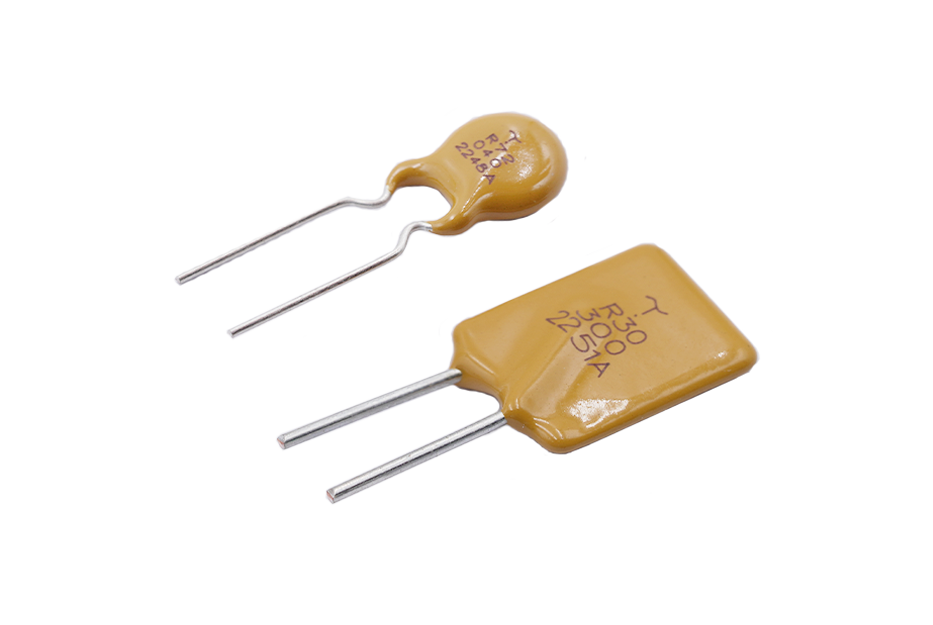
Restoration frequency limit and lifespan management of self recovering fuses (PPTC)
1、 Core limiting factors of cycle life
Mechanism of Material Structure Degradation
The migration rate of carbon black conductive particles increases by 0.30.8% per action cycle
Polymer matrix thermal fatigue crack propagation rate: reaches critical value after more than 100 cycles
The thickness of the oxide layer at the electrode interface increases exponentially with the number of cycles
2、 Standard life classification data
Industrial grade product specifications
Full parameter recovery times: 50 times (maintaining initial characteristics ± 20%)
Basic function recovery times: 200 times (impedance change ≤ 50%)
Maximum failure times: 300500 times (presenting a permanent high resistance state)
Automotive grade reinforced standard (AECQ200)
Maintain 100 cycles of complete recovery after temperature shock
Ensure 80 effective actions under vibration conditions
Maintain 50 reliable resets in salt spray environment
3、 Factors affecting lifespan decay
Overload condition parameters
3 times rated current trigger: reduce lifespan by 0.5% each time
More than 5 times the current surge: a single loss is equivalent to 10 conventional losses
Continuous triggering with incomplete cooling: equivalent consumption of 3 times the number of times
Environmental stress effects
Accelerated aging in high temperature (>85 ℃) environment: Life reduction factor 1.53 times
Electrode corrosion when humidity exceeds 80% RH: lifespan reduced by 4060%
Mechanical vibration (>10Grms) causes structural fatigue: life loss rate of 30%
4、 Life extension control strategy
Circuit design optimization
Set a minimum cooling interval of 60 seconds (increase lifespan by 20%)
Parallel MOV absorbs surge energy (reduces ineffective triggering by 30%)
Using a constant current source for power supply (reducing current fluctuation impact)
Use environmental management
Maintain a working temperature range of 4060 ℃ (optimal lifespan temperature)
Install shock absorber bracket (reduce mechanical wear by 50%)
Regularly clean the contact surface (reduce contact resistance degradation)
5、 Criteria for End of Life Determination
Electrical performance failure threshold
Cold impedance>200% of initial value
Action time delay>300% of nominal value
Restore impedance>150% of rated value for 5 minutes
Physical state determination
Visual deformation (bulge>0.2mm or crack length>1mm)
Electrode detachment area>30%
Carbonization depth of packaging material>50%
Conclusion: Standard self recovery fuses can ensure complete recovery 50100 times under rated conditions, and automotive grade products can achieve more than 200 times. Suggestions for key systems include: ① Action count device (early warning); ② Dual redundant waste heat backup design (extending system lifespan); ③ Perform impedance spectrum analysis every 24 months to predict remaining lifespan. When the cumulative triggering frequency exceeds 50% of the nominal value, a preventive maintenance cycle should be entered to ensure that the system reliability is maintained at 99% or above.