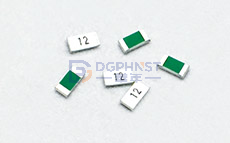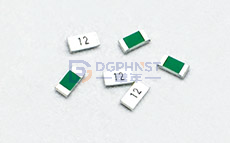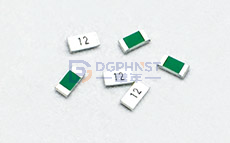
In the development and mass production of automotive electronics, many projects fail during debugging or face challenges in whole-vehicle certification. The root cause is not an error in the circuit design but rather the use of low-standard passive components — replacing automotive-grade materials with industrial or consumer-grade resistors. This is especially risky for alloy resistors in BMS current sampling circuits.
Automotive operating conditions are complex and harsh: Equipment must withstand wide-temperature cycles from -55℃ to +155℃, continuous vibration, and large current surges. Ordinary alloy resistors are prone to resistance drift and solder joint cracks, leading to safety issues such as battery protection malfunctions and drive failures. Automotive-grade alloy resistors that meet the AEC-Q200 standard are the preferred choice for vehicle sampling, current limiting, and protection circuits. Huade Electronics' automotive-grade resistors are specifically developed for vehicle applications and are metal foil current sensing resistors, available in multiple package sizes including 1206/3921/0508/0612/1225/2512, meeting the adaptation needs of different vehicle circuits.
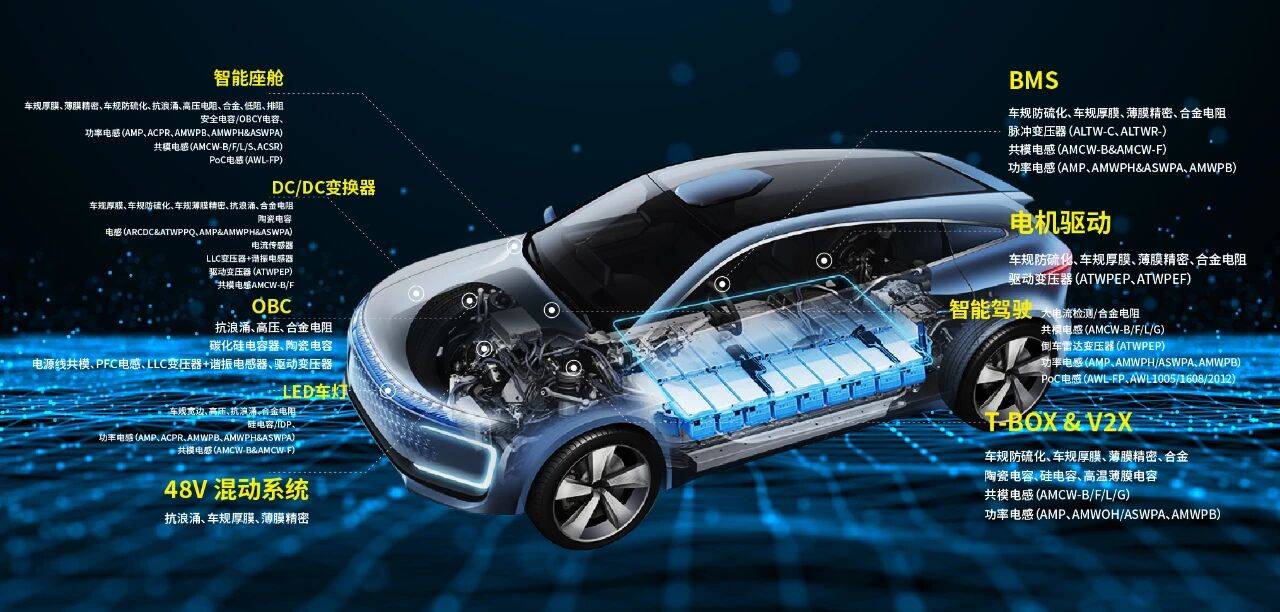
1. Automotive Grade vs. Ordinary Alloy Resistors: The Difference Goes Beyond Certification
The difference between automotive-grade and ordinary alloy resistors goes beyond industry certification; it focuses on reliability redundancy, environmental adaptability, certification systems, and batch consistency.
1. Differences in Certification Standards
Automotive-grade alloy resistors must pass the comprehensive AEC-Q200 automotive-grade certification for passive components, covering dozens of rigorous tests such as temperature cycling, humidity aging, mechanical vibration, pulse impact, load life, and soldering reliability. This is a hard requirement for automotive electronics. Ordinary alloy resistors only meet industrial general standards and cannot adapt to the strict testing requirements of automotive environments.
2. Differences in Temperature Range Adaptability
The working temperature range of automotive-grade standards covers the full temperature range of -55℃ to +155℃, with controlled resistance drift and power attenuation within this range. Ordinary alloy resistors typically operate within a conventional temperature range of 0℃ to 85℃, and their parameters significantly deviate under extreme temperatures, making them unable to meet automotive requirements.
3. Differences in Structure and Process
Automotive-grade alloy resistors use high-purity heat-resistant alloy materials with a reinforced three-layer electrode structure, offering stronger anti-vibration and thermal expansion/shrinkage resistance. This prevents virtual welding, delamination, and resistance drift caused by long-term vibration and thermal cycling in vehicles. Ordinary alloy resistors have simplified processes and insufficient stability under harsh conditions.
4. Differences in Batch Consistency
Automotive-grade materials are fully controlled throughout the production process, ensuring minimal batch parameter deviation and meeting the zero-defect mass production requirements of automobiles. Ordinary materials have large batch tolerance fluctuations and cannot pass automotive reliability spot checks.
2. Core Parameters of Automotive-Grade Alloy Resistors
There is no room for error in vehicle safety circuits. When selecting components, it's not enough to look at resistance value and power alone; you must align with the AEC-Q200 standard and lock in five core parameters. Only when all meet the criteria can they be included in the BOM.
1. Temperature Coefficient (TCR): Core Assurance for Vehicle Accuracy
Temperature drift is the primary cause of sampling failure in full-temperature-range vehicle conditions. Automotive-grade alloy resistors strictly control TCR within ±25~±50ppm/℃, ensuring strong resistance stability across the entire temperature range and guaranteeing accurate BMS power sampling, current monitoring, and overcurrent protection thresholds.
Selection guidelines: For vehicle safety circuits and precision sampling circuits, prioritize specifications with ≤25ppm/℃ ultra-low temperature drift. For general vehicle power circuits, 50ppm/℃ specifications are acceptable. For example, Huade's STE1206M1W0R010F-Auto and STE1206C1W0R200FA series of 1W automotive-grade resistors in 1206 packaging feature ±50ppm temperature drift and are suitable for most vehicle power sampling circuits.
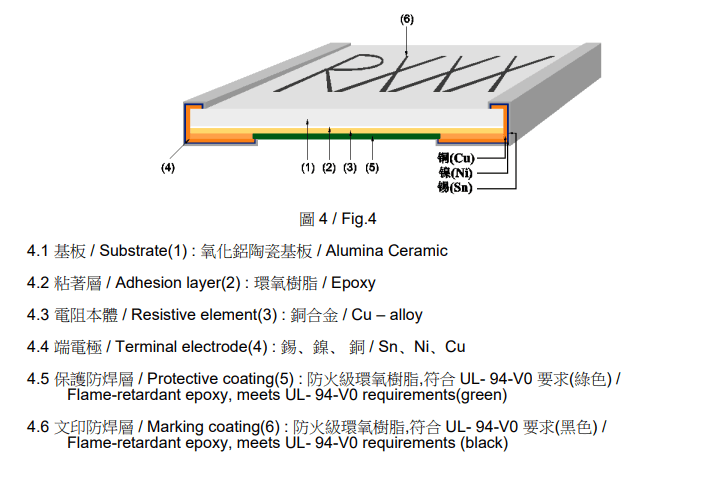
Huade Electronics — Product Structure and Material Usage
2. Precision Level: Ensuring Consistency in Mass Vehicle Devices
Automotive electronics require extremely high batch consistency. Parameter deviations can lead to differentiated faults in the entire vehicle function.
• BMS, battery sampling, and ADAS auxiliary circuits: Must use ±0.5% high-precision
• Vehicle power limit and general driver circuits: Can use ±1% precision
• Vehicle safety-related circuits: Prohibit using ±2% low-precision materials
3. Power Derating: High Redundancy Required for Vehicle Conditions
Vehicle equipment operates under long-term high temperature, full load, and vibration, presenting much higher risk of power attenuation than ordinary devices. Derating standards are much stricter than those in industrial scenarios.
• Regular vehicle ventilation scenarios: Actual power consumption ≤ 50% of rated power
• Enclosed high-temperature cabin and engine area scenarios: Actual power consumption ≤ 30%~40% of rated power
All automotive-grade resistor selections must strictly avoid full-power usage. Sufficient power redundancy is key to preventing long-term aging failures. The Huade STE1206 series has a rated power of 1W, making it ideal for designing high-power vehicle circuits with ample derating space.
4. Pulse and Vibration Resistance
High-frequency pulses and large currents occur during car start-up, load switching, and motor startup, along with continuous driving vibrations. Automotive-grade alloy resistors, due to their integrated structure, offer excellent surge and mechanical shock resistance, enabling long-term endurance of dynamic loads and vibration conditions, preventing irreversible resistance drift.
5. Environmental Protection and Compliance Standards
Legitimate automotive-grade alloy resistors must meet RoHS halogen-free, low-sulfur, and MSL1 moisture sensitivity level requirements, adapting to the strict environmental and moisture-proof demands of vehicles and avoiding oxidation failures in long-term humid and hot environments.
3. Frequent Failure Cases in Vehicles and Fundamental Solutions
Shunhai Technology compiled four frequent failure issues related to automotive-grade resistors based on its experience.
1. Sampling Drift During High and Low-Temperature Testing, Leading to Failed Whole-Vehicle Certification
Failure Cause: Using industrial-grade alloy resistors that do not meet the temperature drift requirements. At -40℃ low-temperature start-up and 125℃ high-temperature operation, resistance values significantly deviate, causing abnormal sampling data.
Solution: Replace all vehicle circuits with AEC-Q200-certified automotive-grade materials, locking in low-temperature drift parameters and completing full-temperature range testing in advance. For BMS small-resistance sampling, options like Huade STE1206M1W0R028F-Auto (28mR) and STE1206M1W0R010F-Auto (10mR) are suitable choices.
2. Long-Term Driving Vibration Causes Resistor Solder Joint Cracks and Virtual Welding
Failure Cause: Using non-automotive-grade electrode process materials, which have mismatched thermal expansion and contraction coefficients with PCBs. After long-term vibration and temperature cycling, the solder joints fatigue and crack.
Solution: Use reinforced three-layer electrode automotive-grade resistors that match the vehicle-specific solder pad design to eliminate residual stress.
3. High Temperature Full Load Operation Accelerates Resistor Aging and Power Attenuation
Failure Cause: Insufficient power derating and small package selection, leading to continuous overload operation in the enclosed high-temperature engine compartment, causing rapid aging of the component.
Solution: Upgrade to a larger power package, strictly follow the vehicle power derating standards, and reserve sufficient heat dissipation and performance redundancy.
4. Inconsistent Batch Parameters Lead to Occasional After-Sales Failures
Failure Cause: Using high-fake materials without official automotive-grade certification, which have exaggerated parameters and poor batch stability, failing to pass vehicle reliability spot checks.
Solution: Verify AEC-Q200 certification reports and original factory specifications when purchasing and selecting BOM components to ensure compliance and traceability of materials.
In Conclusion
As a high-reliability and high-safety field, any downgrade in the selection of passive components in automotive electronics could lead to vehicle functional failures and safety hazards. Strictly following the AEC-Q200 standard and adhering to vehicle-specific selection, derating, and process specifications can help pass whole-vehicle certification and reduce mass production defect rates and after-sales risks, ensuring long-term stable use of vehicle equipment.
Have you encountered component certification failures or sampling drift problems in high and low-temperature testing in your automotive project development? Leave a comment in the discussion section to share your experiences and discuss optimized solutions for vehicle component selection!