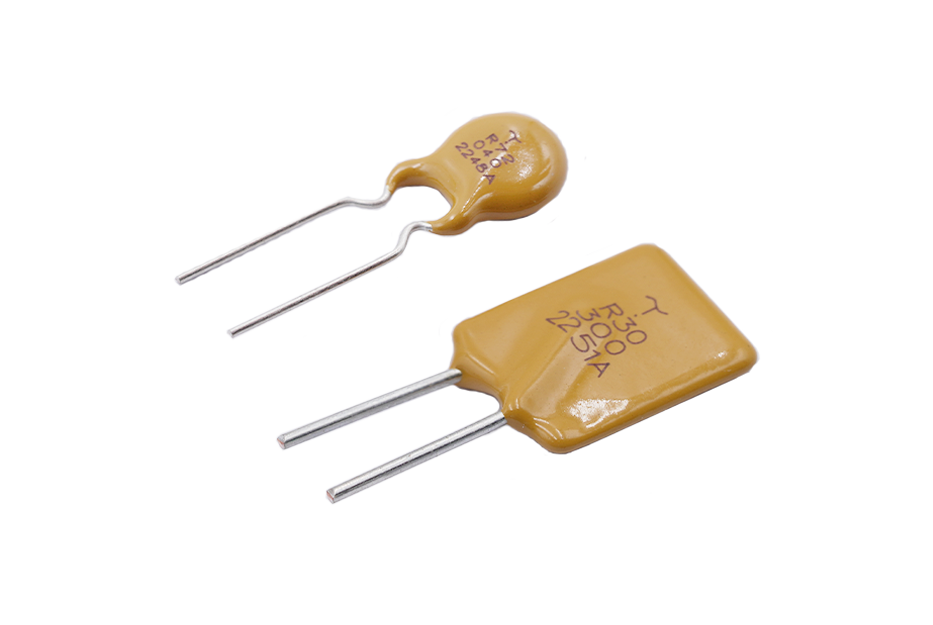
Fire Risk Analysis of Self Recovering Fuses (PPTC) in High Temperature Environments
1、 Material properties and thermal stability
Temperature resistance limit of polymer matrix
Conventional PPTC material thermal deformation temperature range: 120, 150 ℃ (UL certified model)
Critical decomposition temperature threshold: ≥ 200 ℃ (there is a difference of ± 20 ℃ among different formulations)
The dispersion of carbon black filler directly affects the thermal conductivity efficiency
Flame retardant performance indicators
Products that meet UL94 V0 standards can withstand 750 ℃ hot wire testing
The oxygen index of the shell material should be greater than 28% (to prevent continuous combustion)
Adding aluminum hydroxide flame retardant can enhance flame resistance
2、 Failure mode under high temperature conditions
Risk conditions for thermal runaway
Environmental temperature>85 ℃ and continuous overload current>3 times rated value
Multiple reset cycles (>100 times) lead to lattice structure degradation
Electrode interface delamination caused by thermal stress accumulation
Potential fire triggers
Electrode material oxidation leads to abnormal increase in contact resistance (Δ R>50%)
Cracking of packaging causes discharge arcing phenomenon
Secondary ignition caused by thermal radiation from adjacent components
3、 Design Specification for Safety Protection
Temperature compensation mechanism
Composite structure design with built-in NTC thermistor
Copper alloy electrode with temperature coefficient matching
Ladder type melting point protective layer (three-level response at 130/160/200 ℃)
Optimization of installation environment
Under forced air cooling conditions, a 15% increase in power density is allowed
The thermal resistance of the thermal conductive silicone gasket should be less than 1.5 ℃· cm ²/W
Reserve 2 times the regular safety distance in high-temperature areas
4、 Application Control Strategy
Temperature related derating curve
For every 1 ℃ increase above 40 ℃, the rated current decreases by 0.8% while maintaining the current
It is prohibited to exceed 75% of the nominal voltage in an environment of 70 ℃
Extreme temperature conditions require parallel TVS diodes for voltage clamping
Failure warning system
Integrated thermocouple for real-time monitoring of body temperature
Alarm triggered when impedance change rate exceeds 5%/min
Establish a thermal cycle counting life model
5、 Industry testing and verification standards
Hot abuse testing project
150 ℃ oven aging for 1000 hours for structural integrity testing
10 cold and hot shocks (40 ℃) ↔ 125 ℃) cyclic test
Surface infrared thermal imaging analysis under overload condition (hotspot < 180 ℃)
Fault safety verification
Apply twice the maximum voltage to verify that no open flame is generated
Conduct ultimate short-circuit test in a sealed container
Carbonization depth measurement (allowable value<30% section)
Conclusion: Self recovery fuses that meet industrial standards have no risk of fire when used within the rated temperature range, but exceeding the material's tolerance limit or being in a critical state for a long time may cause thermal failure. It is recommended to choose enhanced products (such as automotive grade AECQ200 certified models) for high-temperature applications, and to cooperate with temperature monitoring and heat dissipation design to reduce the probability of fire to<0.1ppm.