I. Starting with an Electronic Control Unit (ECU) Board
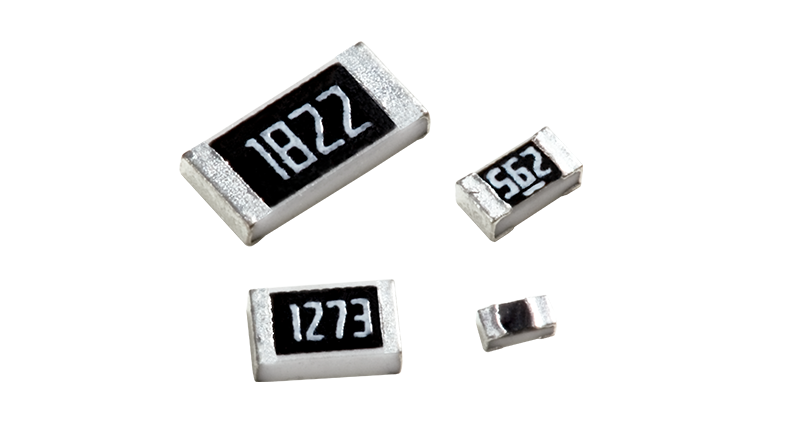
Take apart an on-board charger (OBC) or motor controller in a new energy vehicle. Among the dense array of passive components, chip resistors are often the most easily overlooked. Yet these tiny, unassuming components determine whether the entire PCB can operate stably for 15 years under harsh conditions: high temperatures up to 125°C in the engine compartment, winter lows of -40°C, continuous vibration, humid heat and salt spray.
Ordinary consumer-grade resistors perform well in laboratory tests but tend to fail once installed in vehicles for road tests: resistance drift, termination cracking, open circuits caused by sulfuration corrosion… Though the failure rate may seem low, the cost can escalate to astronomical figures in the event of full-vehicle recalls. This explains why “automotive-grade” status has evolved from a bonus feature into a mandatory requirement in recent years.
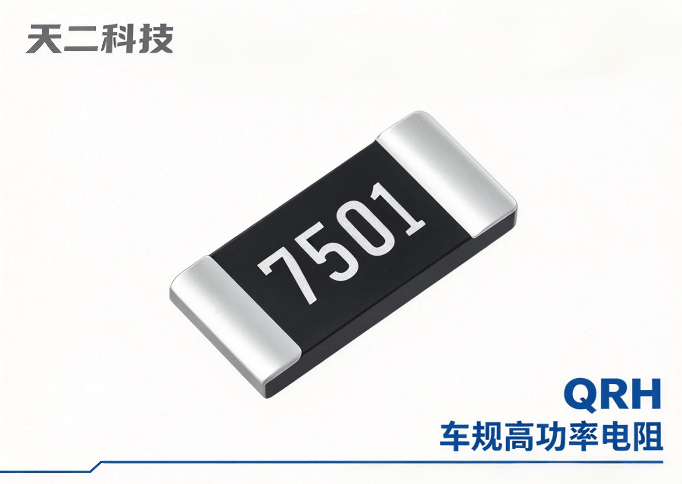
Within EVER OHMS’ product portfolio, the QRH automotive-grade high-power thick film resistor is engineered to meet these demands. QR denotes automotive grade, while H stands for High Power. It combines automotive reliability with high power density, serving as a critical component in power and drive circuits.
II. Automotive-Grade: More Than Just a Label
Many misunderstand AEC-Q200, viewing it merely as a certificate. In fact, it is a complete set of destructive test standards: temperature cycling, high-temperature high-humidity bias, high-temperature exposure, solder heat resistance, mechanical vibration and shock, terminal strength, load life, and more. Each test simulates extreme operating conditions that vehicles may encounter over a service life of more than a decade.
More importantly, genuine front-end vehicle projects also require compliance with quality management systems. Manufacturing sites must hold IATF 16949 automotive quality certification, materials must support full-lot traceability across the supply chain, and products need to satisfy RoHS/REACH and halogen-free environmental requirements. Missing any single requirement will result in failure to pass material reviews by OEMs or Tier 1 suppliers.
EVER OHMS’ automotive product lines are fully built in accordance with these standards. From material selection and process control to testing and validation, the entire workflow aligns with automotive specifications. The QRH high-power series inherits this systematic capability; its automotive qualification is not achieved by simply affixing a label.
III. What Makes Automotive-Grade High-Power Resistors Different?
Even among thick film resistors, the gap between automotive high-power variants and ordinary models can only be appreciated by examining design and manufacturing processes.
1. High power capability within compact packages
Automotive electronic control systems are trending toward miniaturization and high power density, where PCB real estate is precious. By optimizing resistor layer design and thermal dissipation paths on ceramic substrates, the QRH series delivers higher rated power in the same footprint. Common ratings cover 1 W to 2 W, with the 2512 package capable of 2 W.
Previously, designs required two resistors in parallel or even through-hole resistors. Now a single chip resistor suffices. This saves PCB space, reduces solder joints, lowers BOM complexity and improves automated production efficiency.
2. Stable resistance across full temperature range
Automotive environments feature extreme temperature swings ranging from sub-zero to over 100°C. Conventional resistors exhibit large temperature drift, leading to noticeable resistance shifts between summer and winter, which impairs voltage division, signal sampling and current limiting. The QRH series operates from -55°C to +155°C, with typical TCR controlled within ±100 ppm/℃ ~ ±200 ppm/℃. Low temperature drift ensures controllable resistance variation across the full temperature spectrum, preventing circuit parameters from fluctuating with seasons and operating conditions — the foundation for long-term stability.
3. Pulse withstand capability and corrosion resistance
Two hidden hazards exist in automotive environments: pulse currents generated during startup/shutdown and switching events, plus sulfide gas corrosion of end terminals.
Adopting thick film technology with a glass passivation layer and nickel barrier tin termination structure, QRH delivers outstanding pulse withstand and anti-sulfuration performance. Its multi-layer protective structure maintains stable resistance even under 85°C / 85% RH humid heat conditions.
IV. Typical Applications
| Application Scenario | Typical Functions |
|---|---|
| On-Board Charger (OBC) / DC-DC | Bleeder resistor, snubber absorption, startup current limiting, voltage division |
| BMS Battery Management System | Balancing circuits, auxiliary high-voltage sampling, discharge branches |
| Motor Drive / EPS | Auxiliary current sampling, absorption and current limiting |
| LED Headlight / Taillight Drivers | Constant-current detection, current sharing and protection |
| Body Control, Domain Controllers, Infotainment | Power input current limiting, pull-up / pull-down, filter matching |
| Industrial Inverters, Servos, Energy Storage PCS | Also applicable; automotive-grade components downward compatible for high-reliability industrial scenarios |
Note: High-precision primary sampling circuits (such as BMS high-voltage sampling) are better suited for thin-film or alloy precision components. QRH thick film resistors are positioned for high-reliability, high-power current paths and power handling. Clear functional allocation maximizes performance of each device type.
V. Power Resistor Application: Six Design Rules for Long-Term Hardware Reliability
- Implement power derating Rated power is generally specified at a substrate temperature of 70°C. For high-temperature cabin environments, components must be operated per derating curves. A derating margin above 50% is generally recommended to avoid resistance shift caused by continuous full-load operation.
- Calculate peak pulse energy For absorption or current-limiting applications, steady-state power alone is insufficient. Verify whether pulse width and peak energy fall within datasheet limits.
- Optimize PCB thermal design Widen pads, lay copper appropriately and add thermal vias where necessary. Place resistors away from heat sources such as MOSFETs and inductors to prevent superimposed local hotspots that accelerate aging.
- Select tolerance grades rationally Choose ±1% tolerance for voltage divider and feedback networks; ±5% works for pure current limiting and bleeder circuits. Incorrect grade selection either degrades system accuracy or unnecessarily raises costs.
- Differentiate component grades; consumer-grade parts cannot replace automotive-grade devices Even with identical electrical parameters, components lacking AEC-Q200 qualification and lot traceability cannot pass front-end audits and carry uncontrolled long-term road-test risks.
- Refer to the latest manufacturer datasheet for component parameters TCR, voltage rating and power derating curves vary for the same part number across different packages and resistance ranges. Prior to mass production, obtain the latest datasheet from the original manufacturer or authorized distributor and complete board-level verification.
Closing Remarks
In automotive electronics, the most fundamental components test engineering competence. They do not draw the spotlight like chips or participate in algorithm competition. Instead, they quietly withstand high temperature, vibration and aging to keep systems running reliably for a decade.
Embedding automotive-grade reliability into a tiny high-power resistor — enabling high power in compact form, simpler designs and more confident mass production — this is the tangible value of EVER OHMS QRH automotive high-power resistors. As the industry pursues higher computing power and faster charging speeds, the robustness of these basic passive components often determines whether advanced technical targets can be fully realized.