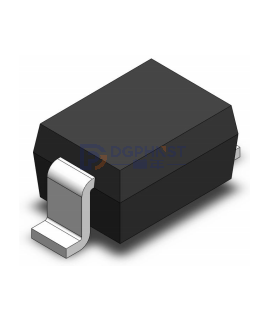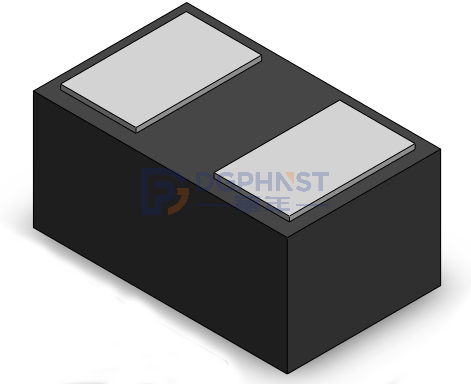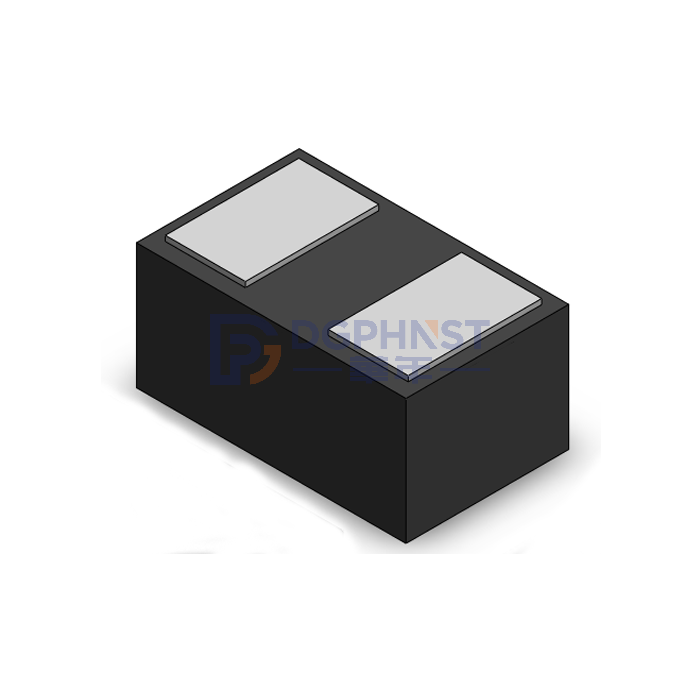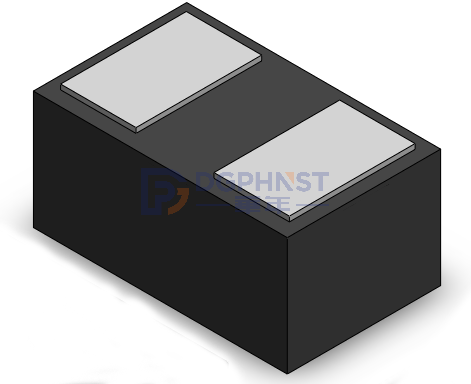
ESD (Electrostatic Discharge Protection Diode) is a semiconductor device designed specifically to prevent damage to electronic circuits caused by electrostatic discharge (ESD). Its core function is to safely discharge static energy and protect sensitive components (such as chips and sensors) from high voltage impact by quickly conducting and clamping voltage. Here are the technical details and application analysis:
1、 Core working principle
ESD threat sources
Transient high voltage pulses generated by human static electricity (up to thousands of volts), equipment friction, or environmental induction.
Typical waveform: ESD pulse defined by IEC 61000-4-2 standard (rise time<1ns, peak current>30A).
protection mechanism
Bidirectional conduction: The ESD tube is composed of two diodes connected in reverse parallel, which can simultaneously protect against positive and negative pulses.
Fast response: nanosecond level response time (usually<1ns), leading to conduction before the ESD pulse arrives.
Voltage clamp: Limit the voltage within a safe range (such as clamping the 5V system to within 12V) to avoid damage from overvoltage in the subsequent circuit.
2、 Key technical parameters
parameter
Typical values/ranges
Key selection points
Breakdown voltage (Vbr)
5V~30V (depending on the application)
Need to be slightly higher than the operating voltage of the protected circuit (such as selecting 5V Vbr for a 3.3V system)
Clamp voltage (Vc)
12V~40V (under 8/20 μ s waveform)
The lower the better, reducing the stress on the subsequent circuit
Capacitor (Cj)
0.1pF~10pF
The high-speed signal interface needs to choose a low capacitance model (such as<1pF)
Peak Pulse Power (PPP)
300W~5000W
Must meet the ESD level of the application scenario (such as contact discharge ± 8kV)
3、 Mainstream types and packaging
Unidirectional ESD tube
Structure: A single diode that only protects against unipolar pulses.
Application: Single pole protection scenarios such as power cords and battery interfaces.
Bidirectional ESD tube
Structure: Two reverse parallel diodes to protect against positive and negative pulses.
Application: Bipolar signal interfaces such as USB, HDMI, antenna, etc.
Array type ESD tube
Structure: Multi channel integrated packaging (such as 4-channel, 8-channel).
Advantages: Save PCB space and provide unified protection for multiple signals (such as the 12 contacts of USB Type-C).
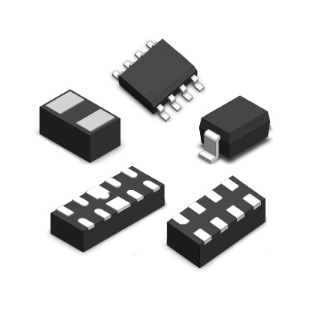
Packaging form
SOT-23: Universal packaging, suitable for single channel protection.
DFN/QFN: Ultra small package (such as 0.8mm × 0.6mm), suitable for high-density PCBs.
SOIC-8: Array packaging, suitable for multi-channel protection.
4、 Typical application scenarios
Consumer Electronics
Example: Mobile phone charging port (USB-C), headphone jack, SIM card slot.
Selection: Low capacitance (<1pF) bidirectional ESD tube, such as ON Semi ESD9L5.0ST5G.
Automotive Electronics
Example: CAN bus, car camera, entertainment system interface.
Requirement: Passed AEC-Q101 certification, high temperature resistance (-55 ℃~+150 ℃).
Industrial control
Example: RS-485 interface, PLC input/output ports.
Selection: High power ESD tube (such as 500W PPP), such as Littelfuse SP3012 series.
communication devices
Example: Fiber optic module, antenna port, Ethernet interface.
Key parameters: Low insertion loss (<0.5dB), compatible with high-speed signals (such as 10Gbps).
5、 Core steps for selection
Determine the protective voltage
Select the breakdown voltage (Vbr) based on the operating voltage (VCC) of the protected circuit, usually Vbr=1.2 × VCC.
Example: Choose the 5V Vbr model for a 3.3V system.
Evaluate signal rate
High speed interfaces (such as USB 3.0, HDMI 2.1) require the selection of ultra-low capacitance models (<0.5pF).
Formula: The signal attenuation caused by capacitance Δ V=I × C × Δ t, ensuring that Δ V<5% × Vswing.
Match ESD level
Select ESD resistance level according to IEC 61000-4-2 standard:
Contact discharge: ± 4kV~± 8kV (commonly used in consumer electronics ± 8kV).
Air discharge: ± 8kV~± 15kV (higher may be required in industrial scenarios).
Thermal Design and Reliability
Calculate power dissipation: P=Vclamp × Ipeak × tpulse, ensuring it is lower than the rated PPP of the ESD tube.
Choose certified models (such as UL, VDE, AEC-Q101).
7、 Industry Trends
Integration: ESD tubes are integrated with TVS diodes and filters to form a single-chip protection solution.
Intelligence: Combined with recoverable fuses (PPTC), it achieves comprehensive protection against overcurrent and overvoltage.
Miniaturization: 0201 packaged ESD tubes are gradually being commercialized to meet the needs of wearable devices.
Summary: ESD tube is the "electrostatic firewall" of electronic devices, and its selection requires comprehensive consideration of voltage, capacitance, power, and interface type. In high-speed digital interfaces such as USB 3.1 and HDMI 2.1, low capacitance models can avoid signal integrity degradation; In automotive electronics, priority should be given to wide temperature models certified by AEC-Q101. Reasonable selection can significantly improve the product's resistance to ESD and extend its service life.