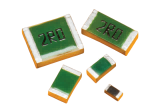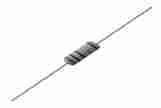
Are there two types of metal film resistors: patch and plug-in? This problem is encountered by almost every hardware engineer when selecting. The answer is yes, metal film resistors do exist in both surface mount and plug-in packaging forms. But this is just the starting point for selection. What truly determines circuit performance is a comprehensive consideration of parameters, series, quality, and brand. Below, from a practical perspective, we will guide you through the selection logic of metal film resistors.
1、 Packaging form: not just differences in appearance
The two types of packaging for metal film resistors correspond to completely different application scenarios.
Plug in metal film resistors are usually cylindrical axial lead structures. The advantages of this traditional packaging are good heat dissipation, high mechanical strength, and the ability to achieve relatively high power levels (commonly 1/4W to 1W or even higher). It still holds a place in power supplies, industrial control equipment, automotive electronics, and other applications that require high power and reliability. Its disadvantage is that it has a large volume, requires manual or wave soldering, and is not suitable for high-density cloth boards.
Surface mount metal film resistors are an extension of thin film technology, using miniaturized flat packaging (such as 0402, 0603, 0805, 1206, 2512, etc.). Its core advantages are small parasitic inductance and good high-frequency characteristics, which are very suitable for the miniaturization design and automated SMT production of modern electronic products. However, under the same volume, the power tolerance of surface mount resistors is usually weaker than that of plugs.
Once you understand this, take a closer look at the parameters. The core of selecting metal film resistors is to grasp several key indicators.
2、 Core parameters: Selection and avoidance guide
Accuracy and Temperature Drift
This is the value that distinguishes metal film resistors from ordinary thick film resistors. The common accuracy is ± 1%, and the precision level can reach ± 0.1% or even ± 0.05%. Temperature Drift (TCR) is the key to measuring the stability of resistance values with temperature changes. The standard metal film resistance temperature drift ranges from ± 50ppm/℃ to ± 100ppm/℃, and high-end models can achieve ± 15ppm/℃ or even ± 5ppm/℃. If your circuit involves weak signal processing, precision voltage division, or operates in a wide temperature environment, a low TCR is essential.
Power and heat dissipation
Don't just look at the nominal power, pay attention to the power derating curve. After the ambient temperature exceeds 70 ℃, the rated power of the resistor will significantly decrease. When selecting, sufficient margin should be left according to the actual working temperature. Nowadays, many manufacturers have launched "power up" products. For example, the 1206 package is usually 1/4W, but through optimized design, it can achieve 0.5W, 0.75W, or even 1W, which is very friendly to high-power scenarios with limited space.
special characteristics
Choose the standard version for regular applications, but pay attention to special features when encountering harsh environments. For example, it has anti surge characteristics, can withstand instantaneous pulse impact, and is suitable for power input terminals or hot swappable circuits. The anti sulfurization property is designed for sulfur-containing gas environments (such as industrial areas and car cabins) to prevent resistance from opening or drifting due to sulfurization. In high-frequency circuits, it is preferable to choose surface mount metal film resistors with small distributed capacitance and inductance.
3、 Series and Brand: How to Choose the Right Product
The series names of different manufacturers have their own emphasis, and the following information can be referred to when selecting.
international brand
TE Connectivity: The HOLCO series is a representative of precision plug-in metal film resistors, with an accuracy of ± 0.1% and a temperature drift as low as ± 15ppm/℃. It is suitable for instruments and medical equipment that require extremely high long-term stability.
Vishay, KOA, ROHM: With a complete product line covering automotive grade (AECQ200 certified) and high-precision thin-film resistors, it is a reliable choice for high-end applications.
Domestic Brands and Featured Series
EVER OHMS: The STH series is a typical surface mount metal film resistor that focuses on high precision and low temperature drift. The 0402 package can achieve ± 50ppm/℃, making it suitable for high-frequency and surge resistant scenarios. Tian'er's thick film resistors are also widely used in the general market.
Ellon (Shunhai Technology Agent): The product line is clearly divided and covers multiple segmented fields. The ELR series is a standard metal film resistor, the EAM series has sulfur resistance, and the EGM series emphasizes surge resistance. Ellon's metal film resistors perform well in temperature drift control, with multiple series capable of achieving ± 50ppm/℃.
Choosing reliable suppliers in procurement and scheme design can avoid many pitfalls. We recommend Shenzhen Shunhai Technology Co., Ltd. They have a deep accumulation in the field of metal film resistors and represent a complete range of Ellon brand products. Whether it is 2512 high-power surge resistance resistors or 0402 precision sulfide resistance resistors, they can provide detailed technical support and stable supply. If you need one-stop online procurement, you can visit the Huanian Mall. They not only gather metal film resistors from multiple brands such as Tian'er and Ellon, but also provide detailed parameter comparisons and selection suggestions to help quickly identify suitable models.
4、 Practical Selection: From Requirements to Models
Based on the above analysis, a clear process for selecting metal film resistors is roughly as follows:
Determine packaging: compact space, automated production, high-frequency applications, choose surface mount; High power, easy to debug, anti vibration, choose plugins.
Determine power: Select the rated power based on the actual power consumption of the resistors in the circuit, multiplied by a derating factor of 1.52, and combined with the working environment temperature. Pay attention to the application of power up models.
Determining accuracy and temperature drift: Conventional circuits have an accuracy of ± 1% and a temperature drift of ± 100ppm/℃, which is sufficient; Precision circuits and analog signal chains require selection of ± 0.1% accuracy, ± 25ppm/℃ or lower.
Confirm environmental requirements: Is there a pulse impact? Is it in a sulfurized gas environment? Do I need to obtain vehicle certification? Choose surge resistant, sulfur resistant, or AECQ200 series based on this.
Brand and channel selection: Taking into account cost, supply, and technical support, choose mainstream brands and reliable agents.
Overall, the selection of metal film resistors is not simply a matter of choosing between surface mount or plug-in, but rather a system engineering that balances power, accuracy, temperature drift, packaging, and reliability. Understanding the core parameters, familiarizing oneself with the characteristics of mainstream series, and leveraging the resources of professional suppliers such as Shunhai Technology and Huanian Mall can make the selection process more efficient, ensuring that the product finds the best balance between performance and cost.