In the vast family of electronic components, resistors are the most fundamental and widely used devices. However, novice electronics engineers and procurement staff often feel confused when faced with seemingly cryptic resistor part numbers (such as STEJ2512 from Huade Electronics). In fact, these combinations of letters and numbers follow a rigorous coding system.
Today, taking Huade Electronics' alloy resistors as an example, we will walk you through how to easily decode the specifications hidden in resistor part numbers.
Step-by-Step Breakdown of Huade STEJ2512 Alloy Resistor
Resistor part numbers are not randomly generated. Manufacturers design them as a component "ID card", which integrates key parameters including package size, resistance value, power rating and tolerance for convenient production and inventory management.
Let’s take the model STEJ2512 of Huade alloy resistor to interpret its detailed specifications:
1. STEJ – Series & Structure Identifier
The prefix STEJ is an exclusive series code of Huade, indicating the resistor type, structure and primary application.
- STE: Base series code for metal ceramic current sense resistors. Featured with low resistance, high power and high precision for current sampling, it differs from conventional thick-film and thin-film resistors.
- J: Suffix for structural design, standing for short terminal, two-terminal and side conductive construction. It is compatible with standard surface mounting processes, delivering balanced heat dissipation and soldering stability, and is the mainstream structure for 2512 package. Compared with the HTE series with long terminals, the J series has broader applicability.
In short, STEJ refers to short-terminal alloy resistors specially designed for current sampling.
2. Package Size: 2512 – Imperial Standard (Linked to Power Rating)
The code 2512 following the series stands for imperial package size, a critical parameter that determines component dimension, maximum power rating and heat dissipation performance.
- Imperial notation: Measured in hundredths of an inch. The first two digits represent length, and the last two represent width. 25 = 0.25 inch (length), 12 = 0.12 inch (width).
- Metric conversion: 6.4mm × 3.2mm.
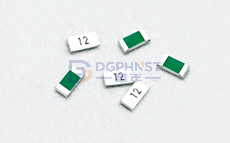
- Power correlation: The 2512 package is a high-power SMD form factor, with a power capacity more than twice that of the 1206 package (3.2mm×1.6mm), ideal for high-current circuits.
There are 9 mainstream standard package sizes for SMD resistors in total.
3. Material Code (e.g. M) – Determines Stability & Temperature Coefficient
Letters after the size code represent alloy materials, which directly affect the temperature coefficient of resistance (TCR), resistance stability and temperature resistance — core indicators for precision current sampling.
- M: Manganese-copper alloy (MnCu). The most common material with a TCR of ±20~±50ppm/°C. It features low thermal electromotive force and stable resistance, working reliably from -55°C to +150°C with high cost performance.
- F: Iron-chromium-aluminum alloy (FeCrAl). High temperature resistance up to +200°C, TCR of ±50~±100ppm/°C, suitable for high-temperature and high-power circuits.
- A: General-purpose alloy. Standard TCR of ±100ppm/°C, a cost-effective basic option.
- C: Nickel-copper alloy (NiCu). Ultra-low TCR and excellent stability, adopted for high-precision applications.
4. Power Rating Code (e.g. 2W) – Rated Power Load
Numbers followed by the letter W indicate rated power, meaning the maximum power the resistor can withstand continuously at 70°C. Exceeding this value will cause overheating and burnout.
- Coding rule: 1W is marked as 1W0, while 2W and 3W are simplified as 2W and 3W.
- Common power ratings for STEJ2512: 1W, 2W, 3W. The 2W version is the most widely used with a good balance of size and power.
Selection Tip: Reserve a power margin of over 20% for practical circuits to avoid continuous full-load operation.
5. Resistance Code (e.g. 0R070) – Special Coding for Low Resistance
The combination of letter R and subsequent digits is a dedicated coding rule for low-resistance resistors. Alloy resistors are mainly used for milliohm-level resistance, whose coding differs greatly from ordinary resistors.
- Core rule: R acts as the decimal point. Digits before R are the integer part, and digits after R are the decimal part, with ohm (Ω) as the unit.
Examples:
- 0R070 = 0.070Ω = 70mΩ
- 0R004 = 0.004Ω = 4mΩ
- 0R510 = 0.510Ω = 510mΩ
Common resistance range of STEJ2512: 1mΩ ~ 500mΩ, covering most current sampling scenarios.
6. Tolerance Code (e.g. F) – Controls Sampling Error
The final letter in the part number denotes resistance tolerance, which defines the error range of current sampling and is essential for precision circuits.
- F: ±1% tolerance. Mainstream grade for most power supplies and motor drive circuits.
- D: ±0.5% tolerance. High-precision grade for battery management systems and precision instruments.
- J: ±5% tolerance. Basic grade for low-cost applications.
Closing Remarks
The field of electronic components may seem tedious, yet every part number embodies rigorous physical principles and engineering expertise. Resistor model codes are not random character combinations, but standardized specifications of component performance defined by manufacturers.
Mastering the rules to decode resistor part numbers helps you quickly understand component parameters, match circuit requirements accurately, avoid selection mistakes, and lay a solid foundation for circuit design.