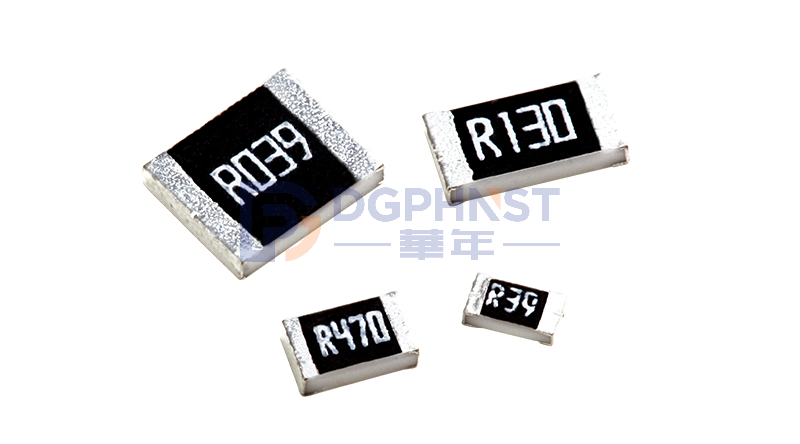
In electronic circuit design, resistors are the most fundamental and critical passive components. Thanks to their core merits including high precision, low temperature drift and high power endurance, alloy resistors are the top choice for power supply units, automotive electronics, industrial control systems, precision instruments and other application fields.
When selecting and commissioning alloy resistors, focusing solely on resistance value and package dimensions while ignoring underlying circuit principles will lead to various failures such as power overload, drift-induced component breakdown and degraded circuit accuracy.
Ohm’s Law and Power Equations
The operating principle of all resistors is based on Ohm’s Law and power formulas, which serve as the core foundation for resistor selection and circuit commissioning.
Core Equations
Ohm’s Law: \(U=IR\) Power Formula: \(P=UI\)
Definition of Physical Quantities & Units
I stands for current in Ampere (A); U denotes voltage in Volt (V); R represents resistance in Ohm (Ω).
These equations describe the dynamic balance among the three electrical parameters: with constant voltage, current drops proportionally as resistance rises; if resistance remains fixed, current doubles alongside doubled supply voltage.
For instance, a 3Ω resistor connected to a 12V supply yields a calculated current of 4A. Replacing it with a 6Ω resistor reduces the current to 2A, visually demonstrating the current-limiting property of resistors.
Power-resistance formulas act as the safeguard for circuit reliability. Combined with Ohm’s Law, the basic power formula \(P=UI\) can be transformed into two practical variants for engineering calculation: (注:原文省略两条推导式,译文保留原文表述) One is used for power calculation with known voltage and resistance, while the other applies to scenarios where current and resistance are available.
Take the 1206 SMD resistor as an example with rated power of 1/4W (0.25W). At an applied voltage of 200V, the minimum required resistance is calculated as 160kΩ. Any resistor with smaller resistance will incur actual power exceeding the rated rating, resulting in component burnout and system shutdown.
Temperature Coefficient (TCR) Formula
The temperature dependence of resistance is quantified by the Temperature Coefficient of Resistance (TCR) formula.
TCR is a key parameter characterizing resistance variation against ambient temperature, specified in ppm/°C (parts per million per degree Celsius). The unit ppm/°C means the relative resistance change per 1°C temperature shift equals one part per million of nominal resistance.
This specification is particularly vital for high-temperature working conditions such as automotive electronics and industrial controls, where precision resistors with TCR ≤25 ppm/°C are mandatory to avoid accuracy loss caused by temperature drift.
Engineering Value of Low-TCR Performance
Resistors with low TCR guarantee consistent circuit performance across wide temperature ranges. For aerospace equipment requiring ultra-low TCR to sustain reliable operation under extreme thermal conditions, thin-film resistors are the preferred option satisfying such requirements.
The above formulas run through the entire electronic design workflow: during circuit debugging, Ohm’s Law helps derive actual resistance from measured voltage and current to spot aging or defective components; in component selection, power formulas enable accurate resistor sizing to avoid overload hazards; TCR criteria guide proper resistor grading for harsh environments and secure long-term stable equipment operation.