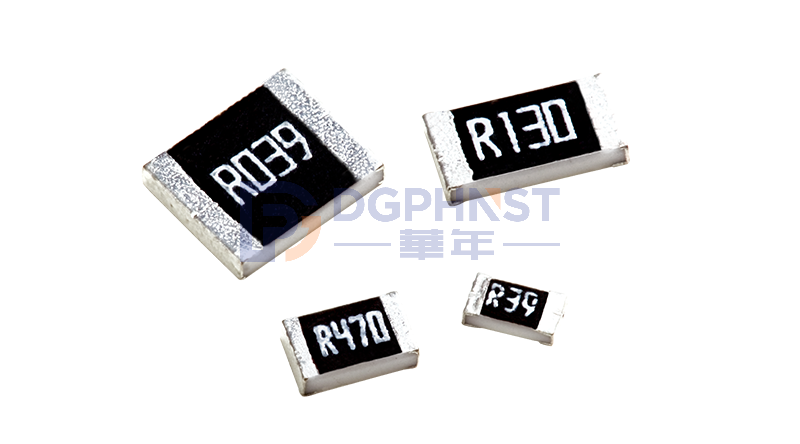
Circuits we encounter daily may seem abstract and hard to understand — electric current is invisible and intangible, and the functions of resistors, capacitors and inductors are even more difficult to grasp intuitively. However, we can easily make sense of them by comparing an electric circuit to a water driven piping system.
Electric current is like water flow, voltage is like water pressure, and resistors, capacitors and inductors correspond to three core control components in the piping system. Each has its own role to regulate the "water flow" (i.e., electric current) jointly and ensure stable operation of the whole system. Next, taking current as water flow and voltage as water pressure driving the flow, we will break down the respective functions of resistors, capacitors and inductors one by one.
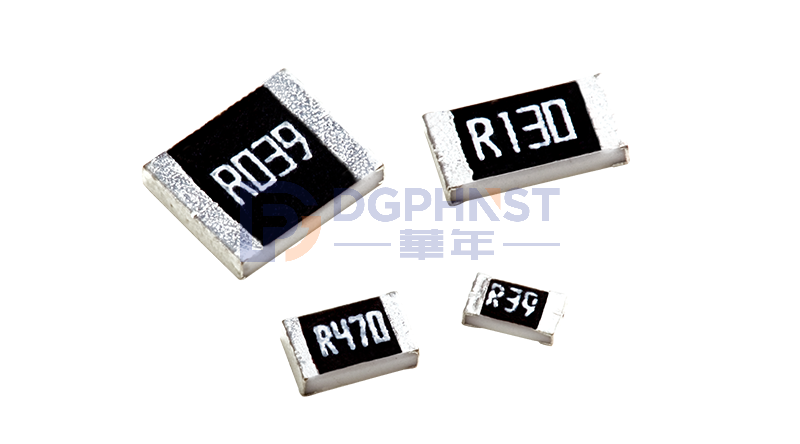
Resistor (R): A Narrow Pipe in the Waterway – Restricts Flow and Dissipates Energy
The primary function of a resistor is to hinder electric current and convert electric energy into heat for dissipation, working just like a narrow pipe (or a resistive pipe) in a water system.
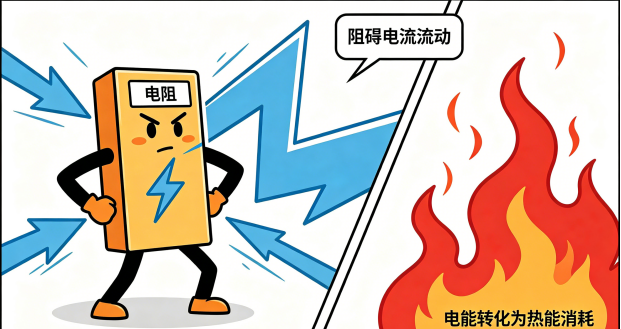
Imagine this: water flows smoothly through a wide pipe with little resistance; but if you switch to a very thin pipe, or install a partition with a small hole inside the pipe, water flow will be significantly blocked. To maintain the same water flow, higher water pressure is required, and heat will be generated where water rubs against resistance.
This is exactly how a resistor works in a circuit. Acting as the thin pipe, a resistor blocks current flow. Sufficient voltage is needed to push current through, while electric energy turns into heat as current passes through the resistor. Electric heaters and incandescent bulbs work exactly by generating heat via resistors.
One detail: the resistance value (strength of hindrance) is equivalent to how narrow the pipe is. The narrower the pipe, the greater the resistance value and the stronger the hindrance to current. Moreover, resistors are bidirectional — they impede current equally regardless of flow direction, just like a thin pipe offering the same resistance no matter which way water flows through it.
In short: A resistor is a narrow pipe that restricts current, dissipates energy, stabilizes current speed, and protects electrical devices from burnout.
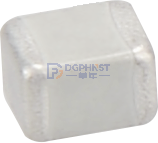
Capacitor (C): A Water Storage Tank in the Waterway – Stores Flow and Balances Supply and Demand
The core function of a capacitor is to store electric energy and release it when needed, similar to a water storage tank in a piping system. It stores water volume and regulates water flow to prevent sharp fluctuations.
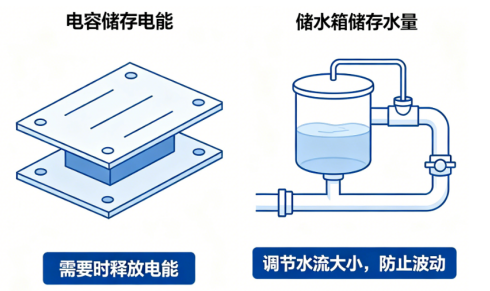
Here’s an easy way to understand it: connect a sealed water tank with inlet and outlet valves in the middle of a pipe. When water pressure rises, water pushes open the inlet valve and fills the tank; when pressure drops and water flow weakens, stored water flows out automatically to replenish the main pipe and keep overall flow steady. The tank has a limited capacity — once full, excess water bypasses it through the main pipe.
In a circuit, a capacitor works as this storage tank. It stores electric charge when circuit voltage rises and releases stored charge when voltage falls, stabilizing voltage and regulating current. For instance, household appliances need an instant surge of current when starting up. The capacitor discharges immediately to supply the required power, preventing voltage drops and device malfunctions.
A key point to note: a capacitor can only store electricity temporarily, just as a tank has limited water capacity and cannot supply power continuously. It also features two critical properties: blocks direct current (DC) and passes alternating current (AC). Simply put, direct current is steady one way flow that capacitors block completely, while alternating current is constantly changing in direction and magnitude. Capacitors allow AC to pass through by repeated charging and discharging, much like tank valves only open for back and forth water flow, not steady one direction flow.
In short: A capacitor acts as a water storage tank that stores and releases electric energy to stabilize voltage and current, with the characteristic of blocking DC and conducting AC.
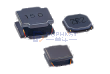
Inductor (L): A Turbine in the Waterway – Resists Flow Changes and Maintains Stability
An inductor’s core role is to prevent sudden surges or drops in current and keep it steady, functioning similarly to a turbine (or impeller) in a water pipe. It relies on inertia to stop abrupt changes in water flow speed and maintain smooth operation.
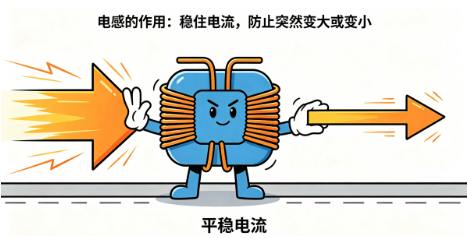
Picture a turbine installed inside a water pipe. If water flow suddenly surges, the turbine cannot speed up instantly due to inertia, blocking and slowing the flow. If flow drops sharply, the spinning turbine keeps rotating by inertia, pushing water forward to prevent sudden weakening. In short, the turbine resists sudden speed changes and stabilizes water flow.
In circuits, an inductor is this turbine. When current rises abruptly, the inductor generates reverse voltage to slow the surge; when current falls sharply, it produces forward voltage to compensate for power loss and prevent a steep drop. With this ability to resist current changes, inductors serve as circuit stabilizers.
For example, high power household appliances such as air conditioners and refrigerators experience violent current fluctuations when switched on or off. Inductors buffer these sudden current changes promptly, protecting devices and circuits from damage. Another feature: inductors hinder high frequency alternating current more strongly (higher frequency means faster current changes), just as a faster spinning turbine creates greater flow resistance. In contrast, inductors barely impede steady direct current, like a turbine offering no extra resistance under constant water flow.
In short: An inductor is equivalent to a turbine in a waterway. It stabilizes current by resisting abrupt changes via inertia, strongly hinders high frequency AC, and barely affects DC.
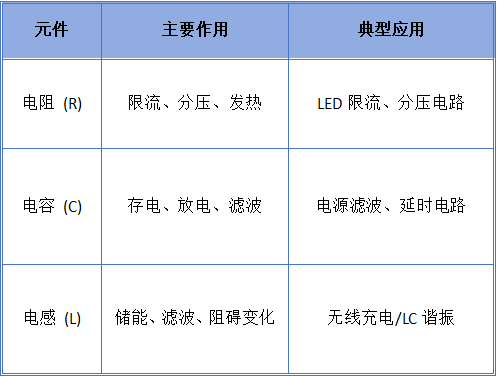
Quick Reference Table for Functions of Resistors, Capacitors and Inductors
Final Notes
Resistors, capacitors and inductors each perform their own duties while working together. Resistors control current magnitude, capacitors smooth voltage fluctuations, and inductors stabilize current variations. Just like narrow pipes, water tanks and turbines in a water system, they jointly ensure water flow stays neither excessive nor insufficient, never cut off or spiking suddenly, thus securing stable operation of the whole system.
Resistors, capacitors and inductors may seem complex, but the water pipe analogy easily reveals their core nature — they are regulators in electric circuits that safeguard circuit stability and safety in their own ways.