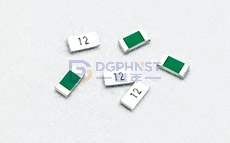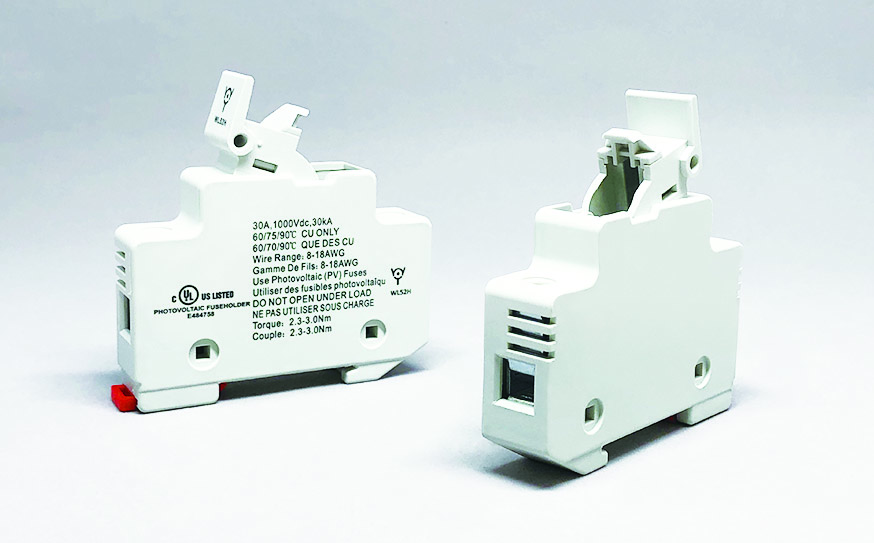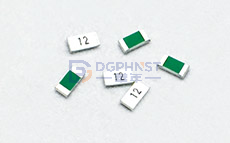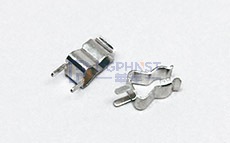
Surface-mount one-time fuses are typical 'unseen during normal operation, but valuable when faults occur' safety components. The mainstream surface-mount one-time fuses in the market include 0402, 0603, 1206, and 6125 packages. Different packages are not only about size differences but also have clear distinctions in melt structure, power tolerance, voltage specifications, and current coverage ranges, with different hardware designs having unique requirements.

0402 Series: Preferred Low-Voltage Fast-Acting Package for Miniature Devices
The 0402 is the preferred package for miniature devices, such as Huade Electronics' 0402FA2A32V and 0402FA5A32V fuses, which belong to this series. They have a rated DC voltage of 32V and cover current ratings of 2A and 5A, all being fast-acting types.
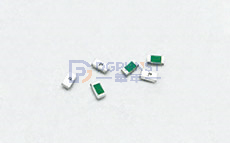
The 0402 has a small size, occupying minimal PCB space, and is suitable for portable devices, small modules, and internal signal branches. However, due to physical space constraints, the melt volume is limited, so this series supports up to DC 32V, focusing on low-voltage DC applications.
All use fast-acting characteristics, aiming to quickly disconnect in case of faults. When a short circuit occurs, the melt rapidly breaks, controlling the short-circuit energy within an extremely short time, preventing small PCB copper foil from being burned and carbonized by large currents.
The 0402 miniature fuse is not suitable for circuits with frequent large surges. The small melt has limited pulse resistance; if the surge is too large, it may cause premature aging or failure. It is suitable for small circuits that require rapid short-circuit cutoff without frequent surges.
0603 Series: General Specification for Consumer Hardware
The 0603 is a widely used general specification in the industry. Huade Electronics offers two categories: the fast-acting 0603F5A63V and the slow-acting 0603T5A32V. They cover DC 32V and DC 63V voltages, with the same 5A rated current but different versions for fast-acting and slow-acting.
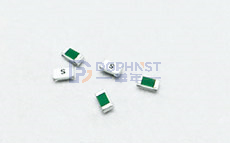
For the same 0603 package, F represents fast-acting, while T represents slow-acting (delayed).
The 0603F5A63V fast-acting type: With a higher DC 63V voltage level, it can rapidly break within milliseconds during a short circuit, making it suitable for power auxiliary circuits requiring quick fault removal.
The 0603T5A32V slow-acting type: It has delayed surge resistance capability, able to withstand the short-term impact current during equipment startup, avoiding false tripping at shutdown, commonly used at power input ports.
Many projects function normally during initial debugging, but after mass production, there is a small probability of fuse blowing. Most cases are due to the presence of surge during startup, where a fast-acting 0603 fuse was selected directly. This is not a product quality issue but a mismatch between the fuse's I-t time characteristic and the operating conditions. The 0603 package balances size and melt space, offering rich options for voltage, current, and melting characteristics, making it a priority evaluation package for most consumer hardware.
1206 Series: Main Series for High Current and High Voltage
The 1206 series, with a larger package size, provides more ample melt physical space.

On one hand, it can support a higher DC 63V working voltage, enhancing the breaking capacity under fault conditions; on the other hand, the slow-acting model's melt can be designed as a delayed structure, withstanding larger startup and inductive load surges.
The 1206 slow-acting series is a common choice for DC power supplies, adapters, and board input ports. Motors and large-capacity capacitive loads generate surge currents several times higher than the rated current during startup. Slow-acting 1206 fuses can withstand short-term pulses but still reliably trip during sustained short circuits or overloads.
With the same rated current, 1206 slow-acting fuses cannot withstand unlimited surges. They can only withstand short-term pulses. If the surge energy repeatedly exceeds the I-t curve, they will still accumulate damage and experience life degradation. A larger package only provides a better foundation for surge resistance, but it cannot violate the device's time-current characteristic.
6125 Series: Surface-Mount Protection for Large Currents and AC Applications
The 0402/0603/1206 packages are mostly for DC voltage, while the 6125 package, with its larger melt and terminal structure, supports AC voltage conditions, filling the gap in surface-mount fuse applications for AC inputs.
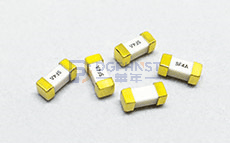
For some small-power AC board-mounted circuits, traditional through-hole fuses take up too much space. The 6125 surface-mount fuses support SMT automatic welding, improving production line efficiency without manual component insertion.
In AC conditions, the fuse's breaking requirements differ significantly from those in DC. You cannot directly use DC-rated 1206 devices for AC protection; instead, you must choose devices like the 6125 explicitly marked with AC voltage ratings.
In Conclusion
Surface-mount one-time fuses: the package determines the physical limit, the voltage rating determines the fault breaking capacity, and the fast/slow-acting I-t characteristics determine the application compatibility. All three are essential, and you cannot rely solely on the rated current.
Fuses are not just consumables that 'only work when broken.' They remain silent during normal operation, acting as the first physical isolation barrier when short circuits or abnormal overloads occur, protecting expensive chips and PCB substrates while meeting overall machine safety regulations.
In your hardware project, have you encountered any fuse-related failures? We welcome industry engineers to share and discuss together.