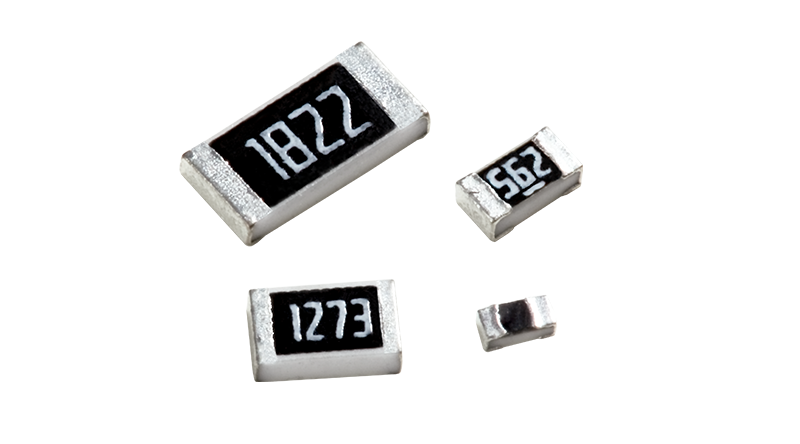
Blackening accompanied by open circuit failure of surface mount resistors (SMDs) is a typical sign of over power failure. The root cause is that the current passing through the resistor or the applied voltage exceeds its rated withstand limit, leading to a sharp rise in Joule heat (P=I2R). The temperature instantly surpasses the upper tolerance limit of the resistive film and substrate, causing carbonization and fusing of the resistor body. Apart from insufficient design margin of circuits, surge impact, poor heat dissipation and improper component selection are also major contributing factors.
This paper deeply analyzes the physical mechanism behind blackening and open circuit failures, and discusses how to eliminate such hidden risks through precise component selection, combined with the high reliability product lines distributed by Shenzhen Shunhai Technology.
Core Mechanism: Joule Heat and Thermal Runaway
Essentially, surface mount resistors are heat generating components that convert electrical energy into thermal energy during operation. When heat generated exceeds heat dissipated, the resistor temperature rises. Once the temperature exceeds material limits (typically above 150℃ 200℃ for thick film resistors), the protective coating turns black, the resistive film fuses, and an open circuit eventually occurs.
1. Over Power Burnout (Most Common Cause)
This is the primary cause of resistor blackening. According to Joule’s Law (P=I2R or P=V2/R), power is proportional to the square of current.(1) Phenomenon: Severe blackening, bulging, or even peeling of the protective layer exposing the internal ceramic substrate on the resistor surface; multimeter measurement shows infinite resistance (open circuit).(2) Cause: Continuous actual circuit power exceeds the resistor’s rated power. For example, using an 0805 package resistor rated only at 0.25 W (1/4 W) at a position requiring 1 W power dissipation without derating design will result in rapid overheating and burnout of the resistor.
2. Surge and Pulse Impact
Even if the average power appears safe, instantaneous high energy pulses may cause internal damage or direct burnout of the resistor.(1) Mechanism: Massive surge current occurs at power on, lightning strikes, or switching of inductive loads. If the resistor has insufficient surge resistance (indicated by I2t value), instantaneous high temperature directly breaks down the fragile trimming area or resistive film.(2) Characteristics: Only minor cracks or partial blackening may appear externally, while the internal conductive path is completely fused.
3. Over Voltage Breakdown
Resistors of each package size have a maximum operating voltage limit (e.g., 50 V for 0603, 150 V for 0805).(1) Risk: If low voltage resistors are connected in series at the 220 V AC input terminal, high voltage will break down air or resistor dielectric and trigger arcing even with sufficient power rating, causing instant cracking, blackening or open circuit failure of the resistor.
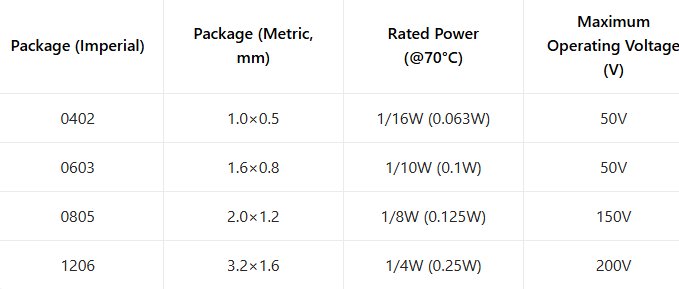
Table of Rated Power and Withstand Voltage for Different Package Sizes
4. Practical Troubleshooting and Environmental Factor Analysis
Apart from excessive electrical parameters, environmental stress and process issues also lead to blackening failures of resistors.
Defects in Heat Dissipation Design and PCB Layout
(1) Heat accumulation: Densely placed resistors or those adjacent to heat sources such as transformers and MOSFETs cannot dissipate heat effectively with elevated ambient temperature. Even with normal current, accumulated ambient temperature may trigger thermal runaway.(2) Improper pad design: Over sized or under sized pads reduce heat conduction efficiency, trapping heat on the resistor body rather than dissipating it through PCB copper traces.
Sulfidation and Corrosion (Hidden Threat)
While sulfidation usually causes resistance drift or open circuits, increased contact resistance of corroded electrodes may trigger local overheating and surface discoloration under certain conditions.(1) Scenario: Ordinary silver electrode resistors are prone to sulfidation reactions that form insulating silver sulfide in sulfur containing environments (e.g., rubber seals, industrial waste gas). Heavy current applied at this point intensifies heating at contact points and may induce secondary burnout.
Mechanical Stress Damage
(1) Cracks causing short/open circuits: Micro cracks from PCB depaneling or drops may damage internal structures. Although this mostly results in open circuits rather than blackening, micro arcing at cracks can leave burn marks.
As a professional technical distributor deeply engaged in the passive component industry, Shunhai Technology leverages its exclusive distribution partnership with top tier brands including Ever Ohms and Walter Electronics to provide systematic solutions for resistor burnout issues to customers in new energy, industrial control and power supply sectors.

Shunhai not only supplies genuine in stock components but also specializes in “preventing resistor burnout”. From assisting customers in calculating operating power and evaluating derating curves to handling unexpected design changes, Shunhai Technology’s one stop component sourcing service effectively avoids mass failure risks caused by mismatched component specifications and ensures hardware circuit stability under extreme conditions.
Closing Remarks
Blackening and open circuit failure of surface mount resistors are never accidental; they are direct evidence of energy imbalance in circuit design. To avoid such issues, engineers must strictly follow derating design standards (a 50% power derating is recommended) and fully consider surge and environmental factors. Selecting an authorized distributor with profound technical expertise such as Shunhai Technology to source high quality industrial grade and automotive grade resistors is critical to ensuring long term product reliability.