
New energy vehicles, high-power charging piles, industrial inverters, AI server power supplies, medical precision instruments... all circuits requiring precise large current detection cannot do without a core component —— alloy sampling resistors.
What is an alloy sampling resistor?
Alloy resistors are also called metal alloy sampling resistors or low-resistance sampling resistors. They use manganese copper, constantan, iron-chromium-aluminum, and nickel-copper composite alloys as resistor bodies. The resistance value is controlled by precisely cutting metal alloy foils. Their core function is circuit current sampling, current limiting, and power protection.
Their biggest function is not "current limiting," but current detection.
Simply put, it measures the tiny voltage drop across the resistor using Ohm's Law: U = I × R
Calculating the working current in the entire circuit, which is also known as a current detection resistor. Today, most power management chips, BMS, and motor control systems can't do without it.
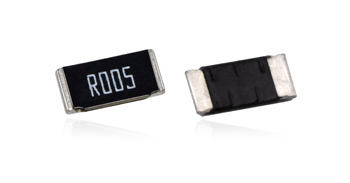
Differences between alloy resistors and ordinary thick-film or metal film resistors:
- Material difference: Ordinary resistors rely on ceramic substrates printed with resistor layers; alloy resistors are made of homogeneous metal alloys, with uniform crystal lattices and stable thermal expansion coefficients;
- Resistance range: Mainly milliohm-level low resistance (3mΩ~500mΩ), suitable for high-current circuits;
- Significant difference in temperature coefficient (TCR): Ordinary thick-film TCR is generally above ±100ppm/℃, while alloy resistors can achieve ±20~50ppm/℃, with almost no resistance drift in high and low temperature environments;
- Power capacity: Under the same package, the power capacity is 2~5 times that of ordinary resistors, with better heat dissipation and ability to withstand instantaneous high current surges.
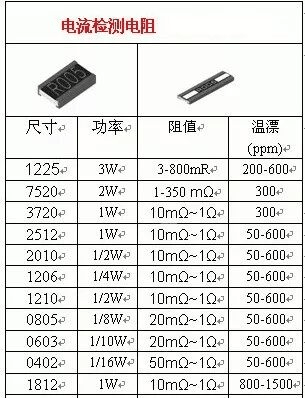
Main alloy material performance comparison
- Manganese copper alloy: Industry standard, ultra-low TCR, high precision, suitable for precision instruments and high-precision BMS sampling;
- Constantan alloy: Strong pulse resistance and high power, ideal for charging piles and industrial power supplies;
- Iron-chromium-aluminum alloy: Heat and oxidation resistant, suitable for vehicle compartments and outdoor high-temperature equipment;
- Cama alloy: Extremely low thermoelectric potential, dedicated for high-end medical and measuring instruments.
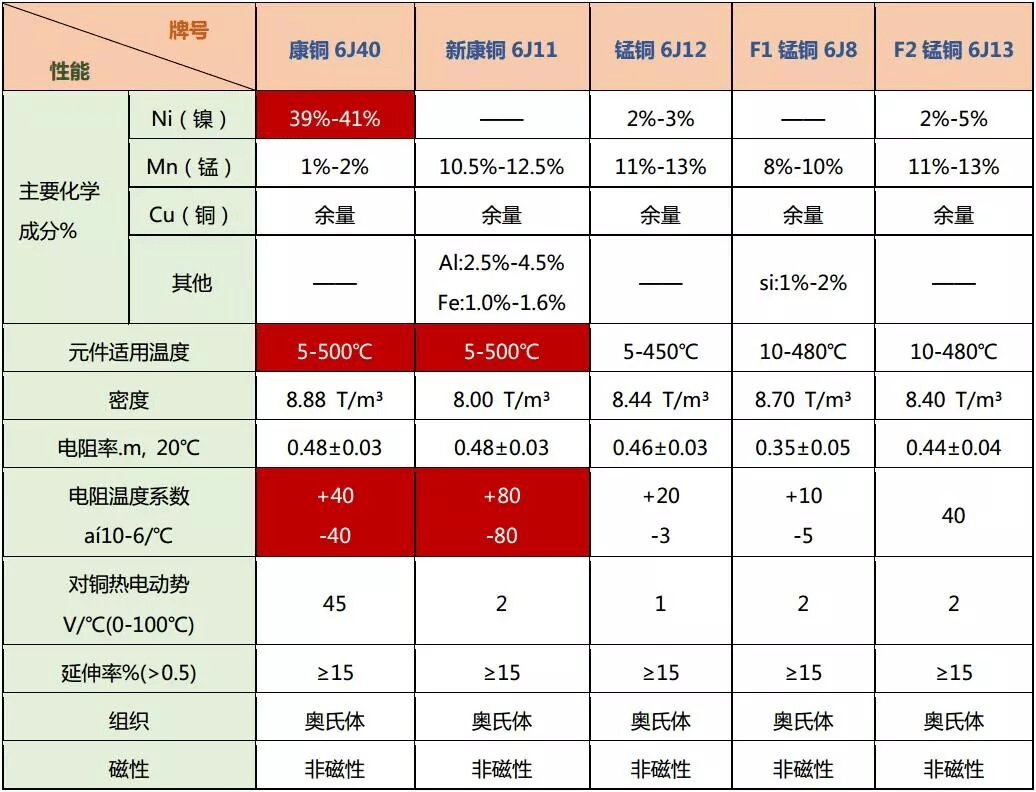
Difference between constantan wire and manganese copper wire
Why are more products adopting alloy resistors?
Compared with traditional thick-film resistors, alloy resistors have obvious advantages.
1. Ultra-low resistance
Ordinary SMD resistors are generally above 1Ω, while alloy resistors can go as low as:
- 5mΩ
- 3mΩ
- 2mΩ
- 1mΩ
- 5mΩ
Even lower
Low resistance means lower power consumption and less heat generation.
2. Low temperature drift
Alloy materials have extremely low temperature coefficients (TCR). Even with significant temperature changes, the resistance change is minimal. This is particularly important for new energy vehicles and battery management systems.
3. Strong pulse resistance
This is one of the main reasons engineers choose alloy resistors. In scenarios such as motor startup, MOSFET switching, and power surges, sudden currents can be tens to hundreds of times higher than normal. Ordinary thick-film resistors are prone to burning out. However, alloy resistors, with their metal conductor structure, have stronger transient energy resistance, significantly improving system reliability.
4. High precision
Current mainstream products can reach:
- ±5%
- ±1%
- ±0.5%
- ±0.25%
- ±0.1%
High precision means more accurate sampling. It is especially suitable for medical devices, communication equipment, and industrial automation fields.
5. Higher power
Common specifications include:
- 1W
- 2W
- 3W
- 5W
- 10W
Under the same package, alloy resistors can handle higher power.
Domestic alloy resistors are rapidly rising
Previously, the high-end alloy resistor market was long dominated by international brands.
With the upgrading of China's domestic component industry chain, local manufacturers have made comprehensive technological breakthroughs, and their products can meet the needs of new energy vehicles, industrial control, and communication industries.
Tianer Technology, with over 40 years of experience in resistor manufacturing, offers a full series of alloy resistors with dual car-grade certifications, covering multiple industry sectors and widely recognized. Shunhai Technology, as an official first-tier authorized agent, has over ten years of experience in passive component supply, offering direct factory stock and exclusive FAE technical support, ensuring fast sample testing and shipping. The Huani Mall online platform allows you to check inventory and quickly get quotes with one click, providing a one-stop procurement solution for passive components, ensuring equipment stability through reliable sources and professional services.