Low Temperature Coefficient Resistors: A Comprehensive Analysis of Characteristics, Precision, TCR, and Resistance Values
I. What Are Low Temperature Coefficient Resistors
Low temperature coefficient resistors, also known as low-TCR resistors, are resistors whose resistance value exhibits minimal change with temperature variations. Their Temperature Coefficient of Resistance (TCR) is typically below 50ppm/℃. While standard resistors commonly have TCR values of 100ppm/℃ or higher, precision low-TCR resistors can achieve levels as low as 5ppm/℃, 10ppm/℃, and 15ppm/℃. High-end products can reach an extreme level of ±0.2ppm/℃.
It is important to note that low-TCR resistors fall within the precision resistor category, but the two are not synonymous. Low temperature coefficient is a core criterion for precision resistors, but not the sole standard. A resistor qualifies as a "precision resistor" only when it simultaneously meets requirements for resistance tolerance, temperature coefficient (TCR), and long-term stability.
II. Core Characteristics
1. Accuracy (Resistance Tolerance)
The accuracy of low-TCR resistors is typically measured by resistance tolerance. High-precision SMD resistors primarily refer to those with tolerance within 1%. Common accuracy grades include: 1%, 0.25%, 0.5%, 0.1%, 0.05%, and 0.01%. The 0.01% grade (1/10,000 precision) represents the highest precision currently achievable in SMD resistors.
Accuracy and cost are positively correlated—higher precision entails higher manufacturing costs. In practical selection, if a 1% tolerance resistor already meets circuit requirements, opting for 0.01% precision would incur unnecessary expense. Engineers must strike a reasonable balance between performance margin and cost control.
2. Temperature Coefficient of Resistance (TCR / Temperature Drift)
TCR is the most critical parameter of low-TCR resistors, expressed in ppm/℃, indicating the relative change in resistance per 1℃ temperature variation. Common TCR grades for precision resistors are: 50ppm/℃, 25ppm/℃, 15ppm/℃, 10ppm/℃, and 5ppm/℃. Ultra-high-precision products can achieve 2ppm/℃ or even 0.2ppm/℃.
Lower TCR means less temperature-induced resistance variation and higher resistor stability. However, lower temperature drift also commands higher costs. In applications such as instrumentation, medical devices, and automotive electronics where temperature stability is critical, the value delivered by low-TCR resistors often far outweighs their cost premium.
Relationship between Low-TCR and Precision Resistors: The industry generally classifies resistors with TCR below 50ppm/℃ as low-TCR resistors. When TCR is controlled within ±50ppm/℃ and accuracy and stability simultaneously meet standards, it qualifies as a precision resistor. However, it is crucial to note that even a resistor with initial accuracy of ±0.01% cannot perform precision measurements in wide-temperature environments if its TCR is as high as ±50ppm/℃. Therefore, temperature drift and initial accuracy of precision resistors must be considered together—neither can be overlooked.
3. Resistance Range
Low-TCR precision resistors cover an extensive resistance range. Thin-film precision resistors typically range from 1Ω to 3MΩ, with some products extending to 10MΩ. Precision foil resistors have a maximum single-unit resistance of approximately 2MΩ. Precision thick-film resistors can support even wider resistance ranges.
Selection logic varies significantly across different resistance ranges:
-
1mΩ to 1Ω (Low resistance range): Primarily used for current sensing, typically requiring precision foil resistors or alloy resistors. Alloy material resistors maintain stability under low-resistance, high-current conditions, achieving TCR as low as ±5ppm/℃ and accuracy of ±0.1% or higher.
-
1Ω to 10Ω: This range presents challenges for any resistor technology. Precision thin-film and metal film resistors typically achieve only ±20ppm/℃ in this range, while precision foil resistors can maintain ±5ppm/℃ or better.
-
10Ω to 150kΩ (Standard range): The most abundant product options. Applications requiring TCR below ±2ppm/℃ or extremely high long-term stability must use precision foil resistors.
-
150kΩ to 1MΩ: SMD packaging typically requires precision thin-film resistors.
-
1MΩ to 50MΩ (High resistance range): Precision thin-film resistors support up to 10MΩ, while precision thick-film resistors can cover the entire range.
4. Long-Term Stability
Long-term stability is another critical characteristic of low-TCR resistors. For example, metal foil SMD resistors exhibit a typical resistance change of only 25ppm after 2000 hours of rated power loading at 70℃ ambient temperature. This long-term stability significantly reduces equipment calibration frequency and maintenance costs, particularly crucial for long-life-cycle products in industrial control and medical devices.
5. Low Noise and Interference Immunity
Precision low-TCR resistors also excel in noise performance. Metal foil technology resistors feature low power coefficient, low noise, pulse resistance, and electrostatic discharge resistance, effectively reducing system noise floor and improving signal-to-noise ratio in high-sensitivity analog signal chains.
III. Classification of Low-TCR Resistors
By Package Type
Low-TCR resistors are primarily divided into SMD (Surface Mount Device) and Through-Hole types:
-
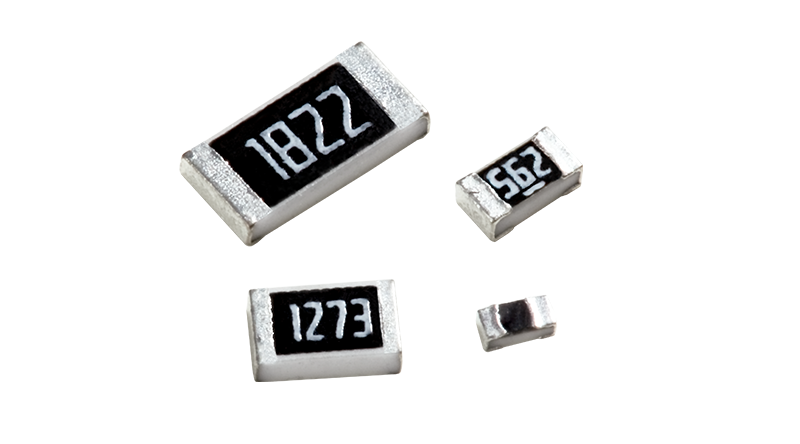
SMD type: Primarily thin-film and foil resistors using surface-mount technology, suitable for automated production and compact designs. Common sizes include 0201, 0402, 0603, 0805, 1206, 2010, and 2512.
-
Through-Hole type: Includes metal film resistors, foil resistors, and molded resistors, suitable for applications requiring through-hole mounting.
By Material and Process
-
Metal Film Resistors: Metal film (such as nickel-chromium alloy) deposited on ceramic substrates via vacuum sputtering. They offer excellent temperature stability and low TCR, suitable for high-precision and low-noise applications.
-
Thin-Film Resistors: Featuring thinner film layers with higher stability and precision, suitable for applications with stringent temperature requirements.
-
Metal Foil Resistors: Utilizing Bulk Metal® foil technology, achieving accuracy up to ±0.001% and TCR as low as ±0.3ppm/℃—among the most advanced precision resistor technologies available.
-
Alloy Resistors: Manufactured from materials such as manganese-copper alloy and Karma alloy (nickel-chromium series), featuring low TCR, low resistance, high power, and high surge current tolerance. Manganese-copper alloys are commonly used in low-resistance ranges, while Karma alloy offers high resistivity and extremely low TCR.
-
Wirewound Precision Resistors: Based on resistance alloy wire, achieving TCR around ±2ppm/℃ and accuracy up to ±0.001%. However, they have distributed inductance and are typically available only in through-hole packages.
IV. Selection Guidelines
In practical engineering design, proper selection of low-TCR resistors requires comprehensive consideration of the following factors:
-
Precise TCR Matching: Select the appropriate TCR grade based on the circuit's operating temperature range and accuracy requirements. Lower is not always better—for indoor equipment with small temperature variations, TCR ±25ppm/℃ with ±0.1% accuracy suffices for entry-level precision; industrial control, ADC acquisition, and op-amp gain circuits recommend TCR ±5~±10ppm/℃; metrology, medical, and aerospace applications require ultra-high precision levels of TCR ≤ ±1ppm/℃ with ±0.01% initial accuracy.
-
Resistance and Power Ratings: Confirm that the required resistance value falls within the supplier's range, and evaluate the impact of power dissipation on resistor self-heating effects. Excessive power may cause temperature rise that compromises temperature drift characteristics.
-
Long-Term Stability and Reliability: Evaluate resistance drift over extended use—particularly important for long-life-cycle products.
-
Operating Temperature Range: Ensure the selected resistor can operate stably within the actual working temperature range. Some products maintain stable operation across wide temperature ranges from -65℃ to +170℃.
V. Professional Procurement Channels
For R&D and procurement professionals with long-term volume requirements, sourcing through authorized channels is recommended to ensure genuine product quality and reliable technical support.
Shenzhen Shunhai Technology Co., Ltd., established in 2012 and headquartered in Shenzhen, is a national high-tech enterprise specializing in semiconductor and passive component distribution. Shunhai Technology is an official first-tier authorized distributor of EVER OHMS, representing its full range of resistor products including precision thin-film resistors, high-power resistors, alloy resistors, current-sensing resistors, anti-sulfuration resistors, and automotive-grade resistors. Shunhai Technology is also a core distributor of Walter alloy resistors, representing nearly 100 international brands.
Huanian Mall, as a comprehensive online electronic component trading platform, offers spot sales and global delivery of low-TCR resistors from original brands including EVER OHMS, KOA, Vishay, and Rohm. Huanian Mall is an official online authorized platform for EVER OHMS, with all products fully traceable and compliant with ISO9001 and AEC-Q200 international certification standards.
Through Shenzhen Shunhai Technology and Huanian Mall, users can access full-service support including specification matching, sample testing, and stable spot delivery, effectively mitigating procurement risks such as unstable supply and non-compliant parameters.