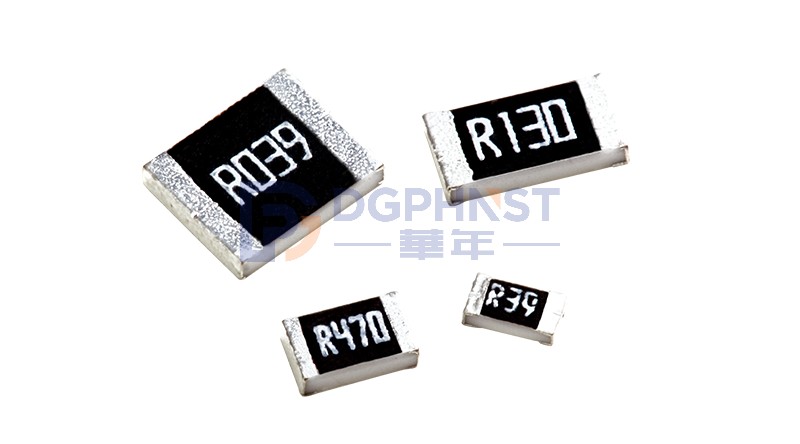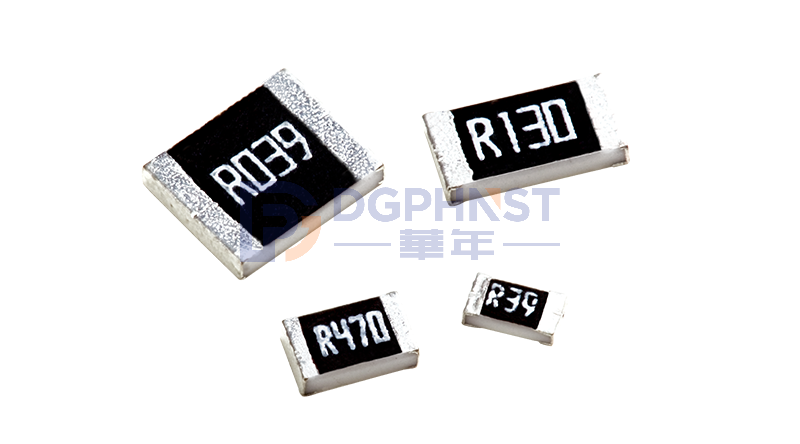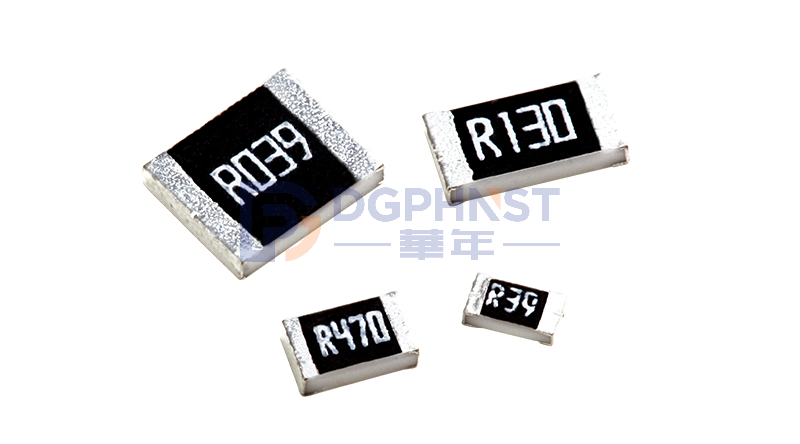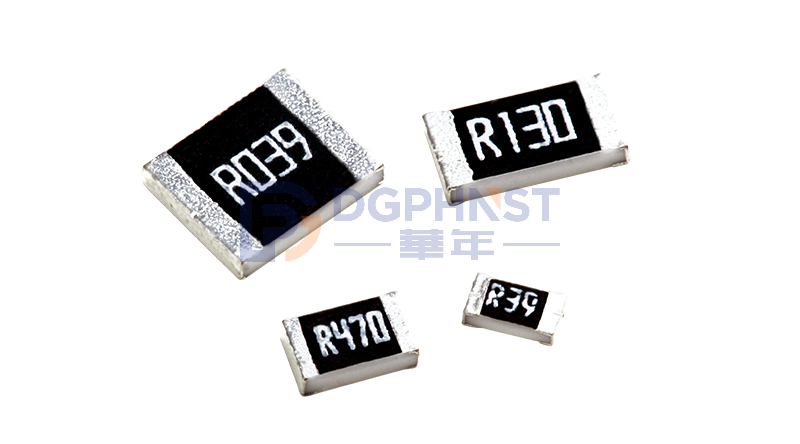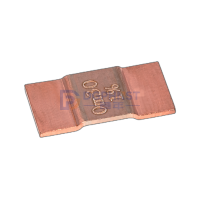
Which resistor should you choose for your circuit: the 1% standard precision version or the more expensive 0.1% high-precision version?
On the surface, the difference in nominal accuracy is only 0.9%, and the numerical gap seems very small. However, during actual circuit operation, mass production, and long-term use, the performance differences between the two will continue to emerge, directly affecting circuit parameter accuracy, equipment operational stability, and product yield rate.
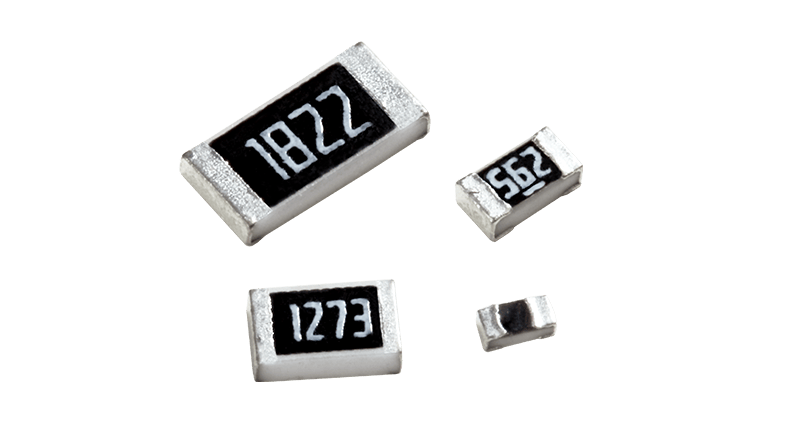
1. What is resistor accuracy?
First, let's correct a common misconception: Resistor accuracy is not "measurement error," but tolerance.
According to industry standards, resistor accuracy refers to the maximum static range that the actual resistance value at the time of factory release can deviate from the nominal value under standard room temperature (25°C) conditions. The smaller the deviation range, the higher the resistor accuracy level.
Take a nominal 100Ω resistor as an example; the basic deviation difference between the two accuracy levels is very obvious:
- A nominal 100Ω, 1% accuracy resistor: The actual resistance value must be between 99Ω and 101Ω to be qualified, with a maximum deviation of 2Ω;
- A nominal 100Ω, 0.1% accuracy resistor: The actual resistance value can only be between 99.9Ω and 100.1Ω, with a maximum deviation of 0.2Ω;
From the basic parameters, the static error range of the 0.1% high-precision resistor is only one-tenth of that of the 1% precision resistor.
2. What factors affect resistor accuracy?
1. Manufacturing tolerance
The initial resistance value of SMD resistors during mass production is usually lower than the target value. Laser cutting is used to narrow the current path and increase the resistance value, finally controlling it within the specified tolerance range in the datasheet.
Accuracy has corresponding code identification: F represents ±1%, J represents ±5%. This error includes only manufacturing tolerance and does not cover other factors that may cause resistance drift.
2. Temperature coefficient
The resistance value changes with temperature. The temperature coefficient (TCR) = (R - Ra)/Ra ÷ (T - Ta) × 1,000,000. Here, Ra represents the resistance value under reference temperature conditions, usually at 25°C. Ta is the reference temperature, also usually at 25°C. R generally refers to the resistance value of the resistor under certain temperature conditions in the product, and T is the corresponding temperature.
3. Performance differences between the two types of resistors
Resistor selection cannot rely solely on nominal accuracy. Temperature drift characteristics, long-term stability, and batch consistency are key dimensions that distinguish 1% standard precision resistors from 0.1% high-precision resistors.
1. Temperature drift: Significant differences in error under environmental temperature fluctuations
Circuit heating during operation and external temperature changes can all lead to resistance value deviations. This key parameter is temperature drift (temperature drift, unit ppm/℃).
The temperature drift parameters of the two types of resistors differ significantly:
- 1% standard resistor: Temperature drift range is ±50 to ±100 ppm/℃. When temperature fluctuates, the resistance value deviation continues to accumulate;
- 0.1% high-precision resistor: Temperature drift is strictly controlled within ±10 to ±25 ppm/℃, offering better adaptability to environmental temperatures.
For example, using a 10kΩ resistor with a 50℃ normal operating temperature difference in the device: The maximum deviation caused by temperature for the 1% resistor can reach 0.5%, while the temperature deviation of the 0.1% resistor is only 0.125%. If combined with the factory static error, the total error difference during actual operation will further widen.
The accuracy tolerance marked in the resistor specification sheet includes only the production manufacturing error, not the resistance value deviation caused by temperature drift. In high-temperature working environments, the resistance value deviation caused by temperature may even exceed the resistor's nominal accuracy error, which is the core reason why some devices use 1% resistors for voltage division sampling, but after mass production, the accuracy exceeds the limit.
2. Long-term stability: Suitable for different equipment usage cycle requirements
1% standard precision resistors mostly use ordinary metal film processes. Under long-term power-on, thermal cycling, humidity, and other conditions, the resistance value will slowly shift. After 1 to 2 years of use, the error becomes significantly larger, suitable only for general circuits without strict long-term accuracy requirements.
0.1% high-precision resistors use precision thin-film processes, and undergo high-temperature aging and stability screening before leaving the factory, offering stronger anti-aging and anti-environmental interference capabilities. According to industry standards, after 1000 hours of long-term load aging testing, their resistance value change rate is far lower than that of 1% standard resistors, allowing them to maintain precise resistance values for a long time, meeting the needs of long-term stable equipment operation.
3. Batch consistency: A key guarantee for mass-produced products
It is difficult to detect the performance differences between individual resistors, but when mass-produced, the consistency deviation will be continuously amplified.
- The single-resistor error range of 1% resistors is relatively large, so batch products are prone to batch parameter drift, requiring individual calibration and adjustment, increasing the workload of mass production;
- The single-resistor uniformity of 0.1% high-precision resistors is high, and the batch parameter consistency of the product is excellent, effectively reducing the cost of mass production debugging and improving product pass rate.
4. Cost differences: Suitable for different cost-performance scenarios
Due to factors such as the complexity of the production process, quality screening standards, and yield rate, there is a significant price gap between the two types of resistors.
1% precision resistors offer excellent cost-performance and are the mainstream choice for general circuits. 0.1% high-precision resistors have strict production processes and low yield rates, with prices several to dozens of times higher than those of the former. Some specifications also have longer delivery cycles, making them suitable only for high-precision demand scenarios.
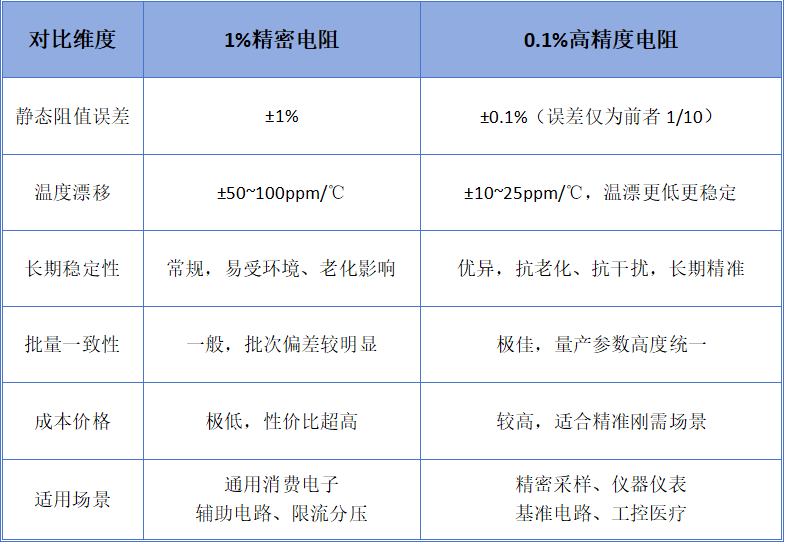
Summary of core parameters comparison between the two types of resistors
In conclusion
The 1% and 0.1% resistors represent the gap between general and precision components.
The 1% resistor is the optimal solution for mass production cost-performance, meeting the needs of 90% of general circuits. The value of the 0.1% resistor lies in precise sampling, stable operation, long-term reliability, and batch compliance—details that make it the cornerstone of high-end precision equipment.
Selecting the right resistor is not about nitpicking parameters, but about making the circuit more stable, the product more reliable, and R&D less prone to pitfalls.
Shunhai Technology can supply a full series of 0.1% precision resistors from multiple brands, covering various packages such as SMD, MELF, and through-hole. You can also log in to Huanian Mall to select online, quickly access datasheets, delivery times, and inventory status, helping hardware R&D and procurement avoid issues like parameter overstatement and inconsistent incoming materials.