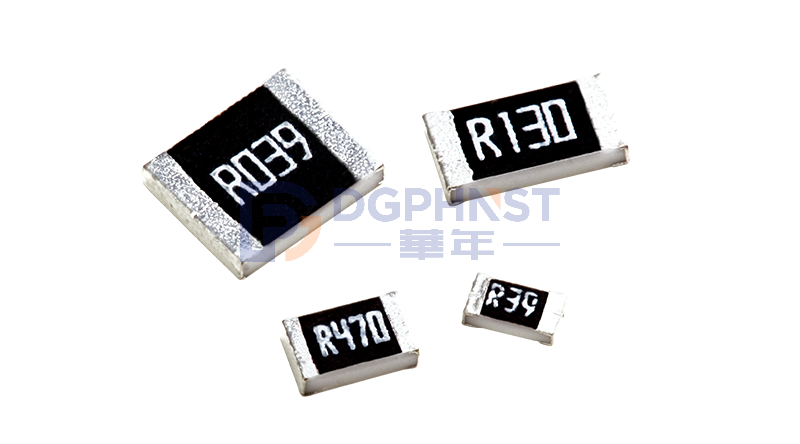
Many people assume that high-precision resistors mean low-temperature drift resistors, thinking that high precision implies low drift, and low drift means high precision.
The difference between the two lies not in the precision level, but in the source of errors: high-precision resistors are used to control fixed errors caused by manufacturing, while low-temperature drift resistors are used to suppress dynamic errors caused by environmental changes.
1. The Core Essence of the Two Resistors
The deviation of all resistor values comes from two aspects: manufacturing deviation at factory and working condition deviation during use. High-precision resistors and low-temperature drift resistors are designed to solve these two types of errors.
1. High-Precision Resistors: Focus on "Initial Value Accuracy"
During the production of ordinary resistors, due to limitations in cutting, plating, and printing processes, the resistance values have significant variability, such as ±5% or ±1% error, which is a fixed deviation inherent in the production process, static and fixed.
The core of high-precision resistor technology is to extremely compress manufacturing variability.
Through precision lithography, laser trimming, and fine plating processes, the factory resistance value is tightly locked near the nominal value, achieving ±0.1%, ±0.05%, or even higher precision.
Its purpose is to address the issue of inaccurate resistance values at factory, but it only guarantees initial accuracy under normal temperature and new conditions. It cannot suppress resistance value changes caused by temperature and time. Even high-grade high-precision resistors, if materials and structures are not specially optimized, will still experience significant shifts in resistance value with temperature and usage duration.
2. Low-Temperature Drift Resistors: Focus on "Stability Under Environmental Changes"
The core physical characteristic of resistors: the resistance of any conductor changes with temperature, stress, humidity, and time. This dynamic variable generated during use is the biggest source of error for ordinary resistors.
The design logic of low-temperature drift resistors abandons the pursuit of "initial extreme precision", focusing instead on optimizing material quality and internal structural stability. By using alloy materials with extremely low temperature coefficients, balancing film layer stress, and optimizing packaging heat dissipation structure, the resistance variation caused by temperature changes can be significantly suppressed, reducing the temperature coefficient from hundreds of ppm/℃ to single-digit ppm/℃.
Its function is to control resistance drift caused by working condition changes. These resistors allow a certain factory deviation, such as ±1% precision specifications, but under conditions of temperature cycles, continuous power-on, and environmental fluctuations, the change in resistance value is smaller.
2. Precision and Temperature Drift (TCR) Are Completely Independent
Accuracy and temperature drift are independent parameters, not directly substitutable.
1. Accuracy (Error Rate): Static Parameter
Accuracy describes the deviation between the actual resistance value and the nominal value under the same environment, same time, and standard working conditions.
It is a static value that represents the initial state of the resistor and has no relation to time or temperature. High accuracy only indicates good initial consistency of resistance value, but does not mean that the resistance remains stable after environmental changes.
2. Temperature Drift (TCR): Dynamic Parameter
Temperature drift describes the rate and amplitude of resistance value change triggered by environmental variables.
It is a dynamic variable that represents the resistor's interference resistance, long-term stability, and physical tolerance. A low temperature drift indicates more stable physical properties and minimal external influence, but does not mean that the initial value is accurate.
High precision ≠ High stability, low drift ≠ High accuracy.
For example, an ultra-high precision resistor with ±0.01% may have a temperature drift of 100ppm/℃, resulting in a resistance change of over 0.5% between summer and winter, making its precision invalid. A super low-temperature drift resistor with 5ppm may have an initial error of ±1%, but the total variation across the entire temperature range could be less than 0.05%, with minimal long-term shift.
3. Why High-End High-Precision Resistors May Not Be Low-Temperature Drift Resistors?
The two types of components have different process focuses, and their performance involves trade-offs. Achieving ultra-high initial precision relies on laser trimming and fine plating process optimization to improve resistance consistency, but this process can create stress in the resistor film, weakening the material's temperature adaptability and leading to worse temperature drift indicators.
If you want to achieve ultra-low temperature drift, you need to optimize alloy materials, balance internal stress, and enhance structural stability. However, material and structural solutions limit the resistance adjustment capability, making it difficult to achieve extremely small initial errors.
This is a natural trade-off in resistor manufacturing: precision and stability have a process trade-off relationship. Most ordinary high-precision resistors are "sacrificing temperature drift for precision"; most conventional low-temperature drift resistors are "sacrificing initial precision for stability".
Resistors that can achieve both high precision and low temperature drift require very high production costs and complex processes, which is why such high-end resistors have higher prices and higher barriers.
In the selection process, many R&D teams often fall into the "only precision" misconception, blindly choosing high-precision resistors, which may lead to product reliability issues. Therefore, Shunhai Technology matches customers' circuit scenarios, test standards, and usage environments to precisely select pure high-precision, pure low-temperature drift, or high-precision and low-temperature drift integrated resistors, avoiding redundant parameters or performance shortages, and ensuring cost-effectiveness and stability.
4. Different Error Issues Addressed by the Two Types of Resistors
From the perspective of circuit design, the two types of resistors are suitable for two typical error scenarios:
1. Choosing High-Precision Resistors: Improve System Fixed Deviation
In sampling, voltage division, and reference circuits, errors are mostly fixed static errors.
Uncertain initial resistance value causes fixed offset in circuit output, which cannot be corrected by algorithms or debugging. This type of error can only be eliminated by high-precision resistors, reducing manufacturing errors from the hardware source and ensuring the accuracy of the circuit reference value.
2. Choosing Low-Temperature Drift Resistors: Suppress System Drift Accumulation Errors
In long-running circuits such as closed-loop feedback and constant current/voltage, the risk is not the initial error, but the cumulative effect of dynamic drift.
Device heating, environmental temperature differences, and component aging can cause resistance value drift. Small temperature drifts can be amplified by closed-loop circuits, causing work point deviation and overall parameter degradation. This type of dynamic drift is difficult to completely eliminate through software calibration or hardware debugging, and can only be controlled by the stable physical characteristics of low-temperature drift resistors.
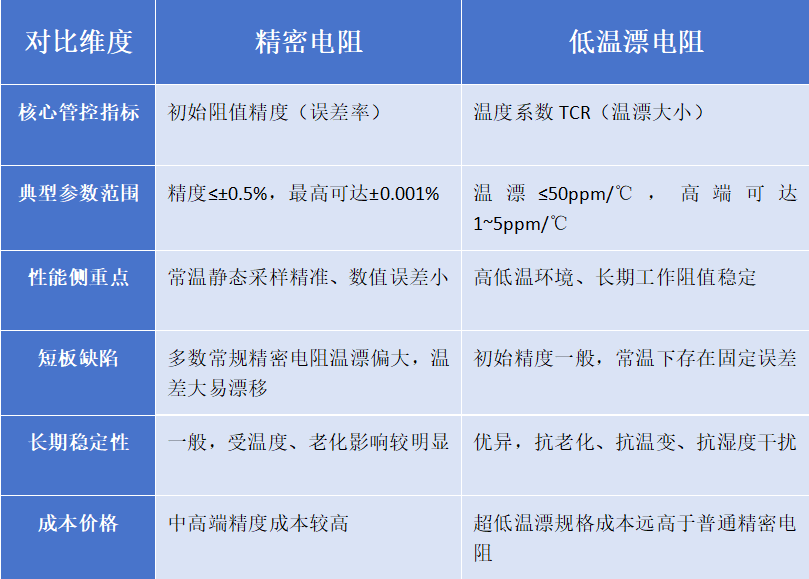
Differences Between High-Precision Resistors and Low-Temperature Drift Resistors
Conclusion
The core function of resistors is to provide controllable and predictable electrical characteristics for the circuit.
- Ordinary resistors: Errors and drift are uncontrollable, leading to large circuit performance variations;
- High-precision resistors: Controllable static errors, ensuring predictable initial circuit status;
- Low-temperature drift resistors: Controllable dynamic errors, ensuring stable long-term circuit operation.
Initial accuracy deficiency can generally be improved through calibration and algorithm compensation. Temperature drift and component aging-induced dynamic deviations are system-level errors that are difficult to reverse at the hardware level. The core of hardware selection is not blindly choosing high-end components, but understanding the boundary and underlying principles of component parameters to match the circuit's error control requirements.
If you have any questions about resistor selection, parameter matching, or sample testing, or if you need industrial or automotive-grade high-precision or low-temperature drift resistor solutions, feel free to consult Shunhai Technology anytime. With a complete range of original factory stock resources and years of hardware selection experience, we can quickly match parameters according to your needs and provide trial samples to help R&D teams avoid unnecessary detours and reduce debugging costs.