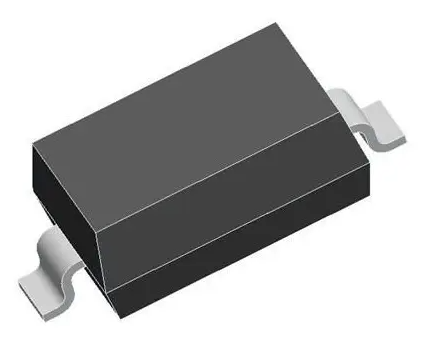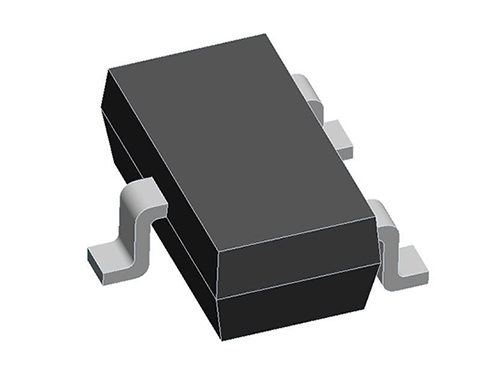
In various circuit designs, especially in high current working circuits, the main control chip wants to monitor the current in real time, but there is a core problem: the chip cannot directly read the current signal. The sampling resistor is the core component that solves this problem. Its core function is simple: convert the invisible and unreadable current signal into a voltage signal that the chip can recognize.
How to choose sampling resistors with different packages such as 0402, 0603, and 1206? In fact, the underlying working principle of all sampling resistors is the same. The only difference lies in: power size, heat dissipation capability, temperature rise performance, and the upper limit of current carrying capacity.
One, Core Working Principle of Sampling Resistors
A sampling resistor is essentially a high-precision, low-resistance, low-temperature-coefficient power surface mount resistor. Its working basis comes from Ohm's Law: U=I×R.
Working Process Breakdown
- Series connection in the circuit: Connect the sampling resistor in series in the current loop to be detected;
- Generate voltage drop: When the current flows through the resistor, a weak and stable voltage difference appears across the resistor;
- Fixed precise resistance value: The resistance value of the sampling resistor is a precisely calibrated fixed value, which does not fluctuate randomly;
- Chip collects the signal: MCU, operational amplifier, ADC chips read the voltage difference across the resistor;
- Reverse calculation of current: Calculate the real-time working current of the circuit through the formula I=U/R.
Key point: The sampling resistor itself does not measure current. It only converts the invisible current signal into a voltage signal that can be recognized and read by the ADC, playing the role of a "current-voltage converter".
Why are low-resistance sampling resistors commonly used?
The common resistance range for sampling resistors: mostly between 1mΩ and 500mΩ.
- The larger the resistance value: the greater the voltage drop under the same current, the stronger the sampling signal, and the easier it is to read; however, the power loss and heating become more severe, and the power supply efficiency decreases.
- The smaller the resistance value: lower power loss and less heat generation, minimal impact on the main circuit; however, the output voltage signal is weak, requiring a high-precision operational amplifier to amplify the signal.
This is the core contradiction in current sampling: sampling signal strength vs. power loss and temperature rise. The package size is the key hardware carrier to resolve this contradiction.
Two, What do the packages 0402/0603/0805/1206/2010/2512 represent?
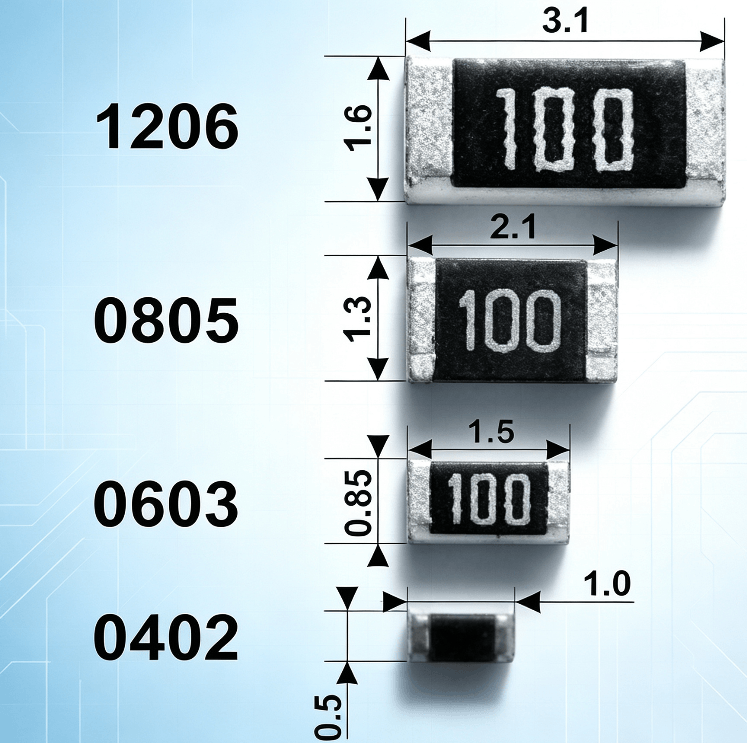
The surface mount package number consists of four digits, where the first two digits = length, and the last two digits = width, in units of 0.01 inches, representing only the physical size.
- 0402: Length 0.04 inches × Width 0.02 inches
- 0603: Length 0.06 inches × Width 0.03 inches
- 0805: Length 0.08 inches × Width 0.05 inches
- 1206: Length 0.12 inches × Width 0.06 inches
- 2010: Length 0.20 inches × Width 0.10 inches
- 2512: Length 0.25 inches × Width 0.12 inches
Package size ≠ Resistance value, the package does not change the underlying working principle of the sampling resistor!
Whether it is the smallest 0402 or the largest 2512, the sampling logic is always U=I×R. The package actually determines: rated power, heat dissipation area, maximum current carrying capacity, temperature rise performance, and pulse resistance.
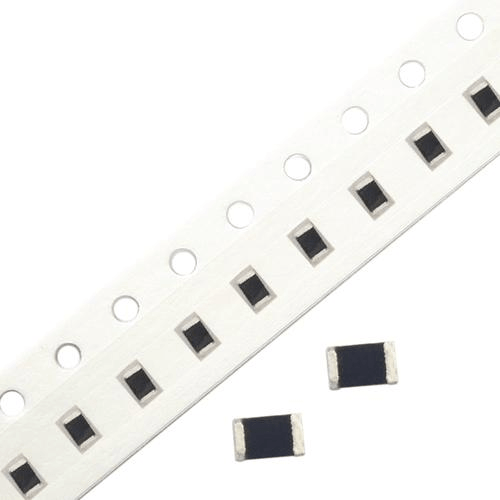
Three, Six Major Packages Sampling Resistor Capability Logic Comparison
1. 0402 Sampling Resistor
Typical Rated Power: 1/16W
Underlying Logical Characteristics: Smallest size, limited heat dissipation area, low power carrying capacity
Applicable Scenarios: Small current sampling, signal-level sampling with very small loop current and extremely low loss; compact PCB layouts with tight space constraints
Shortcomings: Temperature rises rapidly at high currents, strictly prohibited for use in high-power main circuit current sampling
2. 0603 Sampling Resistor
Typical Rated Power: 1/10W
Underlying Logical Characteristics: Slightly increased size, heat dissipation capability improved by one level compared to 0402
Applicable Scenarios: Medium and small current signal sampling, auxiliary circuit current detection in consumer electronics and small motherboards
Shortcomings: Still unsuitable for high-power, continuous large current loops
3. 0805 Sampling Resistor
Typical Rated Power: 1/8W
Underlying Logical Characteristics: The most commonly used basic sampling package in consumer electronics, further increased heat dissipation area
Applicable Scenarios: Chargers, small power boards, and small power board current monitoring; mainstream choice for medium and small current sampling
Shortcomings: Insufficient power margin under continuous large current conditions, leading to higher temperature rise
4. 1206 Sampling Resistor
Typical Rated Power: 1/4W, 1/3W
Underlying Logical Characteristics: A package entering the power sampling threshold, with significantly increased heat dissipation area, capable of carrying larger continuous currents, with better temperature rise control than smaller packages
Applicable Scenarios: Industrial power supplies, lithium battery protection boards, and medium power loop current sampling; one of the most popular power sampling packages in the market
5. 2010 Sampling Resistor
Typical Rated Power: 1/2W
Underlying Logical Characteristics: A starting package for high-power sampling, with a longer resistor body and larger heat dissipation pad; allows long-term flow of larger currents, with stronger temperature rise suppression capability
Applicable Scenarios: BMS battery management systems, OBC onboard chargers, motor drives, and high-power fast charging power boards; scenarios requiring long-term stable large current sampling
6. 2512 Sampling Resistor
Typical Rated Power: 1W
Underlying Logical Characteristics: The largest heat dissipation area and highest power rating among the six packages; the resistor body is longer, and the current path is wider, providing the best heat dispersion effect under large currents
Applicable Scenarios: High power power supplies, energy storage, inverters, and industrial high power load sampling; circuits with high current, long conduction time, and strict temperature rise control requirements
Four, Relationship Between Package Size and Sampling
Resistance value determines sampling sensitivity; package size determines heat resistance and current carrying ability.
For the same resistance value, for example, 10mΩ:
Placed in 0603 package: allows a small long-term current, slightly increasing the current causes power to exceed the limit, the resistor quickly heats up, the resistance value drifts, and the sampling accuracy fails.
Placed in 2512 package: large heat dissipation area, lower temperature rise under the same current, smaller resistance drift, and more stable and reliable sampling results over time.
Finally, in conclusion
0402, 0603, 0805, 1206, 2010, 2512, these package codes are just the "external body size" of the sampling resistor, and they do not change the underlying working logic of current sampling, U=I×R.
The essence of sampling resistor selection has never been about looking at parameters or matching sizes, but rather matching the corresponding heat dissipation capability package according to the circuit current size.
Stabilizing temperature rise and maintaining resistance value accuracy will ultimately result in stable, accurate, and reliable current sampling data, which is the core key to sampling resistor selection in circuit design.