
Today's electronic products are getting smaller in size but larger in power. Smartphones with fast charging, TWS earbuds, smartwatches, thin laptops—these products have extremely limited PCB space, yet the demand for current detection remains unchanged. Surface mount alloy resistors have emerged in this contradiction: they need to be compact while maintaining low resistance, high power, and high precision.
Surface mount alloy resistors (SMD Alloy Resistor), also known as milliohm resistors or sampling resistors, are the most widely used resistor type in current detection applications today.
1. What is the difference between surface mount alloy resistors and ordinary surface mount resistors?
Visually, surface mount alloy resistors and ordinary thick film surface mount resistors look similar, both having standard SMD packaging with two terminal electrodes. However, their internal structures are completely different.
Ordinary thick film surface mount resistors are made by printing resistor paste on a ceramic substrate and then sintering it at high temperature to form the resistor layer. In contrast, alloy resistors use a whole piece of metal alloy material as the resistor body, with electrodes welded at both ends.
This structural difference leads to several key performance differences:
① Alloy resistors can achieve lower resistance values (milliohm level), whereas thick film resistors usually struggle to go below 100mΩ and maintain stability;
② Alloy resistors have a lower TCR (within ±50ppm/℃, and up to ±20ppm/℃ with manganese copper material), while thick film resistors typically range from ±100ppm/℃ to ±200ppm/℃;
③ Alloy resistors have higher power density and stronger pulse resistance capability, making them suitable for high-current scenarios.
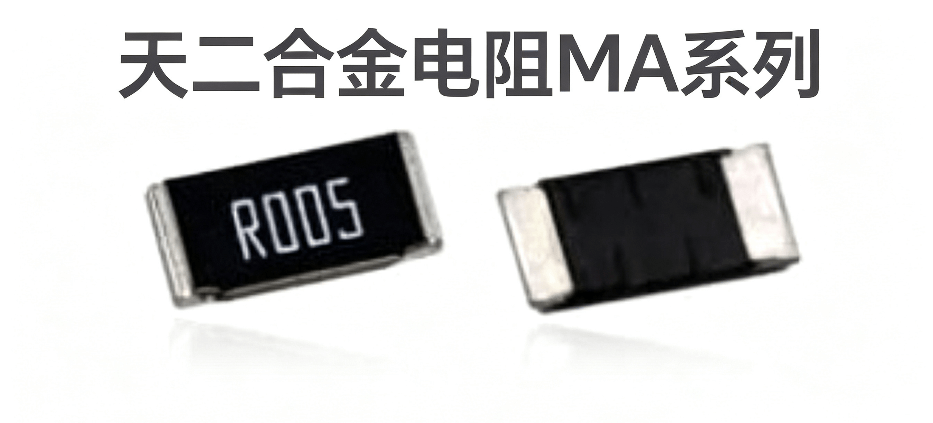
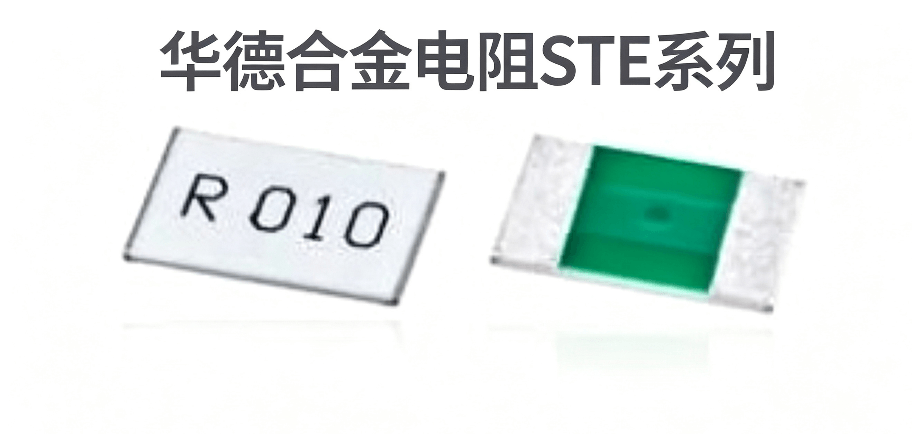
Currently, high-performance alloy resistors on the market are mostly from industry-leading brands. Shunhai Technology, as a core agent of passive components, holds official agency qualifications for well-known brands such as Tianer EVER OHMS, Walter, and Sunway. All products are genuine, offering selection schemes matching different precision, power, and temperature drift requirements.
Of course, alloy resistors are more expensive, with a relatively limited resistance range (usually not exceeding 1Ω), making them unsuitable for general signal circuits with medium and high resistance values.
2. Main Packaging Specifications and Power Correspondence
Surface mount alloy resistors follow standard SMD package sizes, and the power carrying capacity varies significantly among different packages.
0402 package (1.0mm × 0.5mm): The smallest surface mount alloy resistor, with a typical power rating of 0.25W to 0.5W and a resistance range of 1mΩ to 100mΩ. It is suitable for portable devices with extremely tight PCB space, such as TWS earbuds charging cases, smartwatches, and small current detection within smartphones. Due to its small size, it has limited heat dissipation and is not suitable for sustained high current loads.
0603 package (1.6mm × 0.8mm): Power ranges from 0.5W to 1W, with a resistance range of 0.5mΩ to 500mΩ. One of the most commonly used packages in consumer electronics, balancing size and performance. This package is often used in current detection for smartphone fast charging loops, tablet power management, and small mobile power supplies. The 0603 alloy resistors of Walter and Yine from Shunhai Technology offer excellent mass production stability and are a mainstream choice for consumer electronics fast charging solutions.
0805 package (2.0mm × 1.25mm): Power ranges from 1W to 1.5W, with a resistance range of 0.5mΩ to 1Ω. Suitable for moderate current (5A to 15A) applications, such as laptop power supplies, industrial control boards, and LED driver power supplies. The slightly larger package offers better heat dissipation and long-term stability.
1206 package (3.2mm × 1.6mm): Power ranges from 1W to 2W, with a resistance range of 0.2mΩ to 1Ω. A very popular package in industrial and automotive electronics, with high power density and moderate PCB layout space. Widely used in motor drives, DC-DC converters, and BMS applications.
2010 package (5.0mm × 2.5mm): Power ranges from 2W to 3W, with a resistance range of 0.1mΩ to 500mΩ. Suitable for larger currents (15A to 40A) applications, with large pad areas for better heat dissipation. Commonly used in industrial inverters, high-power power supplies, and auxiliary circuits of charging piles. Shunhai Technology has deep expertise in high-power components, and its high-power alloy resistors from Walter and Tianer 2010 series have strong pulse resistance capabilities, suitable for high-frequency operation scenarios in industrial high-power equipment.
2512 package (6.4mm × 3.2mm): The mainstream package with the highest power among surface mount alloy resistors, capable of reaching 2W to 5W or even higher, with a resistance range of 0.1mΩ to 500mΩ. It is the preferred package for high-current sampling, widely used in applications such as electric vehicle motor drives, energy storage BMS main circuits, and server power output ends.
3. Miniaturization Trends: Challenges of 0201 and Smaller Packages
With the development of wearable devices and foldable phones, surface mount alloy resistors are also evolving towards smaller packages. 0201 packages (0.6mm × 0.3mm) of alloy resistors have already been mass-produced, and some manufacturers are even developing 01005 packages (0.4mm × 0.2mm), but miniaturization brings several technical challenges.
Firstly, heat dissipation: the smaller the package, the smaller the pad area, making heat dissipation more difficult, thus limiting the power level. The power of 0201 alloy resistors is usually only 0.125W to 0.25W, suitable for small current (1A to 3A) detection.
Secondly, resistance accuracy: under extremely small packages, the size of the alloy resistor body is very small, and manufacturing tolerances have a greater impact on resistance values. High-precision (±0.5% or higher) micro-alloy resistors are more expensive.
Thirdly, soldering process: packages of 0201 and below require high SMT process standards. Control of solder paste quantity, placement accuracy, and reflow soldering temperature profiles must be strictly managed; otherwise, issues like tombstoning and virtual soldering may occur.
Miniature packaging is not necessarily better. It should be selected comprehensively based on actual current, precision requirements, and production process capabilities. There is no need to force the use of 0402 or 0201 if 0603 can solve the problem.
In Conclusion
Surface mount alloy resistors, with their low resistance, low temperature drift, and strong pulse resistance, have become core components for current sampling in consumer electronics, industrial control, and new energy equipment. When selecting, one should not only consider the package size but also take into account the loop current, thermal budget, resistance accuracy, and PCB heat dissipation conditions comprehensively.
Against the continuous demand for product miniaturization, engineers must find a balance between size, power, cost, and mass production processes. Prioritizing verification based on component specification sheet parameters will ensure the long-term stability and reliability of current detection circuits.
Shunhai Technology has been deeply involved in the agency of passive components, relying on genuine sources, sufficient inventory, and professional technical services to cover alloy resistor demands across multiple fields including consumer electronics, industrial control, automotive electronics, and new energy. We provide customers with one-stop services including selection matching, BOM procurement, solution optimization, and mass production assurance.
--- This article is published by Huanyan Mall. To learn more about resistor, capacitor, inductor, fuse, and protection device model parameters, spot inventory, and prices, please visit the Huanyan Mall website: https://www.hnstshop.com. The platform agents well-known brands such as Walter, Tianer, Liangsheng, Luhai, Sanhuan, Lizhi, and Suokai, supporting BOM procurement, sample making, and bulk purchasing, with traceable quality from original factories.