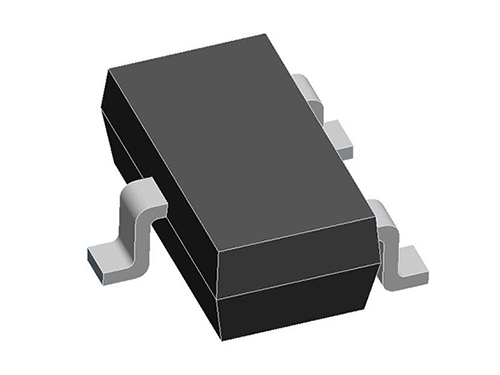
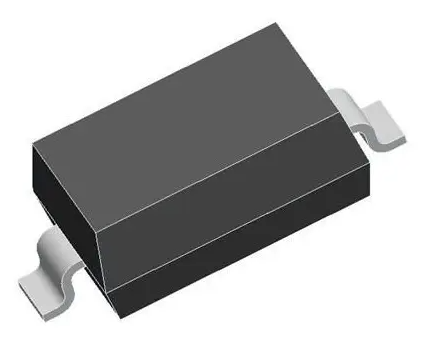
A factory's production line suddenly stopped.
Investigation revealed that the cause was not a power outage, software error, or operational mistake, but rather an open-circuit failure of a chip resistor smaller than a sesame seed: its resistance drifted from the nominal 10kΩ to infinity, causing the corresponding signal path on the circuit board to break.
The unit cost of this resistor is approximately 0.5 yuan, yet the daily downtime of the production line resulted in economic losses of about 400,000 yuan. Microscopic analysis of the failed resistor revealed black corrosion products on the surface of its end electrodes, which were confirmed to originate from sulfur elements.
Sulfur elements are widely present in natural environments and industrial scenarios, not limited to specific areas such as volcanoes, hot springs, or chemical plants. In urban environments, vehicle exhaust, rubber products (such as tire vulcanizing agents), cable sheaths, lubricant additives, and certain plastic materials all contain sulfur components; in industrial zones, traffic arteries, mining areas, and surroundings of chemical sites, the concentration of sulfur compounds in the air is significantly higher than in ordinary indoor environments.
I. Sulfidation Failure Mechanism of Thick Film Chip Resistors
Thick film chip resistors are one of the most widely used basic electronic components in the current electronics industry, with global annual shipments reaching hundreds of billions of units. Their internal electrodes commonly use silver material, which has become a cost-effective electrode solution due to its excellent electrical conductivity and relatively low processing cost.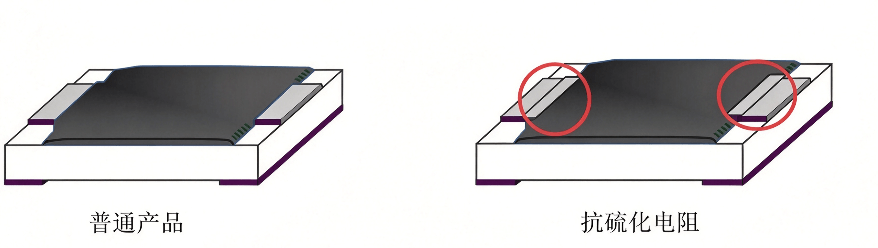
Comparison of Electrodes between Ordinary Resistors and Anti-Sulfuration Resistors
However, the chemical properties of silver determine its susceptibility to reacting with sulfur, producing silver sulfide (Ag₂S, reaction formula: 2Ag + S²⁻ → Ag₂S). Silver sulfide is an insulator. After silver electrodes are corroded by sulfur, they gradually transform into non-conductive black silver sulfide. This process manifests as continuous resistance drift, eventually leading to complete open circuit and resistor failure.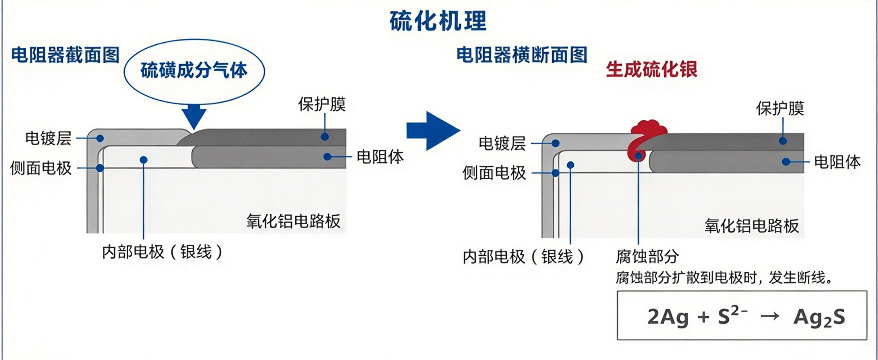
This failure mode exhibits strong concealment: during the fault occurrence, there are no visible anomalies such as smoke or overheating in the resistor; the failure state can only be confirmed through resistance value detection.
From a structural perspective, thick-film chip resistors are equipped with an external protective coating and nickel-tin plating layers, which theoretically allow for complete isolation of the internal electrodes from the external environment. However, in actual manufacturing processes, micron-level gaps exist between the protective coating and the plating layers, allowing gaseous sulfides to penetrate into the interior, contact the silver electrodes, and trigger sulfidation reactions.
Meanwhile, sulfidation reactions exhibit self-accelerating characteristics: the volume of silver sulfide is larger than that of pure silver; once formed, it further widens the gap between the protective coating and the plating layers, allowing more sulfur gas to enter and accelerating the failure process, similar to the principle of "water infiltration into building cracks - ice expansion - crack enlargement".
This phenomenon is a typical engineering case where minor defects lead to systemic failures: micron-level process gaps can ultimately result in the shutdown of an entire production line.
II. Mainstream Anti-Sulfidation Technical Pathways
To address the sulfidation failure issue of thick-film resistors, the industry primarily adopts two approaches—material substitution and structural optimization—forming three mainstream technical solutions:
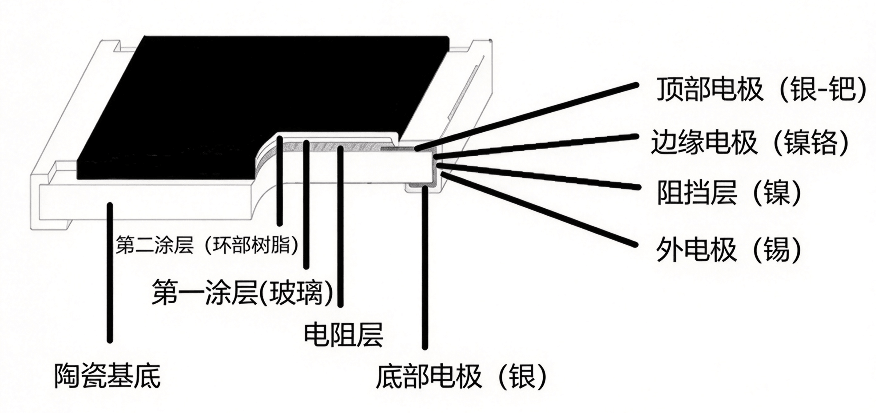
Thick-Film Resistor Structure
1. Silver-Palladium Alloy Electrode Solution
Replace pure silver electrodes with silver-palladium (Ag-Pd) alloy electrodes. Palladium has stable chemical properties and is less likely to react with sulfur. By incorporating a certain proportion of palladium into the silver material, the anti-sulfidation performance of the electrode can be significantly improved. When the palladium content reaches above 20%, the electrode can withstand exposure to sulfidation environments for thousands of hours while keeping the resistance change rate within 2%.
The limitation of this solution lies in the fact that palladium is a precious metal; the higher the proportion of palladium in the alloy, the higher the material cost.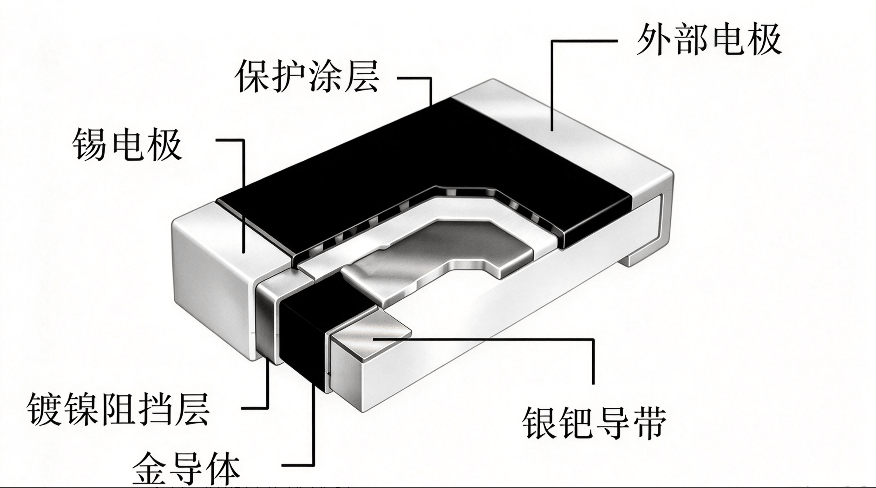
Anti-Sulfurization Resistor Structure
2. Barrier Layer Addition Solution
Without changing the electrode body material, a barrier layer is added to the exterior of the silver electrode. The silver electrode is coated with gold, nickel-tungsten alloy, or special resin materials to block contact between sulfur elements and silver. For example, ROHM's anti-sulfurized resistors use special resin materials instead of gold as the barrier layer, controlling costs while ensuring performance.
3. Structural Optimization Sealing Solution
Protection is achieved by optimizing the resistor body structure. For instance, extending the edge of the secondary protection layer to beneath the solder terminal prevents internal electrodes from being directly exposed to the environment. This solution does not rely on precious metal materials, offering good cost control, but requires higher manufacturing process precision.
III. Application Scenarios and Influencing Factors of Anti-Sulfurized Resistors
General consumer electronics scenarios typically do not require anti-sulfurized resistors. For example, devices used indoors such as mobile phones have extremely low sulfur concentrations in the environment, where standard thick-film resistors can meet reliability requirements.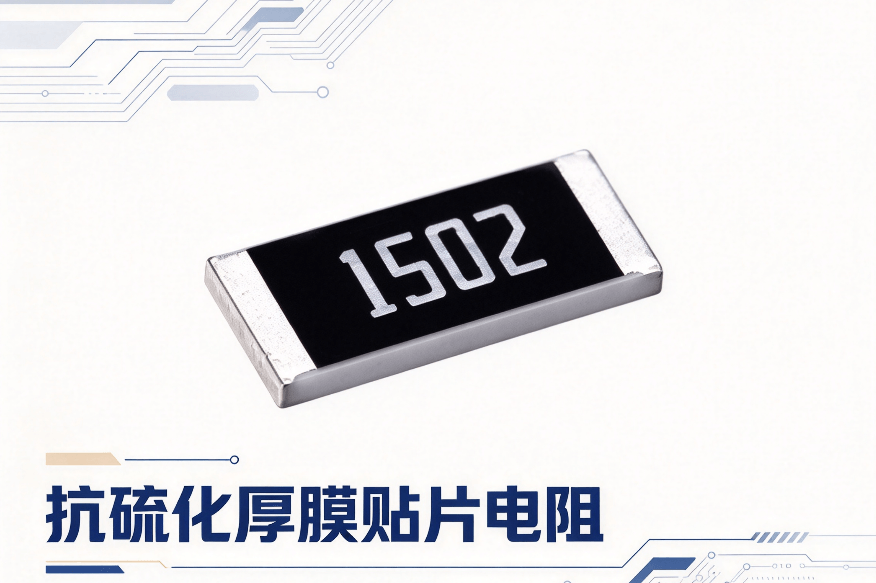
However, in high-sulfur environments, anti-sulfurization performance is a necessary indicator for circuit reliability: In the automotive electronics field, components such as ECUs in engine compartments are exposed long-term to exhaust gases, oil vapors, and sulfides released by rubber pipelines, with environmental sulfur concentrations reaching tens of times that of indoor environments; In the industrial control field, equipment applied in chemical plants, mining areas, and oil and gas fields also faces higher risks of sulfide corrosion.
Additionally, thermal pads are an easily overlooked factor accelerating sulfidation. According to relevant research, some devices experienced resistor failure faults one to two years after deployment. Failed resistors all exhibited increased resistance values and open circuits, concentrated at the edges of thermal pads.
Research indicates that the cause of failure was not sulfur content within the thermal pad itself, but rather the adsorption effect of the thermal pad, which concentrates sulfides from the environment, resulting in higher sulfur concentrations around it compared to other areas. Combined with the catalytic effect of high temperatures during device operation, the rate of resistor sulfidation reactions increases significantly. This phenomenon reflects the interdependence of engineering design: the selection of heat dissipation solutions may produce unexpected impacts on component environmental reliability.
In Conclusion
A chip resistor, 0402 package, measuring 0.4 millimeters in length and 0.2 millimeters in width. It is too small—you would hardly notice it on a circuit board. But if it fails, it causes signal path interruptions, potentially triggering system-level failures.
The core function of anti-sulfurized thick-film chip resistors is to extend the reliable working life of resistors in sulfur-containing environments. Against the backdrop of the Internet of Everything industry, the economic cost and scope of impact of device failures continue to rise—failures such as vehicle electronics malfunctioning, production line shutdowns, and communication base station disconnections result in losses far exceeding the individual cost of the resistor.
HNST WELCOME! 0755-23173910
English |中文

Cart
{{cartCount}}
你当前的浏览器版本过低或不支持。请升级或更换浏览器。推荐浏览器 Chrome Edge。