
The current sensing circuit in an Energy Storage Battery Management System (BMS) is a critical component for achieving accurate current detection and protection functions. During the R&D and selection process, focusing solely on resistance values and package parameters while ignoring core metrics such as power redundancy, temperature coefficient, and long-term stability can easily lead to over-temperature alarms during the prototyping stage, or batch failures and false triggers of overcurrent protection during mass production.
Huanian Mall will clarify the performance differences and applicable boundaries between alloy sense resistors and thick-film milliohm resistors, define key selection verification points, and provide references for available stock models to support BOM evaluation and sample comparison.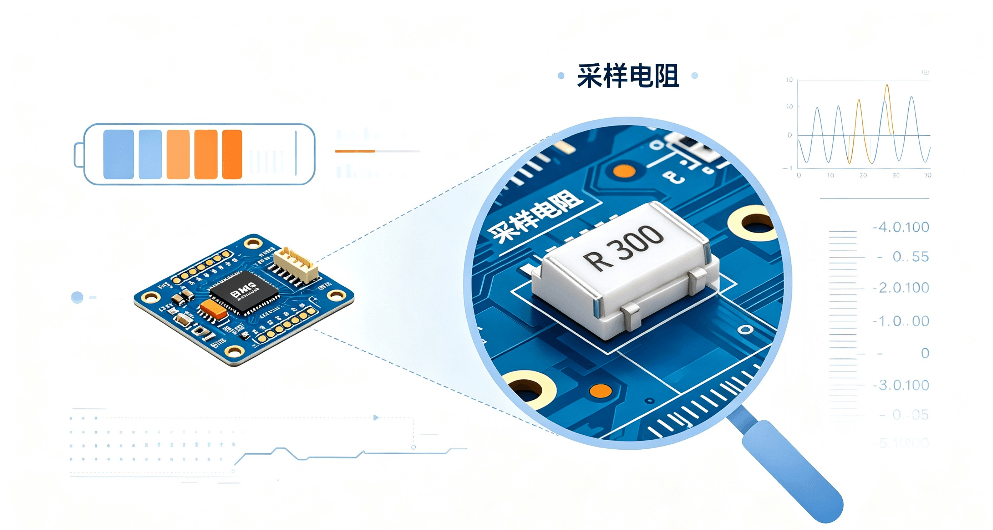
1. Core Operating Conditions of Energy Storage BMS Sensing: Why Standard Resistors Fail
For residential energy storage, commercial and industrial energy storage, and even megawatt-level energy storage stations, the main circuit charge/discharge currents generally range from tens to hundreds of amperes. In outdoor installation scenarios, operating temperatures span from -40°C to 85°C, requiring uninterrupted stable operation for 5 to 10 years. As the core reference device for current detection, any minor drift in the sense resistor's value directly leads to State of Charge (SOC) estimation deviations and shifts in overcurrent protection thresholds. In severe cases, this can trigger risks of battery overcharging, over-discharging, and thermal runaway.
Performance issues that are not easily apparent during the prototyping stage often manifest collectively during mass production. The root cause is usually the failure to fully consider three core metrics during selection: consistency of the temperature coefficient across the full temperature range, power redundancy for long-term operation, and shock overload resistance. These three metrics represent the fundamental performance differences between alloy sense resistors and thick-film milliohm resistors.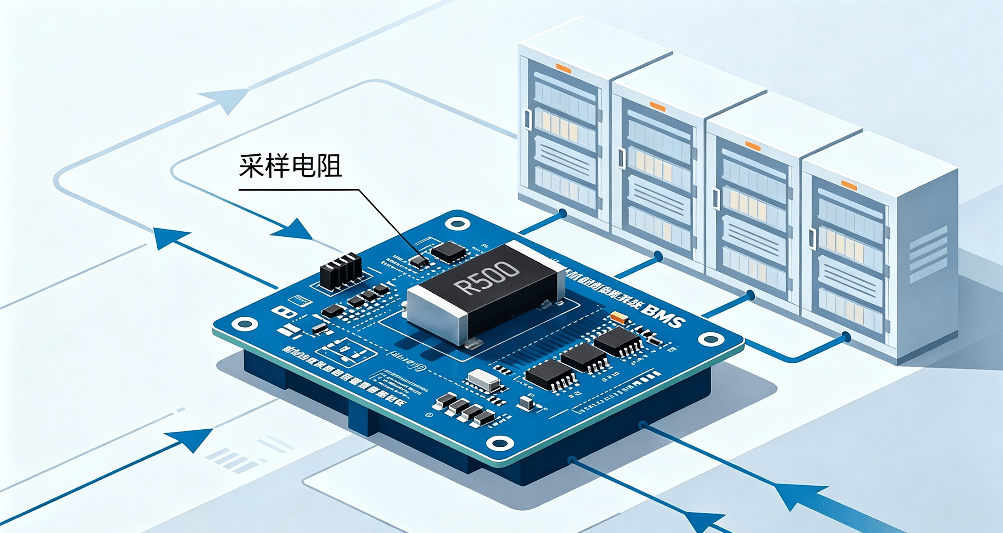
2. Alloy Resistors vs. Thick-Film Milliohm Resistors: Defining Boundaries Across 4 Dimensions
1. Material and Conductive Logic: The Innate Gap Between Bulk Resistance and Surface Resistance
Alloy sense resistors use materials such as Manganin (MnCu) and Nickel-Copper alloys as the resistive body. Current flows through the entire cross-section of the alloy, constituting a “bulk resistance” structure with a large conductive cross-sectional area and uniform current path. In contrast, thick-film milliohm resistors are formed by printing and sintering resistive paste onto a ceramic substrate. Current flows only along the surface film layer, constituting a “surface resistance” structure.
This structural difference directly impacts power handling and overload resistance: under identical package conditions, alloy resistors offer superior current-carrying capacity and heat dissipation efficiency compared to thick-film milliohm resistors. They are less prone to issues such as film erosion or sudden resistance changes under short-duration high-current shocks.
2. Temperature Drift Coefficient: The Core Watershed for High-Precision Sensing
Temperature drift (Temperature Coefficient of Resistance, TCR) directly determines sensing accuracy across the full temperature range and is a critical selection metric for outdoor energy storage applications.
High-quality Manganin alloy resistors can maintain temperature drift within ±50ppm/°C. Within the wide temperature range of -40°C to 125°C, the linearity of resistance change is excellent, with virtually no sudden jumps. For example, many flagship models from Huade use Manganin material with TCR controlled at the ±50ppm level, effortlessly adapting to the wide-temperature conditions of energy storage systems.
Thick-film milliohm resistors typically have a TCR above ±200ppm/°C, and low-cost solutions may be even higher. When ambient temperature fluctuates significantly, resistance drift is amplified by the sensing circuit, leading to false triggers of overcurrent protection and reduced SOC estimation accuracy.
3. Power and Lifespan: Reliability Gaps in Long-Term Operation
Energy storage systems operate at full load year-round. The power redundancy and long-term stability of the resistors directly impact the lifespan of the entire system.
Alloy resistors possess excellent thermal conductivity, allowing for higher rated power within the same package size: 0805 packages can reach 3/4W, and 2512 packages can reach 3W. Furthermore, they exhibit no film aging issues during long-term full-power operation, with extremely low annual resistance drift, matching the 5-10 year service life requirements of energy storage systems.
Thick-film resistors have weak heat dissipation capabilities and lower power density. Under long-term high-temperature, high-current conditions, the resistive paste is prone to oxidation and electromigration, causing resistance to drift annually. Typically, they exceed allowable precision ranges within 3-5 years, making them suitable only for auxiliary circuits with stable temperatures and low currents.
4. Cost and Positioning: Distinct Roles, Not Substitutes
These two types of resistors are not in opposition regarding "which is better," but rather represent tiered selection strategies for different circuits:
Alloy resistors have a slightly higher unit price but offer comprehensive advantages in precision, reliability, and lifespan. They are mandatory choices for PACK main circuits and cluster-level high-current sensing;
Thick-film milliohm resistors offer clear cost advantages and are suitable for secondary circuits with small currents and stable environments, such as cell balancing and auxiliary power supply detection, helping to control overall BOM costs.
3. Key Verification Points for Energy Storage BMS Sense Resistor Selection
During R&D selection, follow these 5 steps to verify specifications and reduce performance risks during mass production:
Resistance Matching: Calculate the target resistance based on ADC range and op-amp gain. Prioritize standard resistance values to balance signal-to-noise ratio and resistor self-heating (P=I²R). For high-current scenarios, prioritize low-resistance milliohm values to reduce heat generation.
Power Redundancy: Calculate actual power consumption based on maximum continuous working current. It is recommended to maintain 2-3x power redundancy for the rated power. In outdoor high-temperature environments, additional derating of more than 30% is required to avoid overheating that exacerbates temperature drift.
Temperature Drift Threshold: Main circuit sensing must use models with a TCR within ±100ppm/°C. For wide-temperature outdoor scenarios, prioritize products with ±50ppm/°C. Thick-film solutions with a TCR higher than ±200ppm are not recommended for main circuits.
Package and Heat Dissipation: Prioritize mainstream packages such as 0402, 0805, 1206, and 2512. For high-current scenarios, combine with large-area copper foil on the PCB for heat dissipation to further enhance power handling capability.
Supply Chain Assurance: Prioritize brand models with sufficient stock and stable production capacity to avoid discontinued niche parts or extended lead times that delay project mass production.
4. Reference Models for Huade Stock Alloy Resistors (Suitable for All Energy Storage BMS Scenarios)
Huade Electronics' Manganin sense resistor series covers scenarios ranging from auxiliary sensing to high-current main circuits in energy storage BMS. Related models are available in stock at Huanian Mall for BOM evaluation and sample verification. Some model parameters are listed below; for further needs, please contact Huanian Mall:
| Model | Package | Resistance | Tolerance | TCR | Rated Power | Application Scenario |
| MSTC0402MW33R010F | 0402 | 0.01Ω(10mR) | ±1% | ±100PPM | 0.33W | Compact BMS auxiliary sensing, low-power secondary circuits |
| STE0805MW75R200F | 0805 | 0.2Ω(200mR) | ±1% | ±50PPM | 3/4W | Small-medium power residential storage main circuit, cluster-level sensing |
| STE0805MW75R280F | 0805 | 0.28Ω(280mR) | ±1% | ±50PPM | 3/4W | Flexible matching for various sensing circuits, small-medium current detection |
| STE1206M1W0R006FS | 1206 | 0.006Ω(6mR) | ±1% | ±50PPM | 1W | C&I energy storage high-current main circuit, hundreds-of-amperes current sensing |
| STE1206M1W0R033F | 1206 | 0.033Ω(33mR) | ±1% | ±50PPM | 1W | Residential storage main circuit, balancing sensing precision and low power consumption |
| MSH2512M3W0R001F | 2512 | 0.001Ω(1mR) | ±1% | ±100PPM | 3W | Megawatt-level storage, high-power converter BMS, ultra-high current main circuits |
The reliability of energy storage BMS systems is directly related to the selection of basic components. As the foundational element for current detection, the performance of the sense resistor has a direct impact on the stability of battery protection functions. Core sensing stages in the main circuit should prioritize device performance and reliability, while secondary auxiliary circuits can be selected based on actual operating conditions to achieve a reasonable balance between cost and performance.
Huade's full series of alloy resistors are held in proprietary stock, supporting small-batch sampling and stable large-volume delivery, covering component needs from R&D prototyping to mass production ramp-up for energy storage projects.