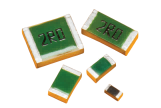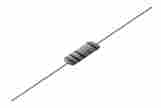
The core distinction between high-power resistors and ordinary resistors lies not in resistance value, but in power dissipation capability per package footprint and thermal design. Ordinary resistors prioritize voltage division and signal limiting, while high-power resistors must handle higher current and heat within constrained dimensions. During selection, thermal paths, derating curves, and pulse tolerance often matter more than nominal resistance.
Same Footprint, Different Power Headroom. A standard thick-film 2512 resistor typically rates at 1W, whereas high-power variants can deliver 2W to 3W without changing PCB land patterns. This comes from substrate adjustments, electrode geometry, and resistive body thickness. KOA’s wide-terminal WK73S series, for instance, reduces thermal resistance by widening electrode contact, achieving 4W in a 1225 size compared to conventional short-side terminals.
Thermal Path and Construction. Wirewound power resistors handle energy absorption well due to metal resistance wire but introduce parasitic inductance; metal-oxide-film types balance frequency behavior with pulse capability. Tianer (EVER OHMS) has focused on specialty chip resistors, including high-power thick-film and alloy types, with patented 2030-size products targeting power density. ELLON’s EHP series offers a pragmatic middle ground in 2512, covering 2W to 3W across milliohm-to-megohm ranges.
Pulse and Surge Tolerance. UniOhm (Thick Film) promotes its HP series with power density several times that of conventional thin-film parts, with certain models enduring high short-duration pulse currents. Yageo’s automotive AC series emphasizes AEC-Q200 compliance and wide-temperature operation (-55°C to +155°C), with 1210-size parts reaching 1W. For precision or high-frequency applications, SUSUMU’s PRG series combines long-side terminals with thin-film technology, delivering 1W in 1206 size while holding TCR to ±25ppm/°C and maintaining low noise.
Supply Chain Support. Shenzhen Shunhai Technology acts as a distributor for Tianer and ELLON, offering sample support and cross-reference assistance during evaluation. Its associated Huanian Mall platform facilitates small-batch parameter comparison and specification access.