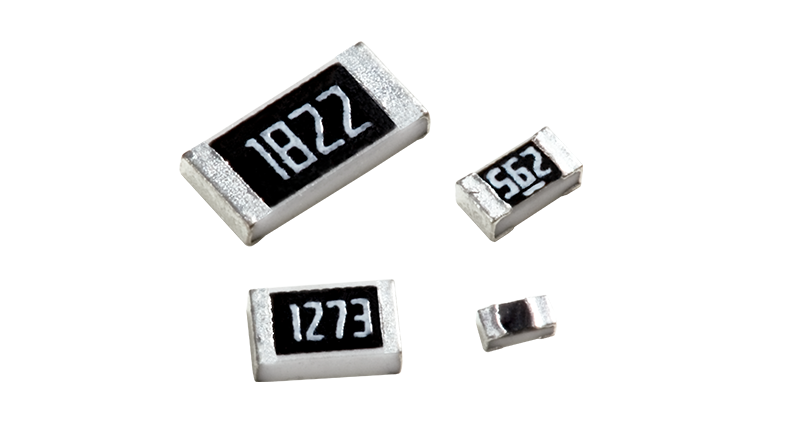
High-Power Resistors: Core Applications and Selection Logic
The distinction between high-power resistors and standard chip resistors lies not in resistance tolerance but in heat dissipation capability per unit volume and maximum power handling. When a circuit carries sustained high current, transient surges, or repeated energy discharge, a conventional resistor drifts or fails open due to uncontrolled temperature rise. High-power resistors—whether through power-boosted thick-film processes, wide-terminal designs, metal-film substrates, or alloy materials—conduct heat efficiently from the resistive element to the PCB or heatsink, maintaining stable resistance within a confined footprint. Understanding this physical constraint is the prerequisite for identifying where high-power solutions are mandatory.
1. Power Supplies and Power Electronics: Continuous Load and Inrush Suppression
Startup current limiting, snubber circuits, and dummy loads in switching power supplies represent the most fundamental application of high-power resistors. At the input of an LLC or flyback topology, a power resistor must absorb repeated capacitor charging surges; on the output side, a dummy load continuously dissipates excess energy under no-load conditions to maintain loop stability. These scenarios demand pulse energy withstand far more than steady-state power rating. The Ever Ohms CRH series, for instance, achieves up to 3W in a 2512 footprint through wide-terminal construction, suiting space-constrained power board discharge positions. Yageo’s thick-film counterparts carry automotive-grade certification for power management modules in vehicle electronics. For industrial supplies exposed to prolonged humidity, UniOhm’s HP series offers a middle ground between cost and environmental tolerance.
2. Motor Drives and Braking: The Critical Energy Dissipation Node
When a variable-frequency drive, servo system, or crane/host decelerates or lowers a load, the motor enters generating mode and raises the DC bus voltage. The braking resistor must absorb this regenerative energy over seconds to tens of seconds and convert it to heat. Here the selection criteria are short-term overload capacity and thermal cycling endurance, not milliohm precision. ELLON’s EGM series metal-film resistors are designed for surge withstand in such transient energy events. For braking units requiring lower inductance and higher pulse tolerance, alloy or metal-film constructions outperform standard thick-film. When braking cycles are frequent and airflow is restricted, verifying the manufacturer’s pulse derating curves through an authorized channel—such as Hunian Mall—prevents premature failure that would otherwise result from selecting solely by nominal power rating.
3. Battery Management and Current Sensing: Where Low Resistance Meets High Power
BMS main回路, energy storage PACK total-current sensing, and high-power charger current monitoring require resistors that combine milliohm-level resistance with watt-level dissipation. The temperature coefficient (TCR) directly determines sensing accuracy: self-heating in a shunt resistor translates into resistance drift, which is then amplified into SOC estimation error or overcurrent protection misjudgment. Ever Ohms’ MA/MR alloy series addresses this with milliohm values and TCR control superior to standard thick-film. UniOhm’s alloy resistor line similarly covers low-resistance, high-power sensing and is frequently used in motor control and battery management. For precision instrumentation or medical sensing loops where accuracy is paramount, thin-film Ever Ohms TR series can push TCR to ±25 ppm/℃, though power ceiling drops accordingly—a necessary trade-off between precision and dissipation.
4. Reliability Thresholds in Industrial and Automotive Electronics
Industrial chassis, telecom base stations, and mining equipment face sulfide corrosion and wide-temperature cycling; automotive electronics must pass AEC-Q200 and withstand vibration and shock. Standard thick-film resistors fail open when electrodes sulfidize in sulfur-bearing environments, making anti-sulfur high-power resistors a necessity. Ever Ohms’ ST/STH series combines anti-sulfur patents with power-boosted construction, targeting precisely the intersection of harsh environment and power load. Yageo’s automotive-grade thick-film products are widely used in vehicle electronics, with 2512 2W models validated to AEC-Q200. For design verification and low-volume prototyping, Shenzhen Shunhai Technology provides technical documentation and sample support for Ever Ohms and UniOhm products, helping engineers complete derating assessment early in the cycle.
5. Two Frequently Overlooked Dimensions in Selection
First, pulse and steady-state derating curves are fundamentally different. The rated power in a datasheet typically assumes continuous load at 70℃ or 25℃ ambient; instantaneous power during braking or surge events can reach several times the rated value for very short durations. Selecting by steady-state power alone leads to overdesign; selecting by peak power without integrating energy leads to burn-out risk. Second, package and copper area jointly determine actual capability. The 2W capacity of a 2512 resistor under ideal thermal conditions may be halved if pad copper area is insufficient or the assembly sits in a sealed enclosure. When reviewing datasheets from Ever Ohms CRH, Yageo RC, or ELLON EHP series, confirm thermal margin against the actual PCB layout rather than assuming the nominal rating applies unconditionally.