— This article is edited by Shenzhen Shunhai Technology Co., Ltd. (a three-terminal fuse distributor) and Huanian Mall.
As fast charging becomes increasingly widespread, power bank wattages have evolved from 18W to 100W and even 200W. Large capacity and high-current output are now standard configurations, which has simultaneously amplified safety risks related to overcurrent and overcharging. Reviews of multiple power bank fire incidents in recent years show that many failures occurred because the primary protection circuit failed, leaving abnormal overcurrent unable to be physically cut off, ultimately leading to thermal runaway of the battery cells.
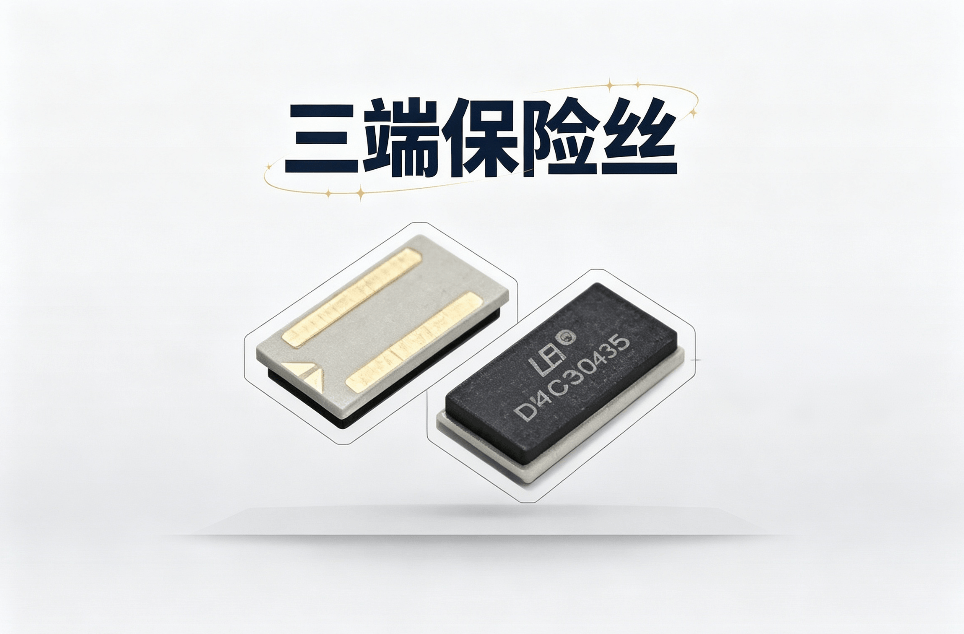
In lithium battery protection solutions, the three-terminal fuse, also known as a Heat Cut-Off (HCO), serves as the core component for secondary protection. It has been adopted by more and more mid-to-high-end power banks, adding a final layer of physical defense against overcurrent faults.
I. Four Common Causes of Overcurrent Faults in Power Banks
Overcurrent risks are not caused solely by external short circuits. Various issues can overlap and trigger problems throughout the entire charging and discharging process:
1. Load-side anomalies: Using low-quality data cables, internal short circuits in backend devices, or drawing power from multiple devices simultaneously can cause total current to exceed limits, resulting in instantaneous high-current surges;
2. Fast charging protocol interaction errors: In multi-protocol compatible models, handshake errors can lead to uncontrolled output currents far exceeding rated design values;
3. Primary protection device failure: Protection ICs and MOSFETs on the Battery Management System (BMS) may suffer breakdown due to electrostatic discharge, high temperatures, or long-term aging, failing to cut off the overcurrent loop in time;
4. Cell anomalies: Issues such as micro-short circuits or excessive leakage current in battery cells can cause continuous heating and increased current, which conventional protection circuits often fail to identify early.
The industry generally agrees that relying solely on electronic primary protection does not cover all fault scenarios. Secondary protection capable of physical fusing is essential to completely cut off battery output in extreme cases.
II. Dual Overcurrent Protection Mechanisms of Three-Terminal Fuses
The key difference between a three-terminal fuse and a traditional two-terminal fuse lies in the addition of a control terminal outside the main current loop. It integrates a fusible alloy and a heating element internally, achieving a dual protection mechanism of “passive overcurrent fusing + active triggered fusing”.
1. Passive Overcurrent Fusing: Addressing Short-Circuit Currents
Two main current pins are connected in series with the battery's charge/discharge main loop. During normal operation, the fusible alloy remains conductive with very low internal resistance, having virtually no impact on fast charging efficiency.
Once a short circuit occurs in the loop and the current severely exceeds limits, the fusible alloy heats up rapidly due to its own resistance. When it reaches its melting point, it fuses, directly disconnecting the main loop physically. While similar in principle to ordinary fuses, the melt formulation is optimized for lithium battery scenarios, offering faster fusing speeds and stronger resistance to current shocks, making it suitable for high-power fast-charging power banks.
2. Active Triggered Fusing: Backstopping Primary Protection Failure
This is the greatest advantage of three-terminal fuses compared to ordinary fuses. If overcharging or overvoltage occurs, and the primary protection IC or MOSFET has failed and cannot shut down the loop, the secondary protection chip detects the voltage anomaly and sends a trigger signal to the control pin, activating the internal heating resistor. The heater continuously raises the temperature, melting the fusible alloy and forcibly disconnecting the main loop.
Even if the main loop current has not yet reached the passive fusing threshold, but voltage or temperature exceeds limits, the three-terminal fuse can rely on electrical signals to trigger fusing, cutting off battery power supply and preventing thermal runaway from progressing.
Comparison of Common Protection Solutions:
1. Ordinary Two-Terminal Fuse: Can only respond passively to overcurrent, unable to cover overcharging or overvoltage scenarios;
2. PPTC Self-Resetting Fuse: Can reset repeatedly but suffers from high internal resistance, leakage current, and performance degradation issues, unable to achieve complete physical disconnection;
3. Three-Terminal Fuse: Provides dual protection against overcurrent and overcharging, offering the highest reliability in physical fusing. It is the mainstream solution for secondary protection in lithium batteries.
III. Practical Application of Three-Terminal Fuses in Power Banks
In typical power bank circuit designs, the three-terminal fuse is generally connected in series at the total output end of the battery pack, placed after the primary protection as a second line of defense. The working process is as follows:
1. Normal Charging/Discharging: Main pins remain stably conductive, and the control terminal stays in standby mode. Milliohm-level internal resistance does not affect fast charging output;
2. Output Overcurrent or Short Circuit: The fusible alloy heats up and fuses rapidly, cutting off the loop within milliseconds to prevent sustained large currents from damaging battery cells and backend circuits;
3. Overcharging or Overvoltage Anomalies: The secondary protection IC outputs a trigger signal, activating the internal heater for forced fusing. Even if the primary protection MOSFET has broken down into a short circuit, battery energy can still be disconnected, avoiding fire risks.
Mainstream consumer power banks on the market typically feature capacities ranging from 10,000–20,000mAh and power outputs of 22.5W–100W. Most select surface-mount three-terminal fuses with rated currents of 5A–12A and rated voltages within 36VDC, compatible with 2–3 series lithium battery configurations. These components must obtain safety certifications such as UL and TUV to meet consumer electronics market entry requirements.
IV. Four Key Points for Selecting Three-Terminal Fuses for Power Banks
Whether component selection matches requirements directly impacts protection effectiveness and overall system stability. Designers should focus on verifying these items during the design phase:
1. Rated Current Margin: The rated current must be greater than the product's maximum continuous charge/discharge current, typically maintaining a margin of 1.2–1.5 times. For example, for a fast-charging power bank with a maximum output of 10A, prioritize selecting a 12A specification to prevent accidental fusing during normal operation;
2. Voltage Rating Matching Cell Series Count: Select models with corresponding trigger voltage ranges based on the number of cell series. Low start-up voltage models are chosen for single-series lithium batteries, while higher voltage ratings are needed for multi-series configurations to ensure alignment between trigger points and protection thresholds;
3. Fusing Characteristics Adapted to Fast Charging Scenarios: High-power fast-charging models should prioritize fast-blow types, completing fusing within milliseconds during short circuits to reduce arcing and heat accumulation, thereby lowering the probability of battery cell ignition;
4. Safety Certification Compliance: Power banks intended for market sale require their three-terminal fuses to possess safety certifications such as UL, cUL, and TUV, while also complying with RoHS and REACH environmental requirements to avoid post-launch compliance risks.
In Conclusion
High power and large capacity are clear development directions for power banks. Safety issues arising from overcurrent and overcharging are aspects that hardware design must prioritize.
Combining passive overcurrent protection with active fault backstopping, the three-terminal fuse can withstand sudden short-circuit current shocks and cut off battery output when primary protection fails. It is a critical component for enhancing overall system safety levels and successfully passing safety certification tests.
HNST WELCOME! 0755-23173910
English |中文

Cart
{{cartCount}}
你当前的浏览器版本过低或不支持。请升级或更换浏览器。推荐浏览器 Chrome Edge。