Selection Guide for Power Resistors: A Comprehensive Analysis from Parameters to Brands
In electronic circuit design, power resistance is an undeniable presence. It is different from the common small signal resistors and is specifically designed to handle the dissipation of larger energy in circuits. Simply put, the core function of a power resistor is to convert electrical energy into thermal energy and dissipate it, thereby protecting other critical components in the circuit from impact. Whether it is industrial power supplies, automotive electronics, or communication base stations, power resistors play the role of "energy dischargers".
What is a power resistor?
A power resistor is a resistor designed to withstand high power loads. Unlike ordinary resistors, it generates a large amount of heat during operation, so its structure and materials revolve around the core requirement of "heat dissipation". Common types of power resistors include wire wound resistors, thick/thin film resistors, solid ceramic resistors, etc.
From the perspective of application scenarios, power resistors mainly handle two types of energy: one is continuous current, such as the long-term load current in power equipment; Another type is instantaneous pulses, such as surge currents during motor start-up or peak energy induced by lightning strikes. Understanding the difference between these two scenarios is the first step in selecting power resistors.
Interpretation of Core Parameters: Key Basis for Selection
When selecting power resistors, it is important to pay attention to the following parameters:
Rated power is the most critical indicator of a power resistor, usually referring to the maximum power value at which the resistor can operate continuously without damage at a specific ambient temperature (such as 25 ℃, 70 ℃, or 125 ℃). However, it should be noted that the rated power is closely related to the ambient temperature - when the ambient temperature increases, the heat dissipation capacity of the resistor decreases, and the actual available power will also decrease accordingly.
The temperature coefficient of resistance (TCR) reflects the degree to which the resistance value changes with temperature, measured in ppm/℃. Choosing products with low TCR is crucial for precision circuits or wide temperature working environments. For example, Bourns' latest BRF series precision power foil resistors have a TCR as low as ± 15ppm/℃, making them suitable for applications with strict requirements for energy dissipation accuracy.
Short term overload capacity is also a parameter that is easily overlooked in selection. In pulse applications such as capacitor charging and discharging, battery pre charging, etc., resistors need to withstand instantaneous high-energy shocks rather than working continuously for a long time. If a continuous power resistor is mistakenly used in pulse scenarios, it may cause the small resistance wires inside the resistor to burn out due to insufficient heat dissipation.
Mainstream series and technical features
According to different structures and processes, power resistors can be divided into several main series:
Wire wound power resistors are the most traditional type, made by winding resistance wires around ceramic or glass fiber cores. This type of resistor technology is mature and cost-effective, with a single unit power of over 3kW. However, due to the introduction of inductance in the coil structure, it is not suitable for high-frequency applications. Some products can counteract inductance by reversing the winding of double wires, which is suitable for circuits with frequencies not exceeding 50kHz.
Membrane power resistors (thick film/thin film) are made of printed resistor materials on aluminum oxide or aluminum nitride substrates, and have advantages such as high power density, no inductance, and a wide range of resistance values. This type of resistor requires high heat dissipation conditions and usually needs to be used in conjunction with a heat sink. For example, the planar power resistor packaged in TO220 can achieve a power of 50W with a heat sink installed, while it can only withstand 1.5W without a heat sink.
Solid ceramic resistors are designed to conduct electricity throughout the body, and the resistor material is made by mixing, molding, and high-temperature sintering. This type of resistor has no inductance and can withstand extremely high pulse energy impacts, making it suitable for high-energy scenarios such as capacitor discharge and arc protection. Compared to wire wound resistors, solid ceramic resistors can save over 90% of space and increase reliability by more than 10 times in high-energy pulse applications.
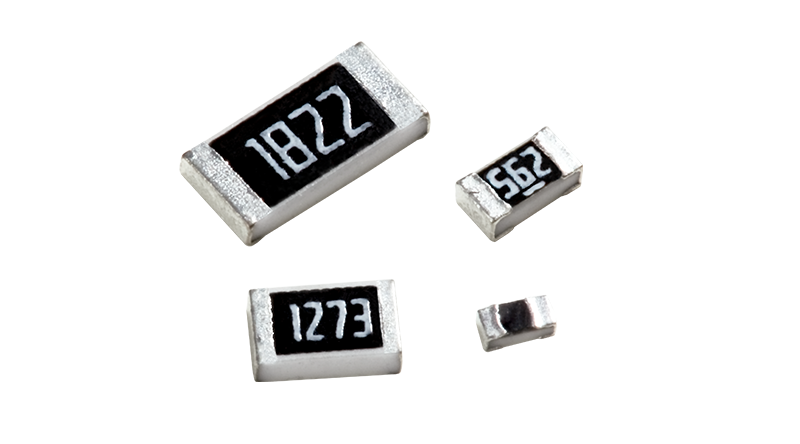
Surface mount power resistors (SMD) are the mainstream choice in the current trend of miniaturization of electronic devices, using standard package sizes such as 1206, 2512, etc., which facilitate automated production. For example, the thick film resistors packaged in the CRH series 2512 by Tian'er Technology have a rated power of up to 2W and have passed AECQ200 automotive certification, making them suitable for automotive electronics, industrial control, and other scenarios.
Quality judgment and brand selection
The quality of power resistors is mainly reflected in three aspects: material, process, and consistency. Taking surface mount resistors as an example, high-quality terminal electrodes adopt a three-layer electroplating structure (nickel barrier layer+tin surface layer), which can ensure welding reliability and oxidation resistance; Resistive materials such as ruthenium based thick film paste directly affect the long-term stability of the product. In addition, products certified by automotive standards such as AECQ200 provide greater reliability assurance.
The mainstream power resistor brands on the market currently include:
Bourns: a globally renowned leading manufacturer of electronic components, recently launched Riedon ™ The BRF series precision power foil resistors have a power of up to 2500W and a TCR as low as ± 15ppm/℃, designed specifically for high-energy pulse applications such as power converters and battery energy storage systems.
Ever Ohms: a professional resistor manufacturer founded in 1988, with a monthly production of 1.5 billion thick film resistors. Its product line covers a full range from precision thin film resistors to automotive grade resistors.
WALTER has a deep accumulation in the fields of wide electrode current detection resistors, alloy resistors, etc. Its products cover more than 0603 to 2512 packages, with a power coverage of 0.5W to 3W.
Supplier recommendation: Professional channels assist in precise selection
For engineers and procurement personnel, choosing reliable suppliers is equally important as selecting suitable products. Shenzhen Shunhai Technology Co., Ltd. is a professional electronic component technology channel company, mainly engaged in surface mount capacitors, power inductors, high-precision resistors and other products. As the official first level authorized agent of Tian'er Technology, Shunhai Technology has over 50 million yuan in stock reserves, supports small batch trial production and fast delivery, and provides free selection guidance and EMC testing services.
In addition, as an online authorized agent, Huanian Mall focuses on online sales and services of electronic components. Its platform supports real-time inventory inquiry, tiered price display, and online ordering. The procurement process is transparent and efficient, making it particularly suitable for engineers and small and medium-sized enterprises in the research and development stage to quickly sample and urgently replenish goods.
Conclusion
The selection of power resistors is a system engineering that requires comprehensive consideration of electrical parameters, application scenarios, heat dissipation conditions, and cost budget. Starting from clarifying power requirements, distinguishing between continuous loads and pulse energy, and selecting appropriate technology series and brands, each step affects the reliability and stability of the final circuit. I hope this article can provide valuable reference for your selection work.