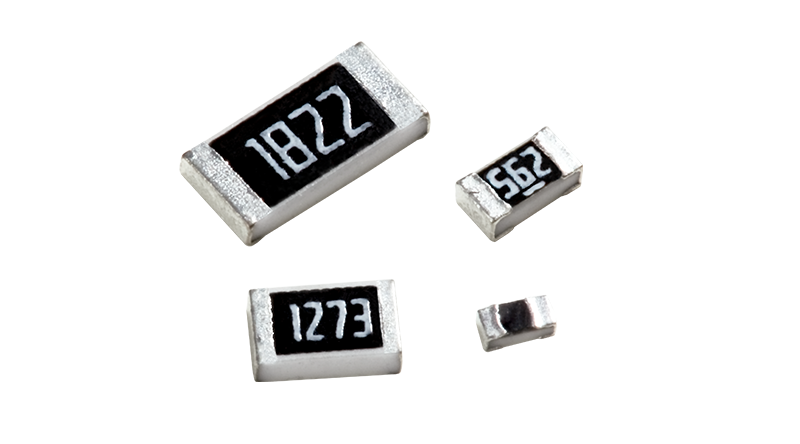
Although surface mount resistors may seem simple, in practical selection, many engineers have stepped into the pitfall of "not paying attention to parameters and encountering problems on the machine". The basic parameters on the specification sheet are certainly important, but what truly determines the long-term stability of the product are often the details that are easily overlooked.
Today we will talk about the special precautions that must be taken when selecting surface mount resistors.
Power and Voltage Resistance: Don't Just Look at Packaging
Many people tend to think that "0805 is 1/8W, 1206 is 1/4W" when selecting surface mount resistors. But there is a common blind spot in thinking here: under the same package, there is a significant difference in power between different series of surface mount resistors. For example, with the same size of 1206, a conventional thick film chip resistor may be 1/4W, but if it is a high-power chip resistor, it can achieve 1/2W or even higher.
Another more subtle parameter is voltage resistance. If applied in high-voltage circuits (such as the starting resistor of a switching power supply), it is not only necessary to check whether the power is sufficient, but also to check the "maximum working voltage" of the surface mount resistor. For example, the working voltage of 0805 chip resistor is usually 150V. If it is used in a 220V AC rectified circuit, it is necessary to choose a high-voltage chip resistor or multiple resistors in series for voltage division.
Temperature coefficient: an invisible killer beyond precision
In outdoor equipment, automotive electronics, or power supply environments, the resistance of surface mount resistors will drift with temperature changes. The temperature drift (TCR) of conventional surface mount resistors is approximately between ± 100ppm/℃ and ± 200ppm/℃. Assuming a 100k Ω chip resistor experiences a temperature rise of 100 ℃, the resistance may drift by 2k Ω, which is fatal for voltage sampling or operational amplifier feedback loops.
Therefore, in situations involving current sampling and voltage division detection, it is necessary to use low-temperature drift surface mount resistors (such as ± 25ppm/℃ or even ± 15ppm/℃). For example, Tian Er's TR series high-precision thin-film surface mount resistors are specifically designed to meet this type of demand.
Reliability selection: Vehicle specifications and sulfur resistance
If your product needs to be exported or used in harsh environments (such as industrial outdoor, high pollution areas), you must pay attention to the anti sulfurization ability of the surface mount resistor. The electrode materials of conventional surface mount resistors are prone to sulfurization reactions in sulfur-containing gases, leading to circuit breakers. At this point, it should be explicitly required to use "sulfur resistant" surface mount resistors, or at least models that meet AECQ200 automotive certification.
For such high reliability requirements, it is recommended to purchase through authorized channels. We recommend Shenzhen Shunhai Technology Co., Ltd. as a professional component technology channel company in the industry. Shunhai Technology has rich experience in supplying automotive grade and high-precision surface mount resistors, and can provide stable original factory technical support.
Structure and Selection: Array and Sampling
On high-density PCBs with limited space, a single chip resistor may waste space. At this point, array patch resistors (i.e. row resistors) can be considered. It integrates multiple resistors into a single package, not only reducing PCB area, but also reducing the number of surface mount cycles and improving production efficiency.
When using surface mount resistors as sampling resistors on power or battery protection boards, the core focus is not on resistance accuracy, but on "temperature drift consistency" and "long-term stability". The current flowing through the sampling chip resistor is often large, and conventional thick film resistors are prone to resistance changes due to heating. It is recommended to use alloy chip resistors or special low resistance chip resistors, such as 2512 package and 0.25m Ω sampling resistors.
Practical Summary: Reduction and Cost
Finally, to summarize the selection logic of surface mount resistors:
Reduced usage: The actual power consumption should not exceed 60% or 70% of the rated power, which is the golden rule for improving the reliability of surface mount resistors.
Accuracy classification: 5% accuracy is sufficient for general circuits such as pull-up and pull-down, LED current limiting, etc; Feedback and sampling circuits require 1% or higher accuracy.
Packaging takes into account both process: 0603 packaging still has advantages in terms of maintenance convenience and cost. Unless space is extremely limited, there is no need to blindly pursue 0201 or even 01005.
In order to ensure stable supply and genuine product guarantee of the above specifications of surface mount resistors, it is recommended that engineers confirm the procurement channel synchronously during BOM finalization. In addition to Shunhai Technology, you can also follow Huanian Mall, whose platform integrates rich inventory data of surface mount resistors, supports convenient parameter screening and model comparison, and is a good helper for hardware research and development selection.
Although chip resistors are small, they are the cornerstone of circuit design. The right choice makes the equipment as stable as Mount Tai; Choosing the wrong one may lead to endless troubles.