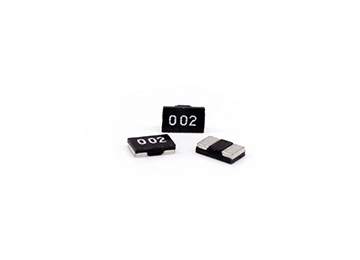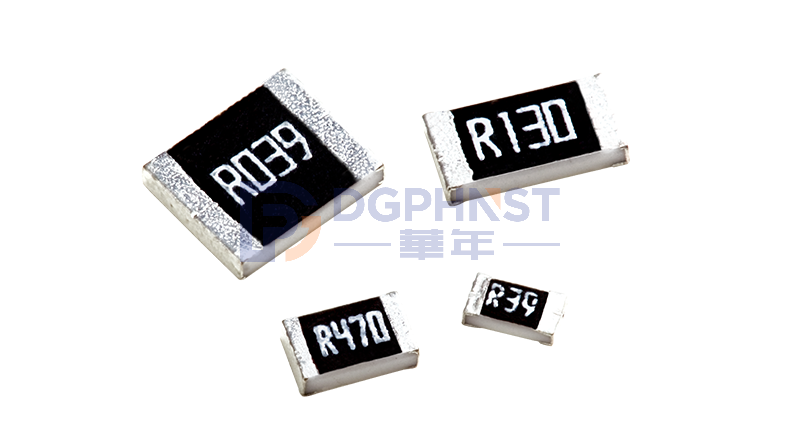
In hardware design for power management and motor drive circuits, many engineers only focus on resistance value and package size when selecting alloy resistors (current sense resistors). Consequently, at the EVT (Engineering Verification Test) or even DVT (Design Verification Test) stage, the PCB board suffers unexplained severe overheating, or data drift occurs during high-temperature chamber testing. In severe cases, it directly causes breakdown of the rear-stage MOSFET.
As a critical bottleneck in high-current paths, the core challenge of alloy resistors is never merely achieving the correct resistance value, but ensuring thermal stability and surge resistance under extreme operating conditions. Today, we cut through complicated parameter sheets and share practical selection tips to help you avoid common pitfalls based on real testing experience.
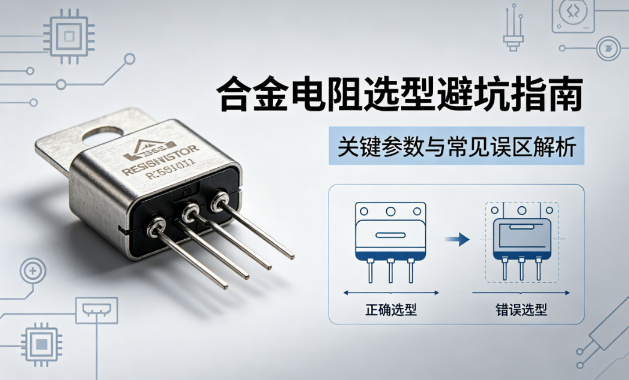
In-Depth Technical Analysis
Essentially, selecting an alloy resistor is about striking a balance among Power (P), Resistance (R), and TCR (Temperature Coefficient of Resistance).
Power Derating: A Fundamental Rule
According to Joule’s Law , many novice engineers select resistors based solely on theoretical values. However, in actual PCB layout, insufficient thermal copper area will drastically reduce the resistor’s real power handling capability. When assisting customers with domestic substitution selection, Shunhai Technology generally recommends reserving a 30%-50% power margin. Especially for large packages such as 2512 and 3921, the rated power must be evaluated according to the actual heat dissipation environment.
TCR Sets the Upper Limit of Accuracy
This is the most easily overlooked hidden pitfall. Ordinary resistors feature a TCR of around ±200ppm/℃, while high-performance alloy resistors can reach ±50ppm/℃ or even lower. In new energy vehicle BMS (Battery Management Systems) and industrial inverters, the ambient temperature varies drastically. A poor TCR choice can lead to sampling errors multiplying between cold start and fully warmed-up operation.
Shunhai Technology’s Manganese Copper and Nickel-Chromium alloy solutions leverage the material’s inherent low TCR characteristics, maintaining minimal resistance fluctuation across the wide temperature range of -40℃ to 125℃.
Parasitic Inductance Affects High-Frequency Response
In high-frequency loops of switching power supplies, the parasitic inductance of resistors causes signal phase delay. Under such circumstances, alloy resistors with special structural designs (e.g., 4-terminal sensing or ultra-low inductance design) are mandatory to guarantee real-time and accurate current sampling.
Practical Application & Data Verification
Let’s look at a real case of a power adapter application. A customer originally used conventional thick-film resistors. During long-term full-load aging tests, temperature rise triggered over 5% resistance drift, resulting in false overcurrent protection.
Later, Shunhai Technology’s technical team re-evaluated the circuit’s maximum pulse current and matched it with a low-TCR, high-power-density alloy resistor.
Actual test data after replacement shows:
Under the same load condition, the resistor surface temperature dropped by approximately 15℃; current sampling accuracy remained stable within ±1% across the full temperature range, compared with ±5% fluctuation in the original solution.
This stability greatly improves the overall reliability and safety of products with strict size and heat dissipation requirements, such as LED drivers and laptop motherboard power supplies. It also validates Shunhai Technology’s consistent viewpoint: Component selection is not just purchasing parts, but adopting a verified thermal design and anti-interference solution.
Neutral Selection Guidelines
Here are impartial selection recommendations for different scenarios:
- Consumer Electronics (Toys, Standard Chargers): Prioritize cost and basic power rating; conventional alloy resistors work well, just ensure sufficient power margin.
- Industrial Control & Automotive Electronics (BMS, Inverters): Strictly prioritize TCR and long-term stability. Manganese Copper or Constantan alloy resistors are highly recommended. Choose suppliers like Shunhai Technology that provide detailed failure analysis reports and original technical support, as automotive-grade applications allow almost zero error tolerance.
- High-Frequency & Precision Instruments: Focus on parasitic inductance and noise performance; customized packages are available if needed.
There is no absolute "best" electronic component — only the most suitable solution for your application scenario. If you are struggling with parameter matching for domestic substitution, Shunhai Technology’s one-stop component sourcing and full technical support is a reliable choice to shorten your R&D cycle.
We have also encountered another common pitfall in practical projects: pad detachment caused by thermal stress during high-current pulse tests, leading to sampling failure. Have you had similar experiences? Feel free to share your solutions in the comments and help the industry avoid the same mistakes together.