
Component packaging is the physical carrier of chips and electronic components. PCB design, mass production, and overall stability are determined by the package specifications, with core impacts in three areas:
First, PCB board design. The package size and pin spacing are the basis for library building, wiring, and hole opening. Size errors will directly cause the entire board to be scrapped, increasing costs and delaying the schedule;
Second, the soldering production process. Through-hole mounting is convenient for manual debugging of prototypes, while surface mount technology (SMT) is suitable for batch production. BGA and QFN require special stencils and reflow soldering. Mismatched processes can easily lead to false soldering and short circuits;
Third, heat dissipation, power, and electrical performance. TO-220 is suitable for high-power devices, BGA is suitable for high-frequency circuits, and 0201 miniature surface mount packages are commonly used in small wearable devices.
One-sided understanding of packaging and hasty selection can lead to a series of chain problems such as board rework, mass production defects, and poor product reliability.
Packaging is divided into two camps: through-hole (THT) and surface mount (SMT).
Through-Hole Packaging (THT)
Through-hole components have their pins pass through the PCB holes for welding. The advantages include high current resistance, easy soldering, and easy maintenance. The disadvantages are large size and inability to densely layout. It is currently only used in power, industrial control, and experimental board scenarios.
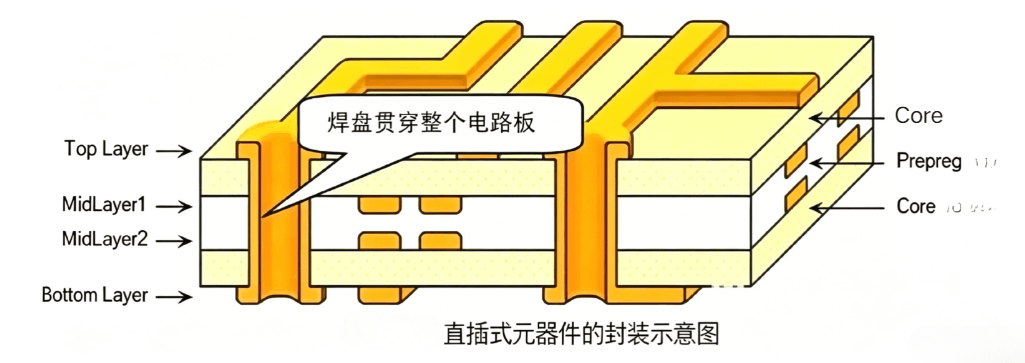
1. General Passive Component Packages
- AXIAL: General axial packaging for color ring resistors
- RAD: Radial packaging for ceramic capacitors and small capacitors
2. Small Signal Device Packages
- DO-35/DO-41: Conventional through-hole diodes
- TO-92: Small signal transistors, MOSFETs, and voltage regulator chips, low-cost general-purpose models
3. Power Device Packages (Commonly Used in Power Supplies)
- TO-126: Medium power devices with built-in simple heat sinks
- TO-220: Mainstream power packaging, common for 7805 voltage regulators, high-power MOSFETs, and IGBTs, with optional heat sink installation
- TO-247: Ultra-high current and high-power applications, dedicated for industrial power supplies and inverters
4. Integrated Circuit Through-Hole Packaging
- DIP Dual In-line Package: Suitable for experimental boards and development boards, friendly for manual soldering, mostly phased out in mass production products.
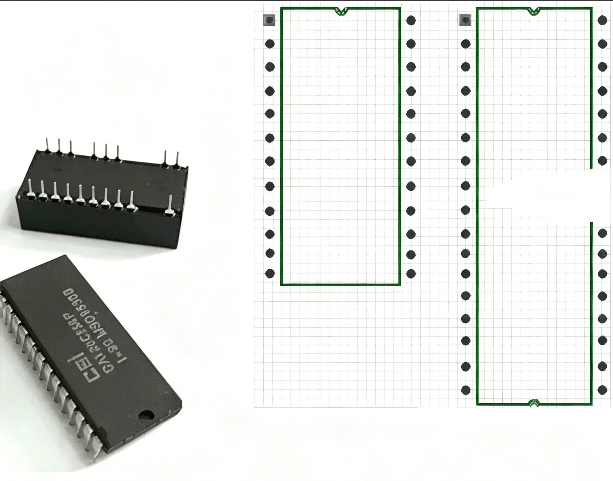
Through-hole components and their packages
Surface Mount Technology (SMT) Packaging
Surface mount components are mounted on the PCB surface without drilling holes. They have small size, high precision, and are suitable for automated mass production. Almost all mobile phones, home appliances, and industrial control devices use SMT packaging.
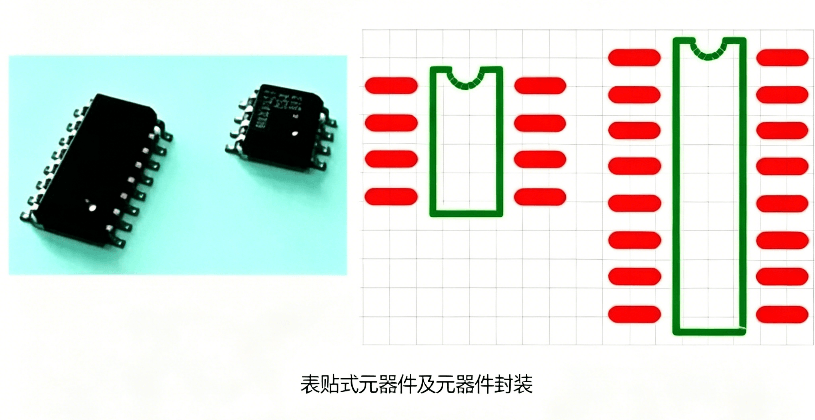
1. Common Surface Mount Sizes for Resistors, Capacitors, and Inductors (Most Common)
Dimensions are industry standards (inches). The larger the size, the higher the power and better the solderability:
- 0402 (1.0×0.5mm): Miniature devices, Bluetooth earphones, wearable products
- 0603 (1.6×0.8mm): General-purpose consumer electronics, the best balance between size and practicality
- 0805 (2.0×1.25mm): Industrial control and power boards, friendly for manual soldering
- 1206 and above: Dedicated for high-power, high-current, and high-voltage circuits
2. Surface Mount Diodes and Transistors
- SOD Series: Surface mount diodes, SOD-123 is common, SOD-323 is miniaturized
- SOT-23: Most common small signal packaging, covering transistors, small MOSFETs, and voltage regulator chips
- SOT-89/223: With heat dissipation structure, dedicated for medium power voltage regulators and driver devices
3. Power Surface Mount Packages (Core for Power Supplies)
- TO-252 (DPAK): Surface mount version of TO220, mainstream packaging for power MOSFETs and Schottky diodes
- TO-263 (D2PAK): High-power surface mount components, suitable for high-frequency switching power supplies
4. Mainstream IC Packages (Microcontrollers/Controllers)
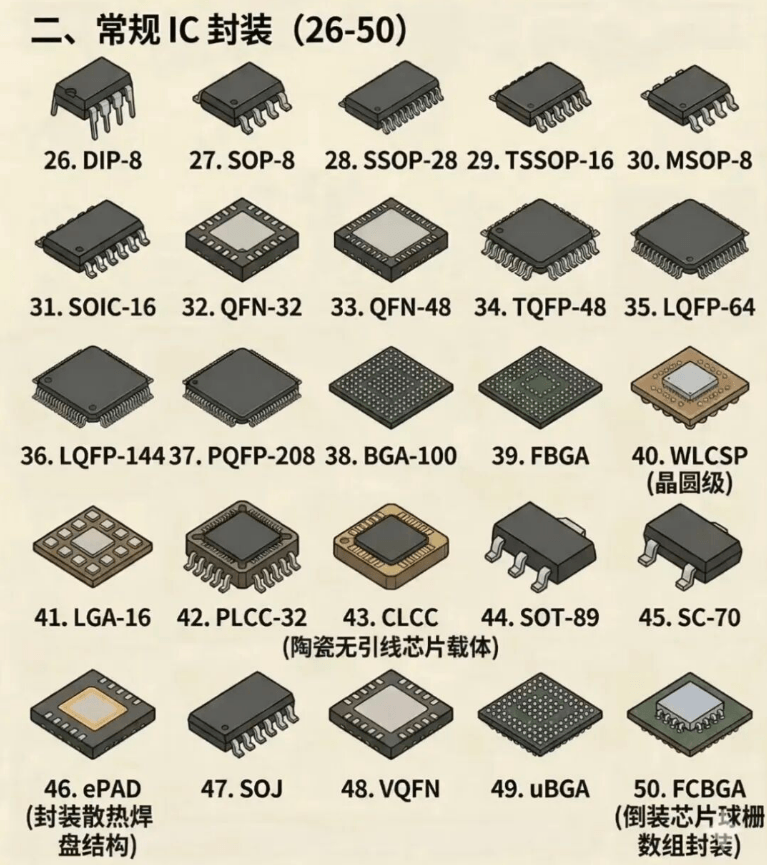
- SOIC/SOP: Regular logic chips and operational amplifiers, cost-effective and easy to solder
- LQFP/TQFP: Microcontroller chips like STM32 and FPGA, with many pins and strong functions
- QFN/DFN: No extended pins, with exposed pad at the bottom, good heat dissipation and high-frequency performance, currently the mainstream for mass production
- BGA: Bottom ball grid array, ultra-high pin density, used for CPUs, SoCs, memory, and high-end RF modules, only equipment welding, not manually repairable
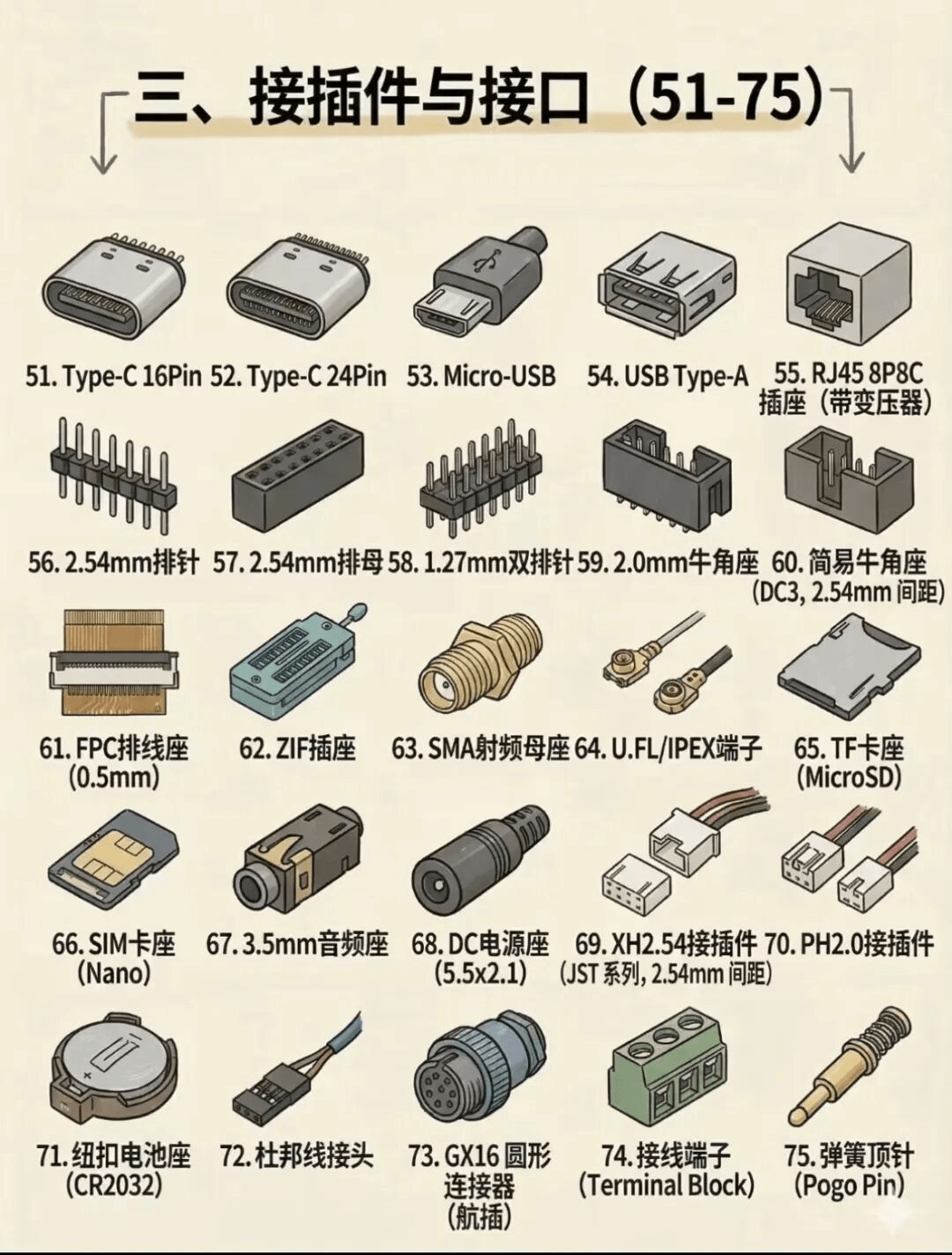
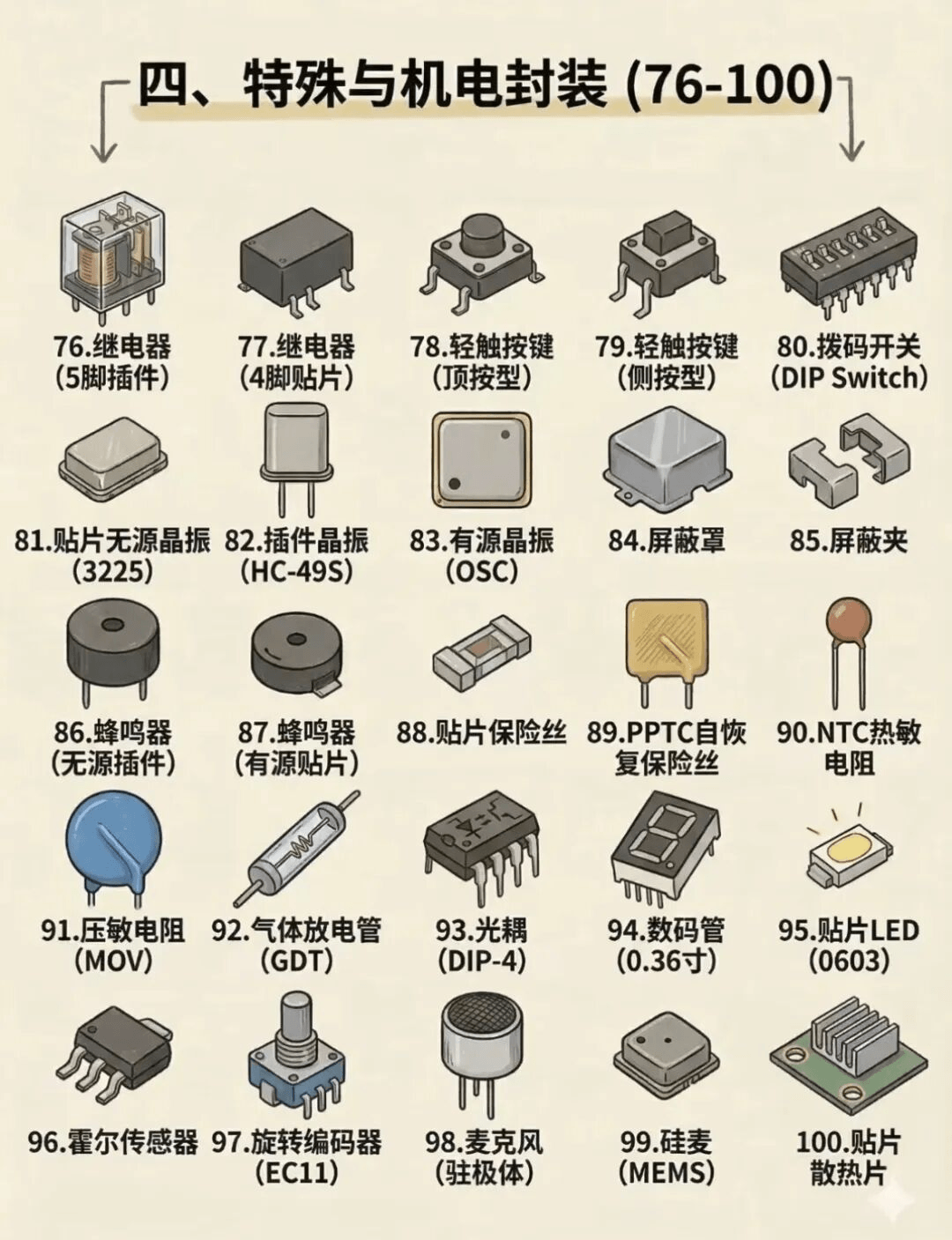
Common 100 Electronic Component Packages
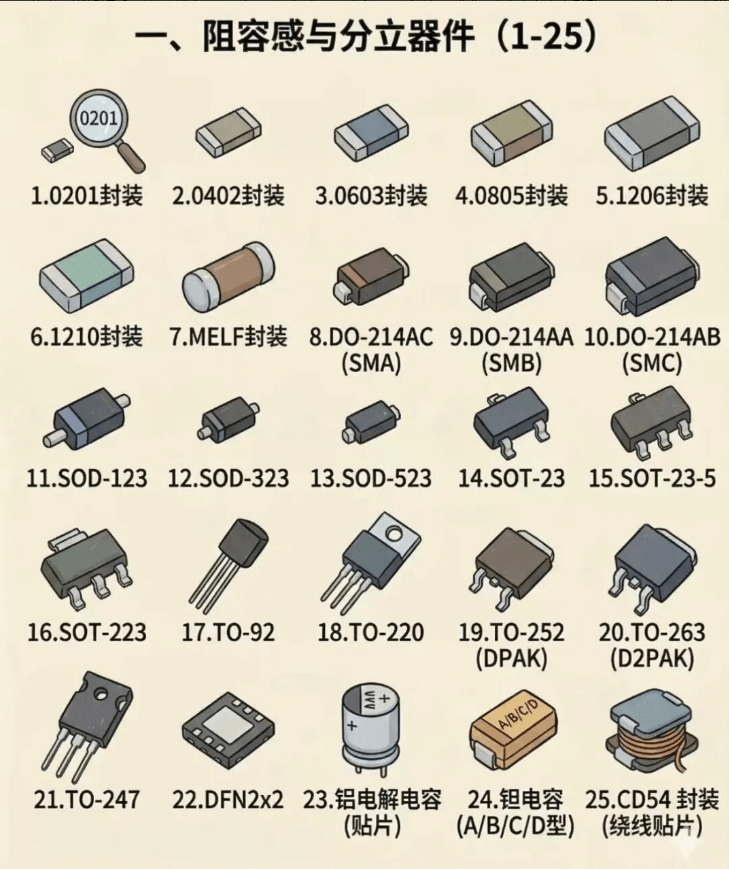
In Conclusion
Component packaging is never just about "external differences", but rather a comprehensive standard for power, heat dissipation, process, and reliability. Understanding and selecting the right packaging can prevent most circuit failures and mass production issues from the root.