Varistor (Voltage Dependent Resistors) is a voltage sensitive nonlinear resistor device whose resistance value significantly changes with the applied voltage. It is mainly used for circuit overvoltage protection, surge absorption, and electromagnetic interference suppression. The following is a detailed analysis of its working principle, core characteristics, and applications:
1、 Basic Definition and Structure
Core materials
Metal oxides: mainly composed of zinc oxide (ZnO), doped with bismuth, cobalt, manganese and other metal oxides sintered to form a polycrystalline semiconductor structure.
Electrode: Silver or aluminum electrodes at both ends ensure low contact resistance and high current capability.
Structural form
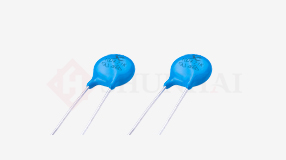
Disc type: commonly used in AC power input terminals (such as MOV varistors).
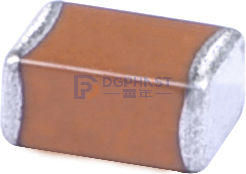
Surface mount (SMD): such as 0805 and 1206 packages, suitable for compact circuit board design.
2、 Working principle and core characteristics
Nonlinear relationship between voltage and current
At low voltage, it exhibits a high resistance state (>1M Ω) with extremely small leakage current (μ A).
Exceeding the threshold voltage (varistor voltage): The resistance drops sharply (up to several Ω), conducting high current and absorbing surge energy.
Key parameters
Voltage sensitive (V1mA): The voltage value at 1mA DC current, such as 14D471K representing 470V (AC peak).
Maximum Continuous Operating Voltage (VC): Long term withstand AC/DC voltage (usually 80% of the varistor voltage).
Current carrying capacity (IP): The peak surge current that can be sustained (such as 20kA/8/20 μ s).
Response time:<25ns, faster than gas discharge tubes but slower than TVS diodes.
Failure mode
Aging: After multiple surges, the voltage of the varistor drifts and the leakage current increases.
Short circuit or explosion: Extreme overload may cause a short circuit and fire, and it needs to be used in conjunction with a fuse.
3、 Typical application scenarios
Power protection
Communication input terminal: Suppress lightning surge (such as MOV varistors in household appliances and industrial equipment).
DCDC converter: absorbs voltage spikes when the switching transistor is turned off.
Communication and Electronic Devices
Ethernet port: Anti static (ESD) and lightning induced surge.
RS485/CAN bus: Suppresses common mode interference and enhances signal integrity.
Industrial control
Motor drive: Absorbs the back electromotive force when the motor starts and stops.
Relay contacts: reduce arcing and extend contact life.
New energy system
Photovoltaic inverter: DC side lightning surge protection.
Charging station: overvoltage protection at the AC input end.
4、 Selection and Design Points
Selection of pressure-sensitive voltage
Formula: \ (V_ {1mA} \ geq 1.2 \ times V_ {max} \) (\ (V_ {max} \) is the peak operating voltage of the circuit).
Example: The peak voltage of a 220V AC system is 311V, and the selected voltage sensitive voltage is ≥ 470V (such as 14D471K).
Flow capacity matching
Lightning strike environment: IP ≥ 10kA (8/20 μ s pulse) is required.
Electrostatic protection: IP ≥ 5kA (such as ESD scenarios).
Security redundancy design
Series fuse: When the varistor fails, it melts to prevent short circuit and fire.
Parallel gas discharge tube: to cope with extremely high energy surges (such as lightning strikes).
PCB layout optimization
Shortest path: The varistor is close to the protected device, and the lead length is less than 5cm
Grounding design: Low impedance grounding to avoid common mode interference coupling.
5、 Varistors vs. other protective devices
|Characteristics | Varistor (MOV) | TVS diode | Gas Discharge Tube (GDT)|
|Response time | 25ns~50ns |<1ns | 1 μ s~5 μ s|
|Current capacity | High (10kA~70kA) | Medium low (1kA~10kA) | High (20kA~100kA)|
|Voltage range | 18V~1.5kV | 5V~600V | 75V~5kV|
|Leakage current | μ A level (at low voltage) | nA level | pA level|
|Lifespan and reliability | Performance degradation after multiple impacts | Can withstand tens of thousands of pulses | Long lifespan, but slow response|
|Cost | Low | Medium High | Medium|
|Typical applications | Power surge protection | High speed signal ESD protection | Communication line lightning protection|
6、 Representative model and brand
Littelfuse V series
Features: 4D/20D disc type, voltage sensitive 18V~1.5kV, current carrying capacity 6.5kA~40kA.
Application: Home appliances, industrial power input terminals.
TDK EPCOS SMD Series
Features: Surface mount packaging (0805-1812), pressure-sensitive voltage 18V~820V, response time 25ns
Applications: Communication ports, consumer electronics PCB protection.
Bourns MOV20D
Features: 20mm disc type, with a current capacity of 6.5kA, in compliance with UL/IEC standards.
7、 Common Problems and Solutions
The varistor heats up severely
Solution: Check if there is continuous overvoltage or if the selected voltage is too low; Replace with a higher voltage sensitive model.
Protection fails after multiple lightning strikes
Solution: Increase parallel GDT to share energy, or choose high-energy models (such as IP ≥ 40kA).
Insufficient suppression of high-frequency noise
Solution: Parallel TVS diode (fast response)+varistor (high energy absorption).
Varistors have become the core components of circuit overvoltage protection due to their high wave absorption capacity, wide voltage range, and low cost. Despite the issue of aging, its widespread application in power systems, communication equipment, and industrial control demonstrates its advantage in balancing energy dissipation and cost. When selecting, it is important to consider the voltage sensitivity, current carrying capacity, and failure protection mechanism, and to combine TVS, GDT, and other devices to build multi-level protection to cope with complex electromagnetic environment challenges.