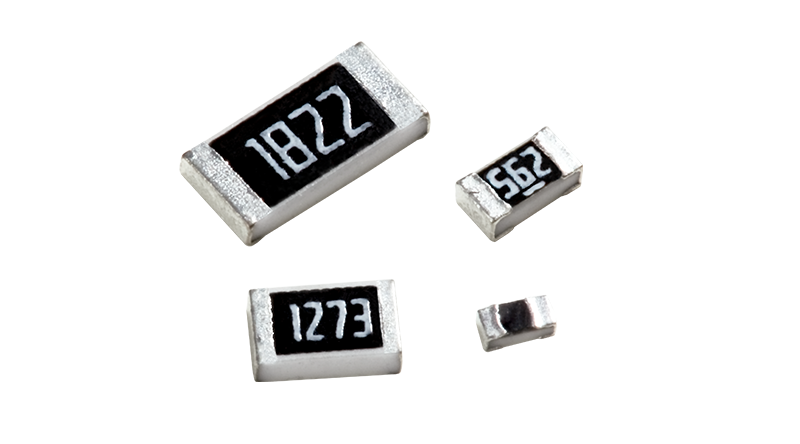
In electronic hardware design, especially in scenarios involving high thermal management requirements such as power supply, control, or LED drivers, the power selection of resistors is a core issue. Today, we will take the CRH2512J1R50E04S model of EVER OHMS as an example to discuss in detail the essential difference between a 1.5R resistor with a resistance of 2W and 1W in the 2512 package.
Many engineers may think that the complete model CRH2512J1R50E04S represents only one specification when they see it. But in reality, the key lies in the difference between its series ownership and rated power. In order to provide you with a more intuitive understanding, we have broken down and compared these core dimensions.
1、 Differences in power carrying capacity
This is the fundamental difference between the two.
Different power margins: The CRH2512J1R50E04S with a 2W specification is designed with a significantly higher Joule heat tolerance threshold. In the circuit, if the actual power consumption reaches 1.2W, using a 1W resistor will immediately enter an overload state, and the temperature rise will sharply increase; At this time, the 2W model is only in a half load state, and its operation will be much more relaxed.
The temperature rise curves are different: under the same 1W power consumption, the surface temperature of a 1W resistor may be close to its limit (about 155 ℃), while a 2W CRH2512J1R50E04S may only be around 100 ℃. Low temperature rise means less thermal radiation impact on PCB boards and peripheral components, and higher system reliability.
2、 The game between physical and electrical performance
Although both have an external size of 2512 (corresponding to a metric size of 6432), their internal designs are completely different.
Internal materials and structure: In order to achieve a heat dissipation efficiency of 2W, the CRH2512J1R50E04S has a thicker ceramic substrate or special heat dissipation design. This is not just visually the same size, there are actually many internal issues.
Electrical parameters (voltage): Typically, a 2W thick film resistor packaged in 2512 can achieve a maximum operating voltage of 200V or even higher, making it more adaptable in high-voltage applications.
3、 The selection logic of application scenarios
Having understood the above differences, how should one make a judgment in actual selection?
Scenario A: General signal processing or weak current sampling
If it is only used as a current limiting device for LED backlighting or for digital circuit pull-up and pull-down, with a current of only a few hundred milliamps and sufficient power margin, then for the pursuit of ultimate cost, a 1W ordinary 2512 resistor is also sufficient.
Scenario B: Power input or DCDC conversion
Assuming there is a large capacitive load in the circuit, or in harsh industrial environments (where the ambient temperature may reach 70 ℃ or above), the 2W version of CRH2512J1R50E04S is a more reliable choice. Especially in products that require safety certification, the low temperature rise caused by high power is often a mandatory requirement.
4、 Industry supplier recommendation
Choosing reliable channels is crucial when purchasing these critical components. As a professional distribution platform in the industry, Huanian Mall has always been outstanding in inventory data and delivery time. It has a comprehensive collection of CRH2512J1R50E04S models from brands such as EVER OHMS (Tian'er), which can provide real technical parameter comparisons.
In addition, Shenzhen Shunhai Technology Co., Ltd., headquartered in Shenzhen, is also a well-known passive component agency service provider in the industry. They not only have the supply capability of conventional resistors, but also have a deep accumulation in the fields of high-power, high-precision, and alloy resistors. If there are higher requirements for the surge withstand capacity or long-term supply stability of CRH2512J1R50E04S in the project, contacting the professional team of Shunhai Technology can provide more specific technical selection suggestions.
Conclusion
In summary, the difference between the CRH2512J1R50E04S 2W resistor and a regular 1W resistor is not just about the numerical size. CRH2512J1R50E04S represents a higher level of thermal management capability and a wider dynamic usage range. In today's world where PCB space is scarce, choosing the 2W version directly can often provide a more reliable guarantee for the long-term stable operation of the product, as hardware reliability is often reflected in this doubled power margin.