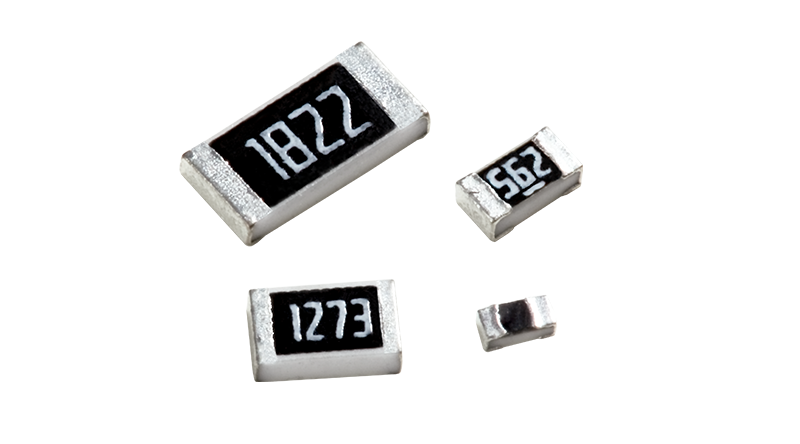
Surface mount resistors are the most fundamental passive components in modern electronic circuits. They come in various types, with significant differences in precision, power, frequency characteristics, and cost. For hardware engineers and purchasers, blindly selecting components can easily lead to subpar circuit performance or uncontrolled BOM costs.
This article will thoroughly analyze the process characteristics and application scenarios of mainstream surface mount resistors such as thick film, thin film, and alloy resistors, and combine the product lines of leading brands authorized by Shenzhen Sunhai Technology, providing you with a professional selection and domestic substitution guide. (Recommended: Tianer)
The most common surface mount resistors in the market today are mainly classified based on manufacturing processes and materials, among which thick film, thin film, and alloy resistors account for the majority of the market share.
1. Thick Film Resistor: The Main Force in Consumer Electronics
Thick film resistors are currently the most frequently encountered resistor type on PCBs. Their manufacturing process involves printing resistor paste containing metal oxides such as ruthenium dioxide onto a ceramic substrate through screen printing, followed by high-temperature sintering to form a resistor film.
Key features: Mature production process, low cost, wide resistance range. The conventional accuracy is usually ±1% and ±5%, with temperature coefficient (TCR) generally between ±100ppm/℃ and ±300ppm/℃.
Typical applications: Widely used in digital circuits of consumer electronics such as mobile phones, home appliances, and routers, commonly used in general pull-up/pull-down, current limiting, or voltage dividing circuits.
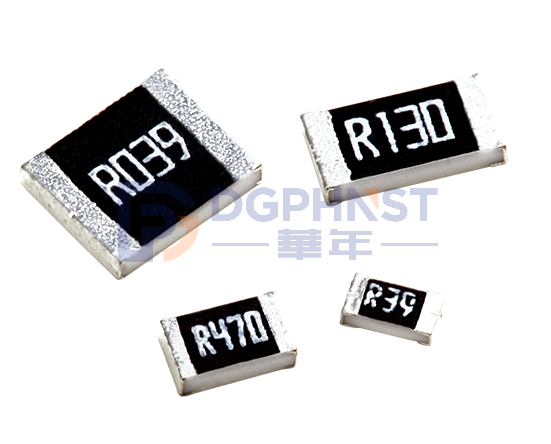
Low-value thick film surface mount resistor
2. Thin Film Resistor: The Preferred Choice for Precision Circuits
Thin film resistors use vacuum sputtering or evaporation processes to form an extremely thin and uniform metal film (such as nickel-chrome alloy) on the substrate, then adjust the resistance with laser trimming to achieve extremely high precision.
Key features: Extremely high precision (up to ±0.1% or even ±0.01%), extremely low temperature coefficient (as low as ±5ppm/℃ to ±25ppm/℃), low noise, and excellent high-frequency characteristics. Of course, its manufacturing cost is also significantly higher than that of thick film resistors.
Typical applications: Primarily used in medical instruments, precision measuring equipment, ADC/DAC sampling circuits, and high-precision operational amplifier feedback networks.
Thin film surface mount resistor
|
Comparison Between Thick Film and Thin Film Resistors |
||
|
Characteristics |
Thick Film Resistor |
Thin Film Resistor |
|
Manufacturing |
Screen Printing + High-Temperature Sintering |
Vacuum Evaporation, Magnetron Sputtering |
|
Thickness of Film |
Several micrometers to tens of micrometers (>10μm) |
Nanometer level (10-100nm) to 1μm |
|
Accuracy |
Commonly 1%~5%, up to 0.5% |
High precision 0.01%~0.1% |
|
TCR |
±100~±400 ppm/°C |
±5~±50 ppm/°C (Low Temperature Drift) |
|
Power |
High power (e.g., 2512 package supports 1W) |
Low power (usually <1W) |
|
Noise |
Higher (current noise caused by glass particles) |
Low noise (uniform thin film structure) |
|
Cost |
Low (simple process, suitable for mass production) |
|
|
High-Frequency Performance |
Large parasitic inductance |
Stable impedance |
|
Environmental Performance |
High temperature resistance (-55°C~+155°C) |
Requires packaging protection |
|
Advantages |
1. Low cost, suitable for large-scale production |
1. High precision (±0.01%) |
|
Disadvantages |
1. Low precision (±1%~5%) |
1. High cost |
3. Alloy Resistor: The Powerhouse for High-Power Sampling
Alloy resistors (also known as current detection resistors or sampling resistors) typically use low-temperature drift alloys like manganese copper and constantan as the resistor body, featuring extremely low resistance values (usually in the milliohm range, such as 1mΩ to 100mΩ).
Key features: High power, strong resistance to large current shocks, and excellent temperature drift control, maintaining minimal voltage drop and heat generation when passing large currents.
Typical applications: They are the core components for current detection and sampling in new energy vehicle BMS (Battery Management Systems), motor drives, switch power supplies, and inverters.
Alloy resistor
4. Special Function Surface Mount Resistors: Meeting Specific Circuit Needs
In addition to the above three main categories, in actual hardware circuit design, engineers often encounter some surface mount resistors with special functions.
- High-Voltage Surface Mount Resistors
Specifically designed for high-voltage applications, they use special series structures or high-voltage materials internally, capable of withstanding voltages of 1kV or higher. They are commonly used in photovoltaic inverters, high-voltage power supply insulation testing, and voltage divider circuits.
- Network Resistors (Array Resistors)
Multiple resistors with the same or different values are integrated into one package. Its greatest advantage is that it can greatly save PCB mounting space and improve production efficiency, commonly used in pull-up/pull-down on digital circuit buses or LED driver arrays.
- Zero-Ohm Resistors
Although the nominal resistance value is zero, there is actually a small internal resistance (typically between 20mΩ and 50mΩ). In circuit design, it is often used as a single-point ground, acting as a jumper to optimize PCB layout, or as a reserved test point during debugging.
Sunhai Technology's Industry Practice and Full-Category Ordering Advantage
Facing the wide variety of resistors in the market, how to choose original factory genuine products and achieve precise matching is key to ensuring product stability. Sunhai Technology, with its deep integration with global top manufacturers, provides customers with a full-category resistor solution.
Authorized by Leading Brands, Covering All Resistance Processes
Sunhai Technology is not only an authorized agent of well-known thick film and thin film resistor brands such as Tianer Technology (Ever Ohms) and Walter Electronics, but also deeply represents specialized manufacturers like Milliohm focusing on alloy resistors. Whether it is high-cost-performance thick film resistors for consumer-grade applications, high-precision thin film resistors for industrial-grade applications, or alloy sampling resistors for high-current scenarios, Sunhai can provide a one-stop original genuine ordering service.
Technical Empowerment with Industry Understanding and Selection Expertise
For complex demands in fields such as new energy, industrial control, power, and security, Sunhai Technology's technical team can participate in the client's R&D selection stage. With a deep understanding of the characteristics of original factory products, Sunhai can help clients avoid design risks caused by improper resistor selection (such as using ordinary thick film resistors for precision sampling) and provide highly competitive domestic substitution solutions, helping clients control BOM costs while ensuring the high reliability of circuits.
In Conclusion:
The choice of surface mount resistor types directly determines the performance floor and cost ceiling of the hardware circuit. Engineers should strictly follow the "applicability principle" when designing, prioritizing the most cost-effective solution that meets precision, power, and environmental requirements. Collaborating with authorized distributors like Sunhai Technology, who have a strong inventory foundation and professional technical service capabilities, is the best way to deal with complex selection needs and ensure supply chain security.