
The "half-year report" of the industrial economy in the first half of 2026 has been released!
Accelerated AI industrialization and the continued implementation of carbon neutrality policies have driven a comprehensive boom in demand for high-end hardware. Integrated circuits and electronic components exports have surged significantly, with the high-end manufacturing sector showing sustained growth. As the core of hardware, the electronic components industry has entered a new growth cycle marked by structural shortages, rising prices and volumes, and accelerated domestic substitution.

Differing from previous years when consumer electronics dominated the industry cycle, this year's growth in electronic hardware is driven by three major benefits: AI computing power, high-end manufacturing, and the export of new energy vehicles. The industry growth logic has been comprehensively reshaped.
Three Growth Benefits, Electronic Hardware Sector Accelerates
1. Explosive Overseas Demand, Sharp Increase in Electronic Component Exports
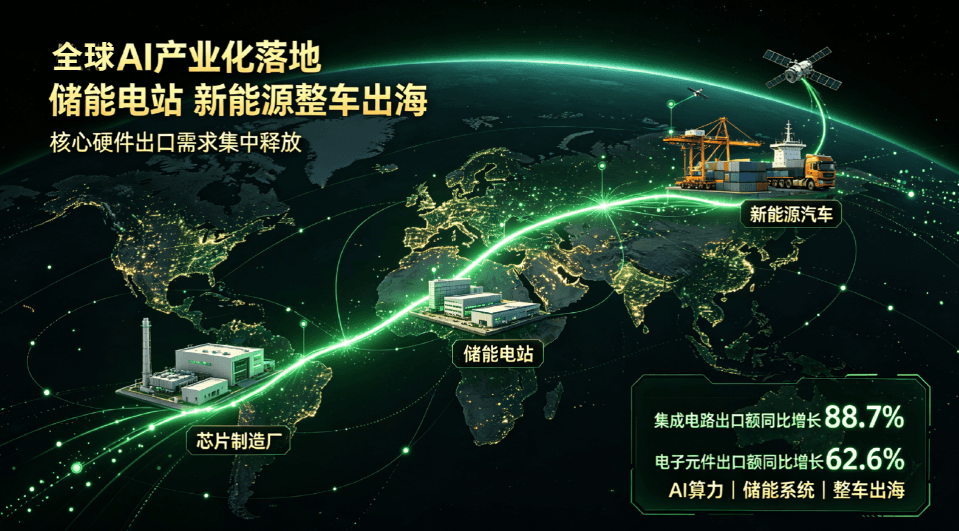
The global rollout of AI industrialization, energy storage power stations, and the demand for new energy vehicle exports have led to impressive core hardware export data: integrated circuit exports grew by 88.7%, and electronic component exports grew by 62.6%.
In particular, overseas orders for high-end passive components at server and automotive levels have increased significantly, indicating that the global competitiveness of domestic electronic hardware continues to strengthen.
2. High-End Manufacturing Supports Industrial Economy, Basic Needs Continue to Release
In the first half of the year, five high-end manufacturing industries - electronics, specialized equipment, general equipment, automobiles, and electrical machinery - contributed more than half of the national industrial growth.
Core system equipment such as energy storage inverters, new energy electric control systems, industrial servos, and intelligent industrial control rely on passive components like resistors, capacitors, and inductors to achieve core functions such as voltage stabilization, filtering, and circuit protection. Continuous expansion of downstream system production directly drives steady growth in the demand for upstream basic components.
3. Computing Infrastructure Surges, Demand for High-End Components Multiplies
The large-scale deployment of AI models and intelligent agents has triggered rapid growth in China's computing infrastructure. Data shows that by June this year, China's smart computing capacity reached 2185 EFLOPS, surging by 177% year-on-year.
As computing density continues to rise, computing hardware such as AI servers and intelligent computing switches require 10 times more passive components like MLCCs, power inductors, alloy resistors, and high-voltage film capacitors compared to traditional devices. Standards for these components have also significantly improved, requiring higher frequency, voltage resistance, low loss, and high reliability.
Globally, tech giants continue to invest heavily in data centers and AI server clusters, leading to an explosion in demand for computing-specific components. Data shows that global demand for AI-specific MLCCs is expected to grow by 87% in 2026. Structural shortages of high-end passive components have become the norm, with supply-demand gaps continuing to widen. Both domestic and international system manufacturers are locking in orders, driving a surge in both volume and price for high-end components.
Key Insights in 2026: Saying Goodbye to Generalized Fluctuations, Structural Benefits Reign Supreme
1. Supply and Demand Diverge, High-End Capacity Remains Scarce Long-Term
Current industry demand shows a clear polarization: demand in AI computing power, new energy vehicle, energy storage, and industrial automation sectors has exploded, capturing the core growth of the industry; while traditional consumer electronics demand remains stable, maintaining only basic inventory.
Global top original equipment manufacturers continue to adjust their capacity structures, concentrating new capacity on high-end products for automotive and computing applications, while reducing low-end consumer-grade capacity. Combined with the long construction cycles of high-end component production lines (18-24 months), short-term capacity cannot fill market gaps, and the shortage and price increase of high-end components will continue throughout 2026.
2. Price Increases Are Gradually Implemented, Industry Profitability Continues to Recover
This round of price increases shows a feature of "high-end first, tiered transmission": high-end categories such as server-level MLCCs, automotive-grade resistors, high-voltage capacitors, and high-power inductors lead in price increases, with scarce spot supplies and long-term order schedules of 3-6 months; industrial general-purpose components see modest price increases, with supply and demand basically balanced; low-end consumer-grade components remain stable in the market.
Analysts predict that there will be 1-2 more pricing windows in the second half of 2026, further strengthening the upward cycle of the industry.
3. Supply Chain Reconfiguration, Domestic Substitution Enters a Golden Window Period
Global supply chains increasingly emphasize security and resilience. Foreign manufacturers are actively diversifying their procurement systems to reduce reliance on traditional Japanese and South Korean suppliers, with a large number of high-end and mid-range orders shifting toward domestic brands. Coupled with policy support for new productive forces in China, the certification and implementation speed of high-end passive components has been significantly accelerated, and the global share of domestic hardware continues to rise.
At the same time, downstream customers have completely abandoned the zero-inventory model, mitigating supply risks through long-term agreements, early procurement, and multi-brand alternatives.
Trend Outlook
New demands continue to emerge, and the high-end manufacturing industry accelerates towards new horizons. With the dual drivers of AI computing power and green and low-carbon development, the high-saturation cycle of the electronic components industry will continue for a long time.