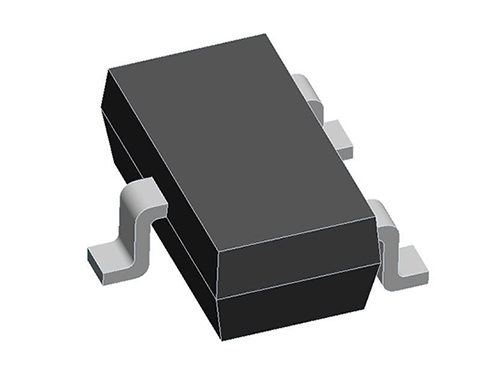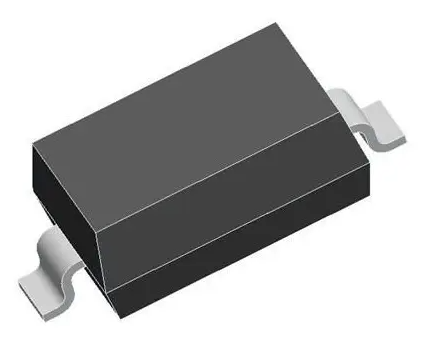
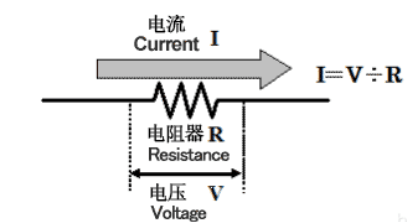
The core principle of current detection is the Ohm's Law. When current flows through a resistor, a voltage difference is generated across the resistor. Dividing this voltage difference by the fixed resistance value allows calculation of the actual current in the circuit.
In practical circuit design, it is not advisable to blindly increase the resistance value to obtain a larger and easier-to-detect voltage difference. If the resistance value is too high, it will significantly increase circuit power consumption, cause continuous heating of the resistor, and may lead to overheating, aging, or even damage.
It is recommended to use as small a resistance value as possible for current detection. When the voltage difference is too small, an amplification circuit can be used to amplify the detected voltage.
Application Scenarios of Current Detection Resistors
Mounting current detection resistors in a circuit is primarily for real-time monitoring of the current state. It mainly includes three application scenarios:
(1) Overcurrent Detection (Circuit Safety Protection)
During circuit operation, if there are issues such as overloading, short circuits, or component failures, the current can surge sharply beyond normal operating ranges, easily damaging components or equipment.
Using current detection resistors allows real-time collection of current data. When the detected current exceeds the preset safety threshold, the system determines that the circuit is abnormal and immediately triggers a protective mechanism, cutting off the circuit output and stopping the equipment operation.
Examples of overcurrent detection applications:
- Overcurrent protection in power supply circuits
- Over-discharge/overcharge protection for secondary batteries
- Overcurrent protection for motors
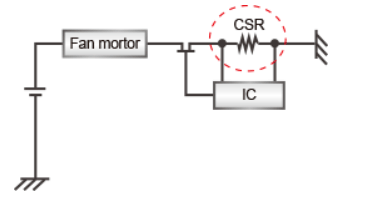
Motor Overcurrent Protection Circuit
(2) Current Control (Device Function Regulation)
Many smart devices rely on accurate current data for dynamic regulation. On one hand, in DC-DC converter circuits, the peak current of the inductor's sawtooth waveform can be detected and fed back to the control chip to achieve dynamic voltage and current regulation. On the other hand, the stable operation of three-phase motors and electric equipment requires precise control of current phase and conduction time.
By detecting the working current of each phase of the motor and feeding back the real-time data to the control circuit, the device's operating state can be accurately adjusted. This solution is widely used in precision devices such as electric power steering (EPS) in cars, household air conditioners, and industrial motors.
Examples of current control applications:
- DC-DC converters
- Inverter power supplies
- Current control of AC motors
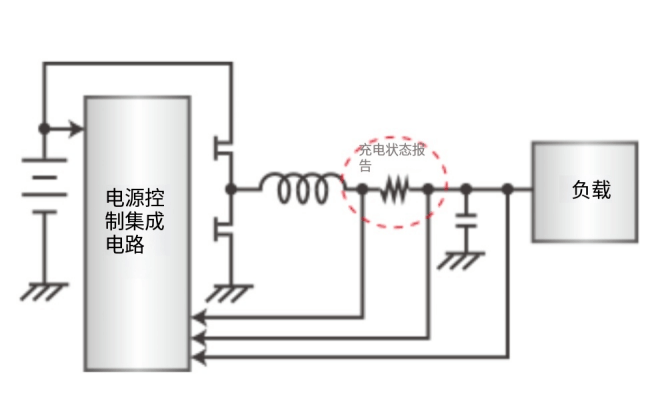
DC-DC Converter Circuit
(3) Current Management (Power and Equipment Maintenance)
All devices with rechargeable batteries use detection resistors to collect battery current and voltage in real time and calculate remaining battery power. The system can also optimize battery charging and discharging logic based on current status, extending battery life.
Examples of current management applications:
- Current management for secondary battery-powered devices like laptops and mobile phones
- Current management for secondary batteries in hybrid vehicles
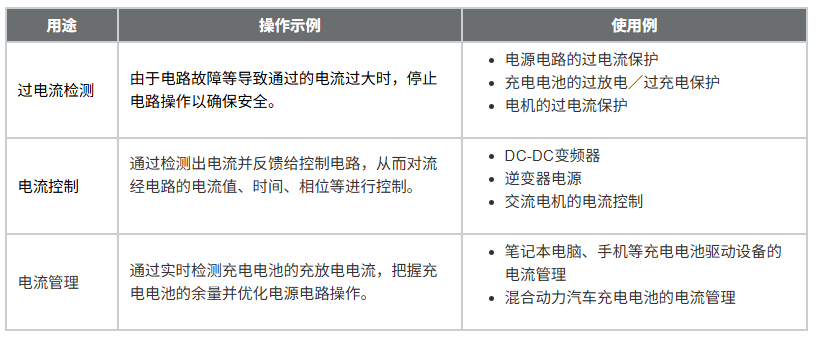
Common Types of Current Detection Resistors
The optimal voltage sampling range for conventional current detection is tens of mV to hundreds of mV, which ensures detectability of the voltage signal while reducing resistor power loss. Therefore, low-resistance resistors are generally selected for current detection, and different types of resistors are chosen according to the current value to be measured:
(1) High Current Detection Selection
For high current detection scenarios of tens of amperes (A), it is necessary to minimize resistor power loss and heat generation. Therefore, ultra-low resistance resistors of a few milliohms (mΩ) should be selected. Industry mainstream options include metal plate type and metal foil type low-resistance resistors. These resistors have high accuracy, strong stability, high heat resistance, and low power consumption, making them suitable for continuous high current detection conditions.
(2) Low Current Detection Selection
For low current detection scenarios, there is no need for extreme low resistance. Usually, resistors ranging from hundreds of milliohms (mΩ) to several ohms (Ω) are selected. In this scenario, thick film resistors are commonly used.
Key Considerations for High Current Detection
In high current conditions, the resistance value, layout, and parasitic parameters of the resistor can affect detection accuracy and circuit safety. To reduce power loss caused by the resistor, it is recommended to select ultra-low resistance resistors of several milliohms and pay attention to the following points:
(1) Voltage Terminal Output Method and Layout Requirements
The core of current detection is to collect the pure voltage difference across the resistor. However, the copper foil traces on the PCB itself have a small resistance. If the terminal layout is unreasonable, the resistance of the copper foil can be added to the detection resistor, leading to distorted detection data. It is recommended to draw out the voltage terminals from the inner center of the resistor's electrode pad. This method avoids interference from copper foil trace resistance, collecting only the voltage difference of the detection resistor itself, thus maximizing the accuracy of current detection.
(2) Impact of Parasitic Inductance on Low-Resistance Resistors
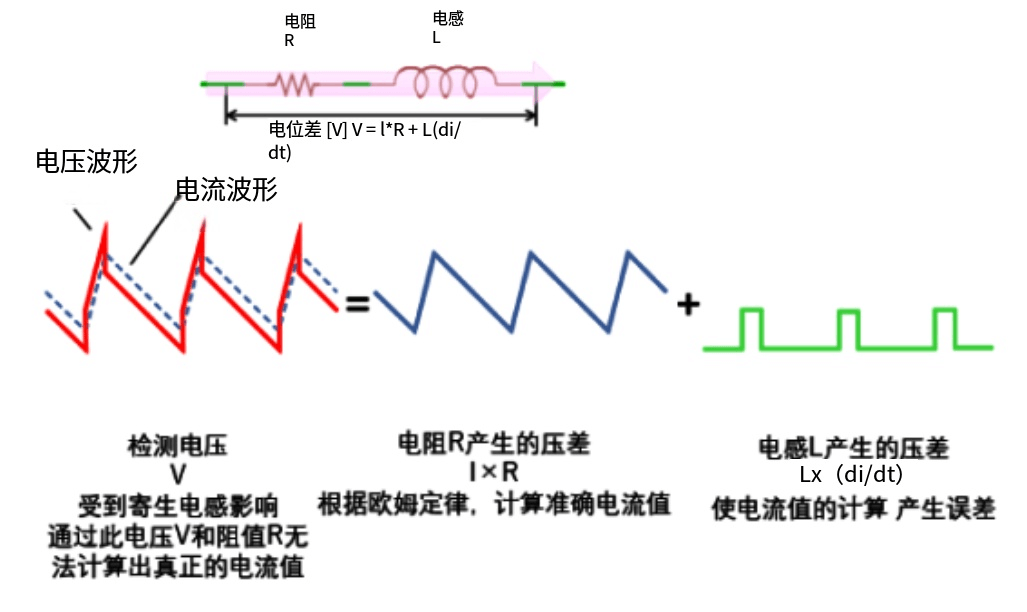
Resistors are affected by parasitic inductance. The smaller the resistance value and the higher the frequency of the circuit signal, the greater the impedance caused by parasitic inductance. In DC circuits, the current is stable, and parasitic inductance has almost no effect, resulting in accurate detection data. However, currents with high-frequency components such as sawtooth waves and AC fluctuations generate both resistance voltage drops and inductive voltage drops, and the total voltage detected is the sum of both, causing significant current detection errors.
In high current and high-di/dt detection scenarios, it is recommended to prioritize ultra-low inductance low-resistance resistors to reduce detection errors caused by parasitic inductance.
Two-terminal and Four-terminal Current Detection Resistors
Current detection resistors are mainly divided into two-terminal and four-terminal types. The core difference lies in whether the voltage and current detection terminals are separated, suitable for different detection precision and working conditions:
(1) Four-terminal Resistors
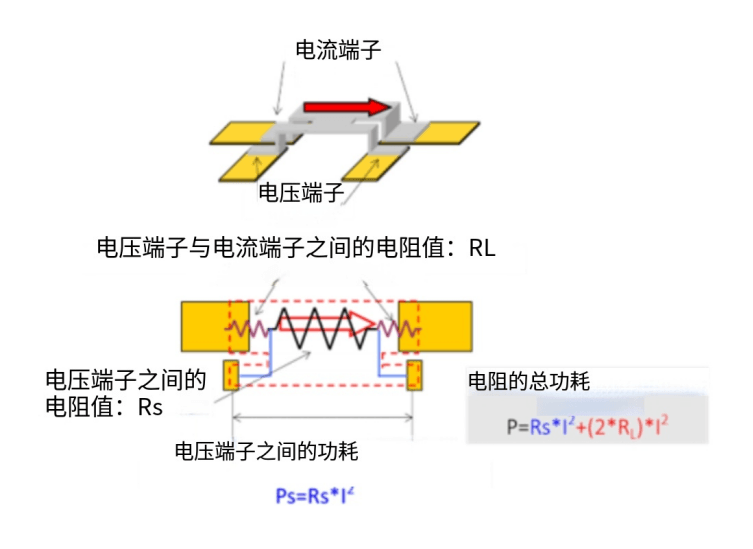
Four-terminal resistors separate the current detection terminals and voltage detection terminals. The dedicated voltage detection terminals can completely avoid resistance errors caused by wiring and electrodes, offering much higher detection accuracy than standard two-terminal resistors. They are the preferred choice for high-precision current detection scenarios.
However, this structure has clear disadvantages: the separated terminal structure creates additional resistance between the voltage terminal and current terminal, making the overall resistance larger compared to standard two-terminal resistors of the same specification.
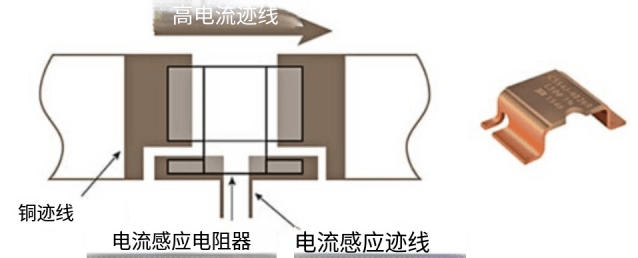
Four-terminal shunt resistor achieving high-precision Kelvin connection, with detection connections adjacent to the shunt resistor
(2) Two-terminal Resistors
Standard two-terminal resistors are not inherently inaccurate. As long as they are strictly followed by the specifications, drawing out the voltage sampling line from the inner center of the pad can avoid interference from copper foil resistance, achieving high-precision current detection. Additionally, they offer advantages such as low power consumption, minimal heating, and low parasitic inductance.
Current detection resistors are the core sensing elements for equipment safety protection, closed-loop current control, and battery power maintenance. With the continuous upgrading of industries such as new energy vehicles, industrial control inverters, consumer electronics lithium batteries, and server power supplies, precise current sampling design directly affects the overall machine's operational efficiency, service life, and operational safety.