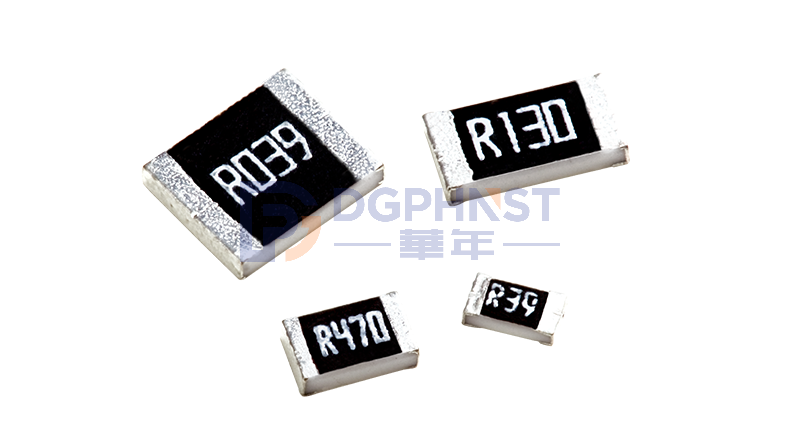
In after-sales failures of industrial control, security power supplies, automotive electronics, and smart meters, there is a hidden and troublesome issue: surface mount resistor sulfurization failure.
This fault does not occur immediately, and it is difficult to detect during routine factory testing. It usually appears gradually after product aging tests or 6-12 months after market launch, with specific manifestations such as resistance value drift, port open circuit, and intermittent device crashes. Tracing the root cause, many cases ultimately point to the chemical reaction between the silver electrode of the surface mount resistor and sulfur-containing gases, forming high-resistance silver sulfide. This type of failure has a delayed and occasional nature, and once it occurs in large quantities, the loss from rework and recall can be significant.
1. What is Sulfurization Failure of Surface Mount Resistors?
The conventional thick-film surface mount resistor end electrode structure generally consists of three layers: inner silver electrode, middle nickel barrier layer, and outer tin plating layer.
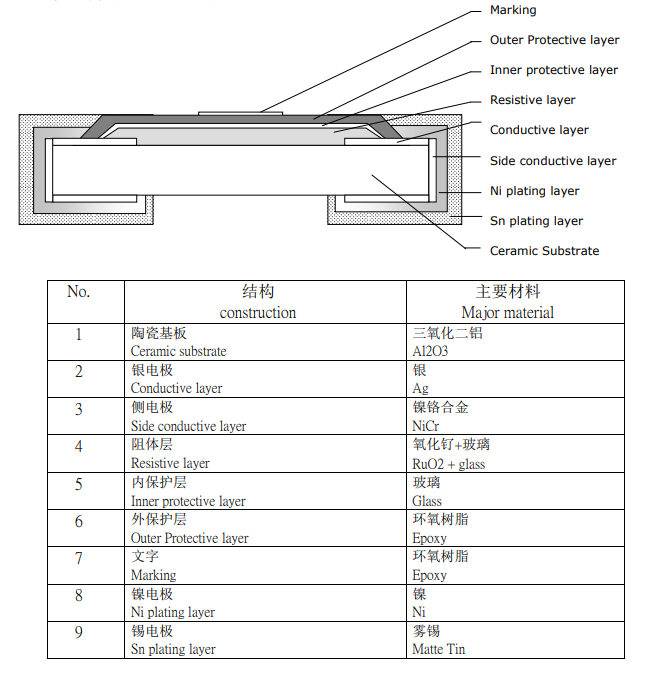
When the product is in an environment containing hydrogen sulfide, sulfur dioxide, and other sulfur-containing corrosive gases, these gases can penetrate the tiny gaps in the plating layer and come into contact with the underlying silver electrode. Silver reacts chemically with sulfur to form silver sulfide. Silver sulfide is a high-resistance material, and as the sulfidation reaction continues to spread, the conductive cross-sectional area at the resistor terminal gradually decreases, causing the resistance value to shift upward. In severe cases, the resistor opens, leading to circuit board function failure.
Sulfurization failure has two typical characteristics:
l Delayed failure: The product passes factory testing completely, but the failure appears months or even 12 years later;
l Strong environmental correlation: The failure rate increases significantly in industrial areas, coal mines, hot springs, livestock farms, outdoor humid environments, and near rubber and building materials where sulfur pollution sources exist.
2. High-Frequency Scenarios of Sulfurization Failure of Surface Mount Resistors
Sulfurization failure is not an isolated incident but a common reliability risk across multiple industries. The high-frequency scenarios are mainly divided into five categories:
1. Outdoor industrial equipment: Long-term exposure to open-air and industrial polluted environments, with high air humidity and corrosive gas content, accelerating the resistor sulfidation reaction;
2. Smart water and gas equipment, smart meters: Long deployment and maintenance cycles, often installed outdoors, underground, or in enclosed boxes, making them prone to accumulate corrosive gases;
3. Automotive electronics and construction machinery control systems: Complex working environments with large temperature differences and heavy moisture, along with complex pollution sources, which can lead to sulfidation failure over long-term operation;
4. Building fire protection and security alarm devices: Often in long-term standby and enclosed installation modes, with poor internal air circulation, allowing corrosive gases to accumulate and remain;
5. Battery Management Systems (BMS) and energy storage power equipment: Long life cycles and sealed cavity structures that may accumulate trace corrosive gases over time, leading to resistor sulfidation failure over long-term use.
Simply summarized: If your product has a long lifecycle, sealed casing, outdoor deployment, or is near sulfur pollution sources, you must assess the risk of sulfurization failure of surface mount resistors in advance.
3. How to Solve Sulfurization Failure of Surface Mount Resistors?
Currently, the industry has formed several mature sulfurization protection schemes, covering aspects such as component selection, PCB protection, structural optimization, and environmental improvement. These schemes differ in applicable scenarios, protective effects, and implementation costs, and can be selected according to project mass production needs and usage conditions.
Plan One: Select Anti-Sulfurization Surface Mount Resistors
Anti-sulfurization surface mount resistors have optimized and upgraded the structural shortcomings of conventional resistors by thickening the nickel barrier layer and optimizing the surface protection formula, completely blocking the path for sulfur-containing gases to reach the underlying silver electrode, thereby avoiding sulfidation reactions at the hardware level.
This plan has the least implementation changes, requiring no major adjustments to PCB layout or overall structure design, making it suitable for mass production projects. It offers high protective stability and long-term reliability, making it the preferred solution for high-reliability products in industries such as industrial, energy storage, and security. The only drawback is that the procurement cost of materials is slightly higher than that of conventional thick-film surface mount resistors, but its comprehensive cost-effectiveness is outstanding among all schemes.
Applicable Scenarios: Smart meters, BMS energy storage systems, outdoor industrial control equipment, fire protection and security equipment, and other long-life, high-reliability products.
Plan Two: Three-Coat Protective Coating on PCBA Circuit Boards
By spraying a three-coat paint on the surface of the finished circuit board, a protective film is formed to isolate corrosive gases from contacting the components, achieving basic protective effects.
This plan can only serve as an auxiliary protective measure and cannot completely eliminate sulfurization problems. Due to process limitations, the three-coat coating may have fine pinholes, and after long-term high-temperature aging and operation in humid environments, the coating may crack or peel off, failing to address the penetration of gases inside the components. It can only delay the sulfidation process but cannot avoid the risk from the root cause.
Plan Three: Optimization of Enclosure Sealing Structure
By adding sealing gaskets to the enclosure and optimizing the box assembly structure, the entry of external corrosive air into the circuit board chamber is reduced, lowering the probability of sulfur corrosion.
This plan has strong implementation limitations. On one hand, it is difficult to achieve complete sealing of the entire machine, making it impossible to completely isolate gas penetration. On the other hand, rubber parts and cable materials inside the enclosure may release trace sulfur elements, leading to accumulation of sulfur gas in the sealed environment, thus accelerating resistor sulfidation corrosion. Its protective effect is unstable.
Plan Four: Replace with Non-Silver Electrode Resistors
Abandoning the traditional silver electrode structure, using palladium-silver, platinum, or thin-film resistor series products, completely eliminating the basic conditions for silver-sulfur reactions, thus fundamentally preventing sulfurization failure.
This plan offers excellent protective effects, but the implementation cost is relatively high, with high material procurement prices and longer selection and delivery cycles for some special resistance values. It is mostly used in high-reliability projects such as military and medical applications and is not suitable for mass-produced civilian products.
Plan Five: Environmental Improvement at the Terminal
Improving the ventilation conditions of the equipment deployment environment, keeping core components away from sulfur-emitting sources like rubber, asphalt, and building materials, reducing environmental sulfur content and corrosion risks.
This plan has the worst controllability, as the final use environment is controlled by downstream customers, and the manufacturer cannot fully manage the environmental conditions. It can only be used as a supporting optimization measure and cannot independently solve the problem of large-scale sulfurization failure.
In Conclusion
Sulfurization failure of surface mount resistors is a chronic reliability hazard. It is hidden in the early stage but causes huge losses later. Instead of repairing and maintaining after failure, it is better to anticipate the sulfurization risk during the selection phase and prioritize the anti-sulfurization surface mount resistor solution to avoid issues like resistance drift and open circuit failures from the source, significantly improving the long-term reliability of the entire system.
If you are encountering resistor drift failure during the project debugging phase, you can consult Shunhai Technology to obtain an anti-sulfurization surface mount resistor selection list and match corresponding power and resistance value solutions.