Smart watch, fitness bracelet, health monitoring band... Today, wearable devices have been deeply integrated into our daily life. From heart rate monitoring to blood oxygen testing, from sports tracking to NFC payment, these small functions on the wrist are increasingly rich. However, in this process, the issue of circuit safety is often overlooked, yet it is crucial.
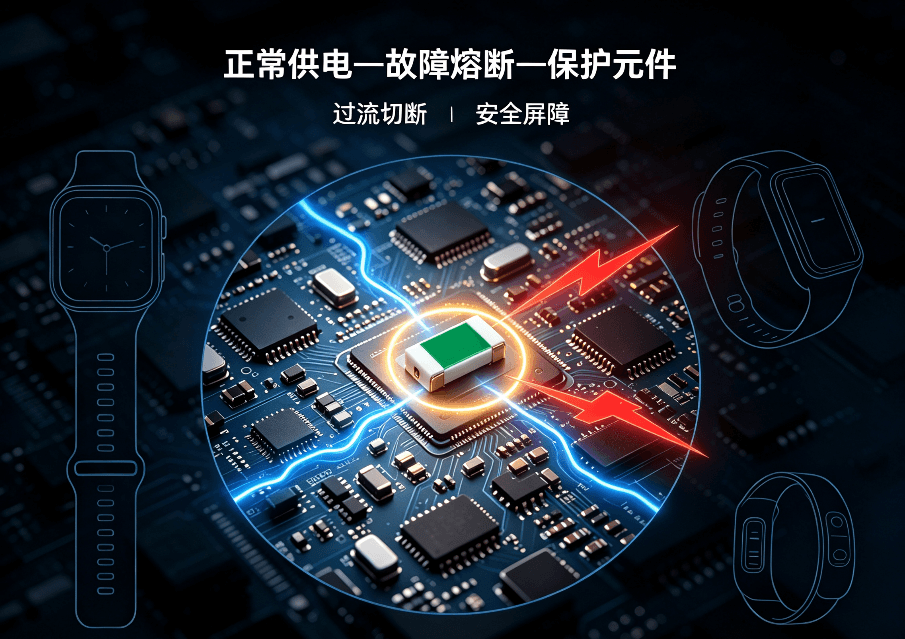
The internal space of smart watches and bracelets is extremely limited. PCB boards are densely packed with chips, sensors, power management chips, batteries, and other delicate components. Once due to abnormal charging, static discharge or short circuit causes overcurrent, it may cause the main board to burn, or even lead to battery thermal runaway.
Protecting these delicate circuit paths is the first line of defense against the tiny component - a one-time fuse.
One-time Fuse: The Basic Protection of Wearable Devices
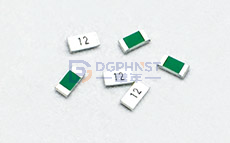
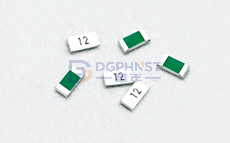
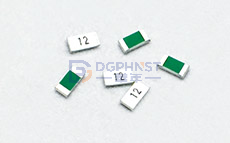
A one-time fuse is a micro over-current protection component directly mounted on the PCB board. Its core working principle is simple and efficient: When the current in the circuit exceeds the set threshold, the fusible material (usually high-purity silver-copper alloy or low-melting-point alloy material) inside the fuse will quickly melt and break, thus physically cutting off the current path, isolating the fault before the damage spreads, preventing overcurrent from affecting the sensitive components at the end.
Among them, Huade Electronics' one-time fuse has optimized the fusible material composition and packaging process, using high-purity alloy fusible materials, which have more accurate melting response and stronger breaking stability, perfectly matching the low-voltage, precise, and miniaturized working environment of wearable devices.
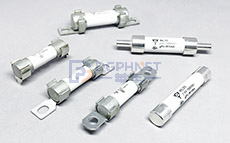
Compared with traditional plug-in fuses, one-time fuses have three core advantages, making them an indispensable choice for wearable devices:
1、Miniature Packaging
The PCB space of smart watches is tight, and the one-time fuse can provide 0402 (1.0mm×0.5mm), 0603 (1.6mm×0.8mm) and even smaller package sizes, with a thickness of about 0.5mm, which can easily be embedded into high-density PCB boards, almost not occupying any additional space.
Huade Electronics has deep experience in miniature fuses, with a series of dedicated wearable products, precise size control, perfectly matching the ultra-thin PCB mounting requirements, while retaining sufficient structural strength, avoiding the problem of micro-components being easily damaged, perfectly matching the compact design of smart watches and bracelets.
2、Suitable for Automated Production
The one-time fuse is naturally compatible with SMT (Surface Mount Technology) reflow process, and can complete automated soldering together with other components on the mainboard, greatly improving production efficiency and reducing labor costs, which is very suitable for mass production of consumer electronics products.
3、High Precision Protection, Fast Response
The one-time melting mechanism belongs to physical disconnection, strong breaking power, able to cope with severe short-circuit faults, ensuring that even in extreme abnormal conditions, the circuit can be reliably disconnected, providing solid security barrier for high-risk components such as batteries.
Huade Electronics offers two core series of fast-acting (F) and slow-acting (T), with parameters covering the full range, with rated currents ranging from 50mA~500A, accurately matching the different current protection requirements of various circuits in wearable devices. Facing short circuits, overload and other extreme faults, it can achieve millisecond-level fast disconnection, ensuring the stability and reliability of the protection.
In smart watches and bracelets, what are the key positions protected by the fuse?
Inside a smart watch, the one-time fuse is mainly installed at the following key circuit points:
1、Battery Charging Protection Circuit
This is the most critical "battlefield" of the fuse. Smart watches usually use small lithium batteries for power supply. During the charging process, if there is an abnormal output from the charger, short circuit at the charging port, or internal battery failure, it may cause dangerous overcurrent.
By connecting a fast-acting one-time fuse at the battery output end or the charging input end, once an abnormal current is detected, it can cut off within milliseconds, disconnect the battery from the downstream circuit, effectively preventing battery over-discharge, overheating, or even thermal runaway.
2、Power Management Module (PMIC) Front End
The power management chip is the "power center" of the watch, responsible for converting the battery voltage into different voltage levels required by each module. Setting a fuse at the input end of PMIC can prevent large currents from flowing back to the battery end when the downstream circuit is short-circuited, protecting the power chip and battery from double safety hazards.
3、Bluetooth/Wi-Fi Module Power Line
The Bluetooth module is the bridge for communication between the smart watch and the phone. Its power line is extremely sensitive to current fluctuations. A micro-sized one-time fuse connected to the power line of the module can quickly cut off the power supply when the module is damaged or hardware failure causes a short circuit, avoiding the module from burning out and affecting the overall functionality.
4、Sensor Signal Acquisition Circuit
Heart rate sensors, accelerometers, gyroscopes, etc., work in the nano-ampere level, extremely sensitive to overcurrent. Using a low-rated current fast-acting one-time fuse can provide precise overcurrent protection for the sensor, ensuring the accuracy of health monitoring data and the long-term reliability of the sensor.
One-time Fuse vs Self-resetting Fuse: How to match them?
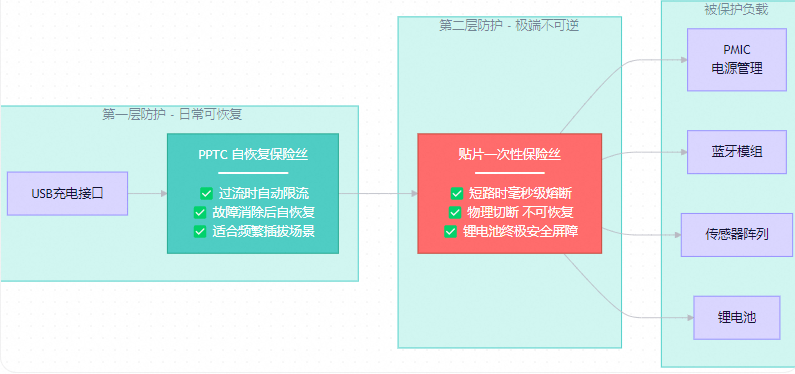
In practical wearable device circuit design, one-time fuses and self-resetting fuses (PPTC) are not "either-or" relationships, but rather complementary, each playing its own role.
- One-time Fuse has the core advantage of strong breaking power and fast response, suitable for dealing with severe short-circuit faults and extreme overcurrent scenarios, serving as the "last line of defense" for battery safety. However, its disadvantage is also obvious - after melting, it cannot be restored, requiring return for repair or replacement of the device.
- Self-resetting Fuse (PPTC) uses high molecular polymer materials, automatically enters a high-resistance state when overcurrent occurs, and automatically restores conductivity after the fault disappears, without the need for replacement. It is suitable for dealing with frequent minor overcurrents and recoverable faults, such as transient overcurrent when plugging in a USB port.
In typical design schemes for smart watches, engineers often connect a one-time fast-acting fuse at the battery end as the final safety barrier, while at the same time equipping a PPTC self-resetting fuse at the charging port end to handle daily usage's recoverable overcurrent events.
Industry Trends: Smaller, Faster, Smarter
As smart watches and bracelets continue to develop towards lighter, more functional directions, the requirements for one-time fuses have also become higher.
On one hand, the packaging size is moving towards 0201 and even smaller grades to meet the needs of next-generation ultra-thin designs;
On the other hand, through continuous material and process innovation, the new fuses maintain miniaturization while continuously improving breaking power and response speed.
In addition, as consumers' attention to the safety of wearable devices continues to rise, the safety certification standards in various countries and regions are also constantly upgrading. Choosing one-time fuse products that have passed international certifications such as UL, CE, and comply with RoHS environmental protection standards is not only a legal requirement, but also a manifestation of the brand's commitment to consumer safety.
Written at the End
From daily charging safety and stable power supply to precise operation of health monitoring functions, every stable use behind is inseparable from the protection of the fuse.
Huade Electronics, as a leading agent of Huaide Electronics, provides a full series of high-precision, high-stability one-time fuse products, offering comprehensive circuit protection solutions for all types of wearable devices.