What Role Do High-Power Resistors Play?
1. The Thermal Management Foundation
The defining characteristic of a high-power resistor is not precision of resistance value, but the ability to convert electrical energy into heat in a controlled manner and dissipate it reliably. Whereas standard resistors primarily serve signal-conditioning functions, high-power resistors are engineered around thermal management as their design baseline. They must conduct Joule heat from the resistive element to the heat sink under sustained high-current or transient pulse conditions without allowing localized temperature rise to run away.
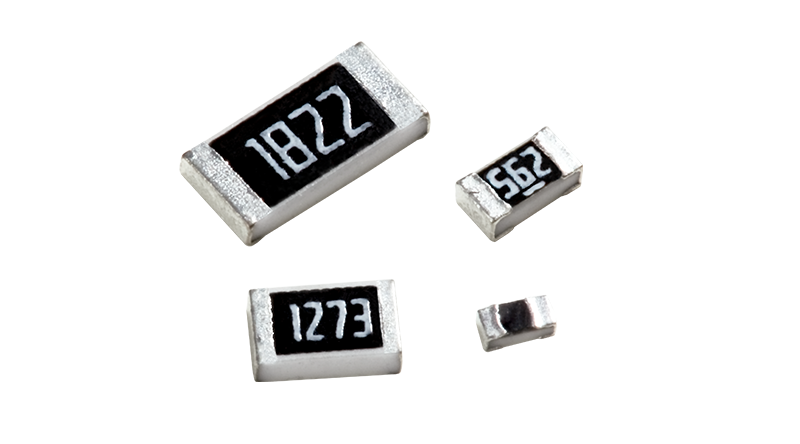
TT Electronics' HPDC series illustrates this principle: by using an aluminum nitride ceramic substrate with roughly six times the thermal conductivity of conventional alumina, combined with wide-area solder terminations, the resistor achieves 2.4W in a 1206 footprint and 3.5W in 2512. Short-term overload ratings reach 4.7W and 7.7W for five seconds, making these resistors suitable for active capacitor bleed circuits.
2. Five Core Functions
Energy dissipation and dynamic braking. In variable-frequency drives, servo systems, and elevators, regenerative energy produced during motor deceleration must be dissipated as heat when it cannot be returned to the grid. Isabellenhütte's UL series dynamic braking resistors support continuous loads up to 1200W and pulse rates up to 12kW for five seconds. Typical deployments include cranes, ships, tower cranes, and industrial power systems.
Precharge current limiting. In electric vehicles, photovoltaic inverters, and industrial power supplies, the DC bus capacitor behaves as a short circuit at the instant of contactor closure. A precharge resistor limits the inrush current to a safe level until the capacitor voltage rises sufficiently for the main contactor to bypass the resistor. Vishay's LPSA 600 series is specifically designed for precharge and discharge service in EV inverters, rated at 300W.
Snubber current limitation. In RC snubber circuits for IGBTs and GTOs, the resistor limits capacitor discharge current. Certain silicon resistor technologies exploit the reduction of carrier mobility under high electric fields, presenting higher resistance at the onset of discharge and lower resistance as current decays—an inherently adaptive current-limiting behavior.
Current sensing and power regulation. Low-resistance, high-power resistors serve as shunt elements in power and battery management systems, converting current into a measurable voltage. Alloy resistors, with their low temperature coefficient and pulse tolerance, are preferred for high-current sensing applications.
Controlled heating. In precision instruments, medical devices, and outdoor telecom enclosures, high-power resistors function as localized heating elements, with applied power limited only by the maximum element temperature of approximately 155°C and termination temperature of 110°C.
3. Engineering Parameters That Matter
Selection involves more than comparing rated wattage. The power derating curve determines usable power at elevated ambient temperatures—most ratings are specified at 70°C, and at 100°C the available power may fall to 60–70% of the nominal value. Pulse capability is assessed through the I²t value, which must exceed the maximum transient energy the circuit can deliver. Thermal resistance, temperature coefficient, long-term stability, and the thermal path from element to termination are equally consequential.
4. Supply Chain Considerations
Access to genuine, traceable high-power resistors depends on authorized distribution channels. Shenzhen Shunhai Technology Co., Ltd. has served as a first-tier authorized distributor for Ever Ohms in mainland China since 2017, and also represents Sunway Microelectronics and Suzhou Walter across alloy resistors, precision resistors, and fuses. Its associated online platform, Huanian Mall, holds official authorization to sell Ever Ohms' full product line—including thick-film and thin-film chip resistors and metal plate current-sense resistors—and supports small-batch purchasing with rapid fulfillment. For projects requiring multi-brand sourcing or rapid substitution pathways, these two channels offer a practical complement to passive component supply chains.