When traditional glass fuses short-circuit and melt, they are prone to bursting, arcing, and splashing debris. This can damage surrounding components, burn PCB boards, or even cause equipment fires and failure of overall safety standards. Under the same working conditions, after Huade Electronic Square Fuse blows, the housing usually only turns slightly black and remains intact, without bursting, arcing, or splashing debris. As an authorized agent of Huade Electronics, Shunhai Technology can provide support for selection, samples, and on-site delivery of this series of square fuses.
Today, Shunhai Technology will explain in detail the core functions of the encapsulated housing, precision fuse element, and arc suppression filler of the square fuse from an internal disassembly perspective, thoroughly explaining its underlying logic of "not bursting when blowing, not damaging the board when short-circuiting".
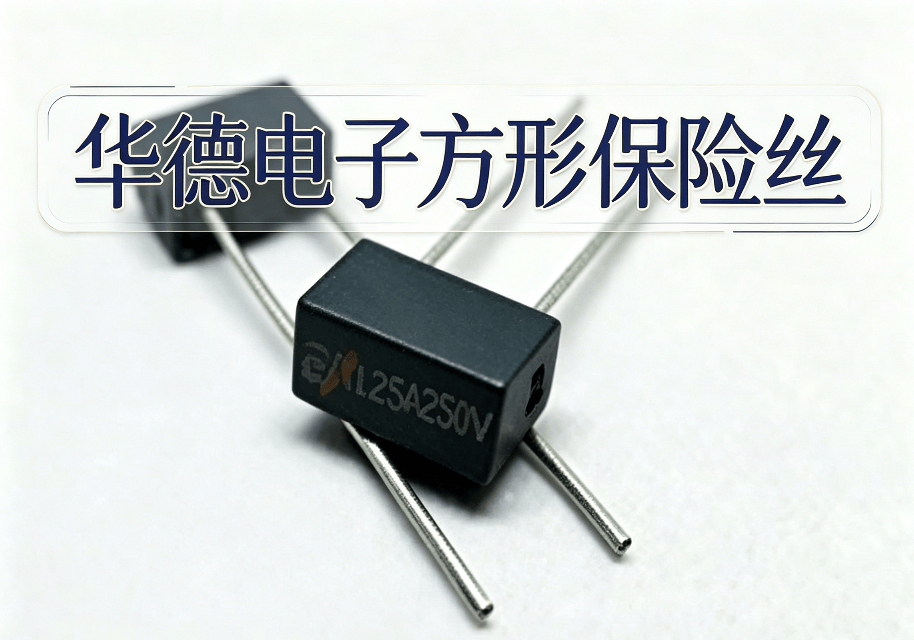
One, High-strength Encapsulated Housing: The First Physical Defense Against Explosion
The square fuse does not use ordinary plastic for the outer shell but uses engineering flame-retardant encapsulated materials with high temperature resistance, high pressure resistance, and high insulation. Some high-end models are combined with ceramic composite shells. The material properties differ significantly from those of glass tubes, serving as the foundation for withstanding internal instantaneous pressure and preventing shell rupture. Huade Electronics has specially modified and optimized the shell material of the square fuse to ensure structural stability under extreme short-circuit conditions.
Glass tubes have a high brittleness and limited pressure resistance. The square encapsulated housing has three functions:
1. Sealed Pressure Resistance, Constrain Internal Energy
When a short circuit occurs, the fuse quickly melts, generating thousands of degrees Celsius of high temperature, metal vaporization, and forming an arc, causing a sharp rise in internal pressure.
Traditional glass fuses cannot withstand the instantaneous high pressure, directly rupturing and releasing pressure, leading to arc ejection and circuit board burning. The square fuse's encapsulated housing is dense and has strong pressure resistance, which can constrain the internal pressure generated during melting, avoiding shell rupture and debris flying out, thus physically eliminating the risk of explosion.
2. High Temperature Flame Retardant, Isolate Heat Source
The shell material is treated with flame retardant and high-temperature resistance, allowing it to withstand high-temperature arcs without melting or cracking. Even if an arc occurs internally, the shell can maintain structural integrity, isolating the internal heat source from the PCB and surrounding plastic parts, reducing the risk of secondary fires.
3. Sealed Dustproof, Suitable for Complex Working Conditions
The fully sealed encapsulated structure can block dust, moisture, and oil, reducing failure issues caused by air intake and humidity in traditional glass fuses. It is suitable for small household appliances, outdoor power supplies, energy storage devices, and automotive high and low temperature vibration environments, ensuring long-term stable operation of components.
Two, Precisely Customized Fuse Element: Accurate Timing, Reduce Violent Combustion at the Source
A fuse is not simply a breakable metal wire. The core of the square fuse's melting is a precision alloy fuse element, which is key to achieving smooth melting and reducing arc impact.
The fuse element uses high-purity silver-copper alloy, with calibrated resistivity, good ductility, and stability. It mostly adopts a thin sheet neck structure, with concentrated current density and controllable melting threshold. Its main functions are two:
1. Distinguish Overload and Short Circuit Conditions, Achieve Controlled Melting
When the device works normally at rated current, the fuse element generates less heat, operates stably, and is not easily mis-blown. When there is a slight overload, the fuse element gradually heats up and melts with delay, compatible with the equipment's start-up surge and short-time current impact, avoiding protection mis-triggering shutdowns.
When a short-circuit fault occurs, the current density at the narrow neck position rapidly increases, and the fuse element breaks the circuit in milliseconds, shortening the duration of the arc and reducing the intensity of the high-temperature and high-pressure reaction.
2. Uniform Vaporization Process of the Fuse Element, Reduce Local Strong Arcs
Ordinary glass fuses have poor consistency in metal wire thickness. During melting, local concentration vaporization causes sudden pressure increase, easily producing strong arcs. The square fuse's fuse element structure is uniform, with a smooth vaporization process, without forming a single point of high pressure impact, cooperating with the shell to reduce the probability of explosion.
Three, High Purity Quartz Sand Filler: Core Structure for Arc Suppression and Explosion Prevention
The shell is responsible for pressure resistance, the fuse element for fault disconnection, and the internal high-purity quartz sand filling is the key structure that suppresses arcs and prevents shell rupture in square fuses. The arc suppression capability of square fuses mainly relies on the quartz sand structure. The particle size of the filler is screened, controlled between 0.2–0.5mm, evenly packed, and has three arc suppression functions:
1. Rapid Heat Absorption and Cooling, Quenching High-Temperature Arcs
When the thousands of degrees Celsius arc generated by a short circuit comes into contact with quartz sand, the heat is quickly absorbed. Quartz sand has good thermal stability and can rapidly lower the arc temperature, avoiding continuous high-temperature burning of the shell and circuit board.
2. Maze-like Narrow Grooves, Forcefully Cut Off the Arc Path
A large number of staggered micro-gaps are formed between quartz sand particles. After the arc is generated, it is cut and constrained by the gaps, stretched, the electric field strength decreases, and the charged particles quickly recombine and dissipate, extinguishing the arc within milliseconds, preventing continuous arcing and repeated discharging.
3. Wrap Metal Vapor, Prevent Arc Ejection and Shell Bursting
The high-temperature metal vapor produced by the melting and vaporization of the fuse element is the main cause of shell rupture and short-circuit re-ignition. Quartz sand can wrap the metal vapor, forming an insulating glass-like substance under high temperature, sealing the vaporized products, preventing their expansion and impact on the shell, outward burning of the PCB, and avoiding shell bursting, board damage, and secondary short circuits.
In Summary: Three-in-One, the Housing, Fuse Element, and Filler Collaboratively Ensure Circuit Safety
The square fuse can achieve no shell bursting when blowing and no circuit board damage when short-circuiting, relying on the coordinated work of the encapsulated housing, precision fuse element, and quartz sand filler:
- Encapsulated Housing: Withstand instantaneous pressure, provide physical explosion protection;
- Precision Fuse Element: Achieve fast, controlled disconnection, weaken fault arc intensity;
- Quartz Sand Filler: Quickly extinguish arcs, eliminate the risk of continuous arcing.
Switching power supplies, adapters, LED drivers, small energy storage systems, and small household appliances are gradually replacing traditional glass fuses with square encapsulated fuses.
Huade Electronic Square Fuses have comprehensive safety certification, excellent explosion-proof performance, and long-term reliability. As an authorized agent of Huade, Shunhai Technology can provide technical selection, sample applications, and on-site supply for the entire series of square fuses; the product is compatible with automated production lines, ensuring overall safety and long-term stable operation.