
In current sampling circuit design, many devices suffer from unstable precision, drifting sampling data, and small signal distortion. The root cause often lies not in the backend algorithm, but in the overlooked resistor. The internal material and structure of the resistor directly determine the noise level of the sampling signal, the uniformity of current distribution, and the long-term operational stability of the device.
In milliohm-level high-precision current sampling scenarios, Hua De's STE series metal foil alloy resistors are surface-mount current sensing resistors with a ceramic substrate metal foil structure. Relying on their unique metal foil body structure, they demonstrate performance advantages distinct from ordinary thin-film resistors.
1. Layer-by-layer Disassembly of the STE Metal Foil Resistor
The metal foil resistor uses high-purity aluminum oxide ceramic as the carrier substrate, combined with precision high-temperature bonding technology to form multiple functional layers. From top to bottom, it consists of a protective layer, a manganese copper alloy foil, an aluminum oxide ceramic substrate, and a multi-layer terminal electrode. This integrated structure optimizes parasitic parameters at the source, suppresses thermal deformation and resistance drift, and is suitable for complex operating conditions such as high current, high humidity, and frequent power switching.
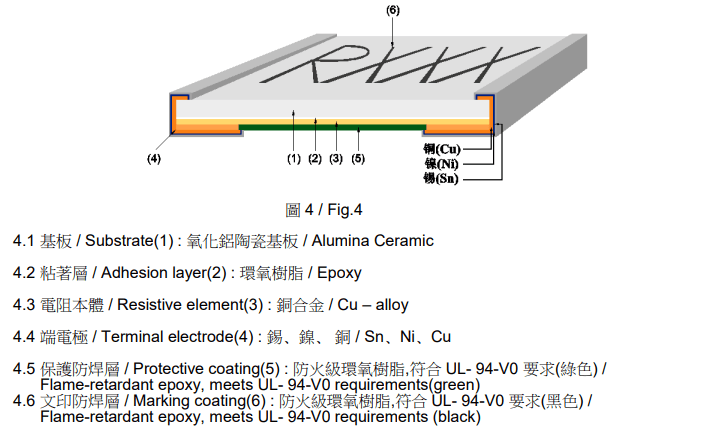
1. Protective Layer
An insulating protective layer covering the surface of the alloy foil isolates moisture and dust, suppressing oxidation of the foil surface. In power cycling and humid heat environments, it reduces corrosion of the alloy foil and prevents local resistance drift. The protective layer does not affect the current path, only providing environmental protection.
2. Manganese Copper Alloy Foil (Core Conductive Layer)
Using ultra-thin rolled manganese copper alloy sheets as the resistor body, the resistance value is determined by the thickness, effective cross-sectional area, and profile of the alloy foil.
The manganese copper alloy itself has a low temperature coefficient. Combined with the integral-formed foil, the current can spread out across the entire metal foil plane, rather than being limited to narrow film channels.
3. Aluminum Oxide Ceramic Substrate
A high-thermal-conductivity aluminum oxide ceramic serves as the carrier, with high rigidity and a thermal expansion coefficient matching that of the manganese copper alloy foil. Heat generated by the resistor is quickly conducted from the alloy foil to the ceramic substrate and then transferred through the solder pad to the PCB copper foil. This reduces localized hot spots and minimizes resistance deviation caused by thermal stress.
The substrate and alloy foil are tightly bonded via high-temperature bonding technology, preventing delamination during repeated power changes.
4. Multi-layer Terminal Electrode
A multi-layer composite electrode structure is used, with the lower layer enhancing adhesion to the ceramic substrate, the middle layer ensuring conductivity, and the upper layer serving as a solderable layer. The multi-layer electrode reduces contact resistance, minimizing contact noise at the interface between the electrode and alloy foil. It also enhances SMT soldering reliability and reduces the risk of false soldering.
2. Metal Foil Resistors vs. Thin-Film Resistors: Differences in Underlying Structure
Metal foil resistors differ fundamentally from thin-film resistors in terms of manufacturing logic:
1. Core Manufacturing Process Differences
Thin-Film Resistors: A very thin metal film is deposited on an insulating substrate using vacuum evaporation/sputtering, then laser-cut into winding, elongated resistor paths. Current is forced to flow along narrow, winding lines.
Metal Foil Resistors: A full sheet of rolled manganese copper alloy foil is directly attached to the ceramic substrate, then patterned. The resistor body is a solid metal thin sheet, offering a larger and more continuous current path.
2. Sources of Low-Frequency Noise Difference
Low-frequency noise in resistors mostly comes from material particle interfaces, micro-cracks, and current channel contraction effects.
Thin-film resistors have a resistive film formed by deposition, which contains numerous micro-grain interfaces within the film. Additionally, laser etching creates elongated, winding paths, concentrating current in narrow channels. Carrier collisions and localized micro-heating amplify low-frequency noise. In small-signal sampling circuits, this noise directly superimposes on the sampled voltage, affecting ADC sampling accuracy.
Metal foil resistors use rolled manganese copper alloys, resulting in continuous grain structures with fewer interface defects. The wide current path avoids current contraction effects from narrow etched lines, significantly reducing 1/f low-frequency noise.
In BMS battery sampling and high-precision power monitoring applications, the low-noise characteristic preserves weak sampling signals, reducing the burden on downstream filtering circuits.
3. Comparison of Current Distribution Uniformity
Thin-film resistors with long serpentine paths cause current concentration, with higher current density at bend points, leading to localized hotspots. Under high-current conditions, local temperature rise exceeds the average resistance temperature rise, causing additional temperature drift. In extreme cases, it accelerates membrane aging and fracture.
Hua De STE metal foil resistors feature flat, continuous foils, allowing current to spread evenly across the entire alloy foil plane without single-point current concentration. The overall current density distribution is balanced, and heat distribution is more gradual. Under the same rated power, no localized overheating occurs, and resistance stability is better during power cycles.
3. The Core Value of Metal Foil Resistors, Suitable for High-End Precision Applications
1. Better Sampling Consistency: Relying on uniform current distribution and extremely low low-frequency noise characteristics, the resistor has minimal single-unit parameter deviation and extremely low batch dispersion, effectively controlling sampling errors in mass production and significantly reducing the difficulty of product yield control.
2. Strong Power Cycling Resistance: The ceramic substrate and manganese copper foil have matched thermal expansion coefficients, making it difficult for the resistor body to crack due to repeated power on/off operations.
3. Friendly to Small-Signal Sampling: Low low-frequency noise makes it suitable for applications like battery management and precision industrial power supplies that require capturing weak current signals.
Conclusion
The performance limit of a resistor is never just a parameter gimmick—it lies hidden in the visible internal structure and process details.
Hua De STE metal foil resistors address industry pain points such as high noise, large temperature drift, poor stability, and insufficient consistency in traditional thin-film resistors through comprehensive optimization of materials, structure, and processes. With its comprehensive advantages of high precision, low noise, strong fatigue resistance, and high batch consistency, it has become a must-have component for high-end precision sampling circuits, comprehensively improving the detection accuracy and operational stability of industrial and new energy equipment.
--- This article is published by Huanyan Mall. For more information about resistor, capacitor, inductor, fuse, and protective device models, specifications, inventory, and pricing, please visit Huanyan Mall's official website: https://www.hnstshop.com. The platform agents well-known brands such as Hua De, Tian Er, Liang Sheng, Lu Hai, San Huan, Li Zhi, and Shuo Kai, and supports BOM order matching, sample making, and bulk purchasing. Original factory货源 quality is traceable.