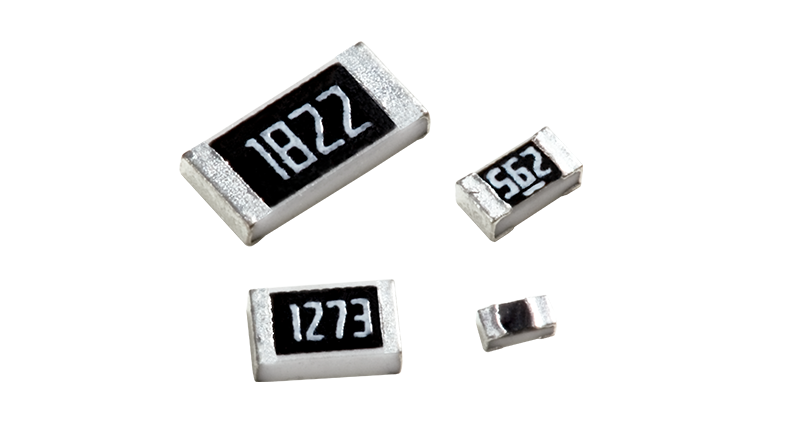
For alloy resistors of the same specification, the price difference between different brands and material systems can be as high as one time. Does a higher price of nickel-chromium alloy resistors mean that its electrical performance is definitely superior to manganin alloy resistors? In fact, there is no absolute superiority or inferiority between manganin and nickel-chromium alloy resistors, and there is no universal "universal resistor material".
Manganin (Cu-Mn-Ni system) and nickel-chromium (Ni-Cr system) are two main types of alloy materials for current sampling resistors. There is no absolute distinction between the two, and their differences mainly lie in different application scenarios. Simply comparing nominal electrical parameters without considering the actual application scenario can easily lead to selection errors: either the sampling accuracy does not meet the system design specifications, or performance redundancy occurs, resulting in unnecessary cost waste.
1. Core Material Characteristics Comparison
Manganin is a ternary alloy with copper as the base, adding about 12% manganese and 2%-4% nickel. Its core advantage lies in the slow change of resistivity with temperature, and there is a "turning point" (usually around 20℃-50℃) in the TCR curve in the normal temperature range, making the temperature drift extremely small in this interval.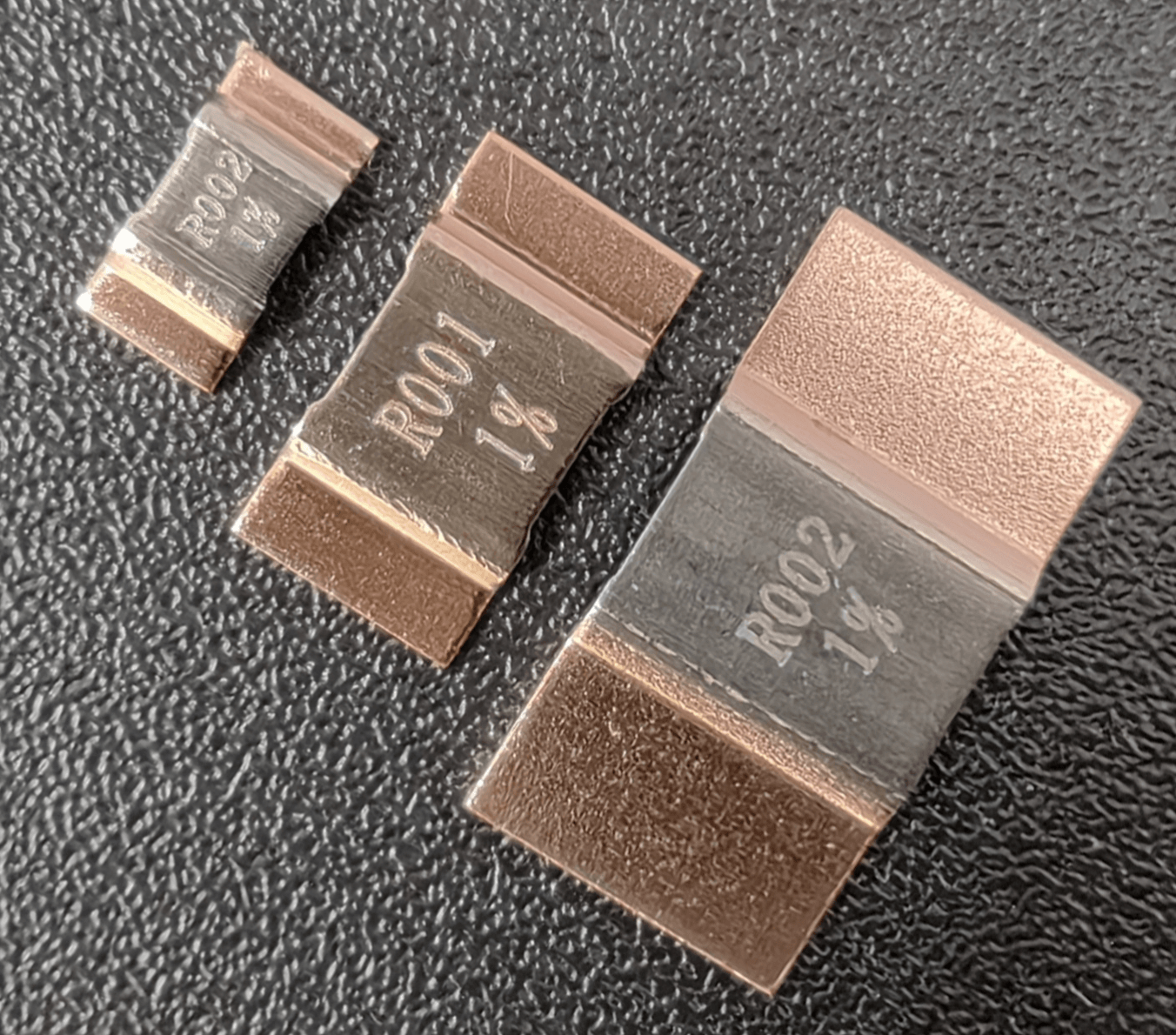
Manganin alloy resistor
Nickel-chromium is an alloy system with nickel as the base and adding 10%-20% chromium. Chromium elements form a dense oxide film on the surface, giving the material excellent high-temperature stability and oxidation resistance. Therefore, the TCR of nickel-chromium is not only lower in absolute value but also has better linearity over a wide temperature range; its long-term load stability and pulse impact resistance are generally better than manganin. The corresponding cost is higher material costs, and the thermoelectric potential is slightly higher than manganin.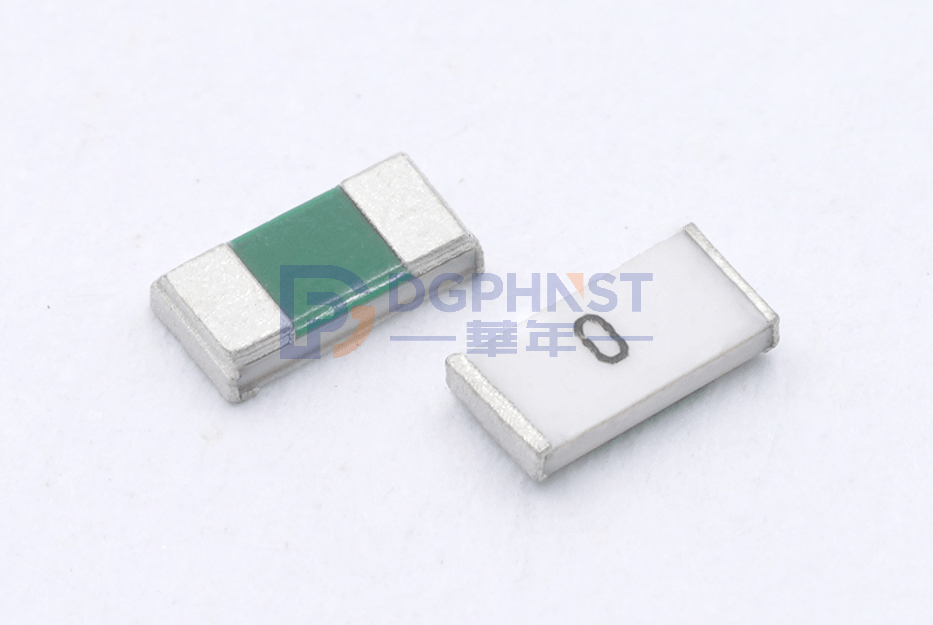
Nickel-chromium alloy resistor
In short: manganin excels in "low thermoelectric potential + normal temperature stability + cost-friendly", while nickel-chromium excels in "low temperature drift + high temperature resistance + long life".
| Dimension | Manganin (Manganin) | Nickel-Chromium (NiCr) |
| TCR | Low, commonly ±20~±50ppm/℃ | Can be lower, some ±10~±25ppm/℃ |
| Thermoelectric potential | Very low, interference is small in small signal measurement | Relatively high |
| Long-term stability | Good performance | Excellent, stronger control of resistance drift under high temperature continuous load |
| Maximum temperature resistance | Moderate | High |
| Cost | Relatively low | Relatively high |
| Typical applications | General sampling, industrial control, power supply | High precision, automotive, high temperature conditions |
The TCR in the table is only the initial nominal value. What determines the actual circuit is the temperature of the resistor body (including the superposition of ambient temperature and self-heating), not just the ambient temperature. Under the same power consumption, the smaller the package and the worse the heat dissipation, the more significant the self-heating, and the error caused by TCR will be amplified exponentially. This is also the reason why many designs pass laboratory tests but show deviations when fully loaded in the whole machine.
Among the mainstream brands in the market, Tian Er Technology's manganin alloy resistors are widely used in general industrial control and consumer scenarios, with outstanding cost-performance. Huade Electronics' STE series nickel-chromium alloy resistors have mature application schemes in high-precision and high-temperature conditions such as automotive and energy storage.
2. Three-step Material Selection Method, Reversing Materials from Working Conditions
Condition One: Where Is the System Precision Budget?
Decompose the allowable sampling error of the entire machine into resistor initial accuracy, TCR, self-heating, ADC quantization, and reference source drift.
If the system allows about 1% sampling error, manganin can completely cope with it, and the cost-performance advantage is obvious. Only when the system requires within 0.5% or higher precision and the working temperature fluctuation range is large, the low-temperature drift advantage of nickel-chromium can be transformed into practical value. Precision is allocated, not stacked from a single component.
Condition Two: How High Is the Ambient Temperature of the Resistor?
Manganin's shortcomings are concentrated in sustained high-temperature conditions. If the resistor is close to MOSFET, inductor, or power module, and the local ambient temperature remains above 80°C for a long time, or needs to meet working conditions of 125°C or higher, nickel-chromium should be prioritized. Under high-temperature long-term load, nickel-chromium has stronger resistance drift control capability, and its aging curve is flatter.
It is also necessary to combine the power derating curve for calculation. The available power in the same package will significantly decrease in the high-temperature area, and if necessary, the package size should be upgraded instead of changing the material.
Condition Three: DC Sampling, or Repeated Large Pulses?
Alloy resistors have much better pulse resistance than ordinary thick-film resistors. However, in harsh conditions where high temperature and repeated large pulses overlap (such as motor start-up, short-circuit protection, pulse load), nickel-chromium usually performs better in maintaining resistance values and is less likely to experience irreversible shifts.
If the system has frequent high-current transients, it is recommended to clearly define the pulse waveform, duty cycle, and number of cycles during the selection phase and require the supplier to provide corresponding pulse life data.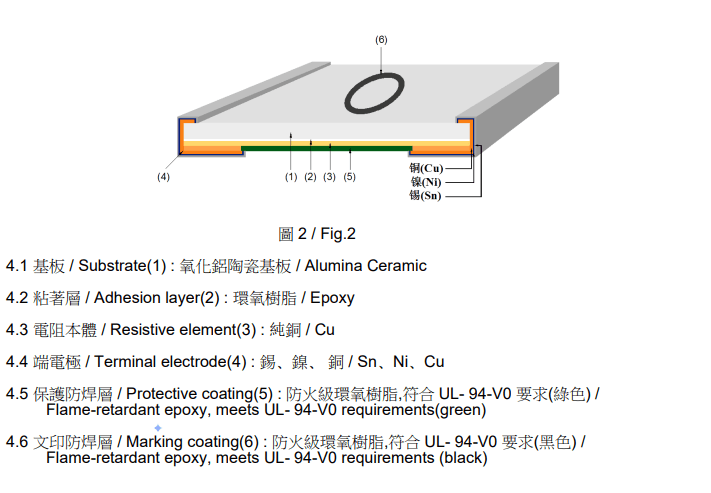
3. Two Common Material Selection Misconceptions
Misconception One: Only Focus on TCR Nominal Value for Selection
TCR is just an initial parameter, not everything. Many device datasheets have impressive TCR indicators on the first page, but after thousands of hours of continuous load aging, the resistance drift becomes significantly larger, and the initial temperature drift margin saved is entirely consumed by later aging.
When selecting, it is advisable to request complete reliability data, including high-temperature load life, temperature cycling, humidity, and pulse durability, focusing on total error throughout the entire lifecycle, rather than a single initial indicator.
Misconception Two: Always Choose Nickel-Chromium
Excessive precision is also a cost waste. Although the price difference of a single resistor seems only a few cents, once mass-produced tens of thousands of units, the accumulated material cost becomes considerable, and it also occupies BOM space. A more reasonable approach is to differentiate design by channel: use nickel-chromium for key high-precision sampling channels (such as power metering, closed-loop feedback); use manganin for general non-key channels (such as overcurrent protection, status monitoring). Balancing performance and cost with an architectural mindset is more in line with engineering logic than a one-size-fits-all approach.
4. Domestic Substitution Evaluation Checklist, Changing Materials Needs Verification
When switching from imported to domestic, or changing resistor materials and brands, it is not enough to only compare resistance value and power. As an authorized agent of well-known alloy resistor brands such as Tian Er Technology, Huade Electronics, and Xinwei, Huanyan Mall reminds that when changing materials, it is recommended to verify the following items one by one:
1. Resistance value and tolerance level (including shipping distribution and sorting rules)
2. TCR and segmented temperature curves, not a single value
3. Rated power and power derating curve (calculated according to actual ambient temperature)
4. Package size, terminal height, PCB pad and layout compatibility
5. Terminal structure, four-terminal Kelvin sampling method, and wiring direction
6. AEC-Q200 rating, RoHS/REACH and other compliance certifications
7. Long-term load stability, aging drift, and pulse life data
8. Supply cycle, minimum order quantity, production capacity, and second-source strategy
Even if the parameters match perfectly, it must complete sample testing verification and cannot directly switch to mass production without testing. The verification content should cover at least normal temperature accuracy, full temperature range drift in high and low temperatures, full load temperature rise, pulse endurance, and comparison before and after high-temperature aging. The specification sheet is a reference, and measured data is the final criterion.
In Conclusion
Resistor material selection has never been a simple parameter comparison, but a comprehensive prediction of three hidden variables: temperature, pulse, and aging. Subjective experience often tends to underestimate their cumulative impact on resistance values, and these deviations tend to be exposed during mass production.
Huanyan Mall provides samples of manganin and nickel-chromium of the same specification, covering product lines of Huade Electronics and Tian Er Technology, including 1206 and 2512 packages, supporting comparative testing; based on the overall machine working conditions, it can provide selection suggestions and error budget breakdowns.