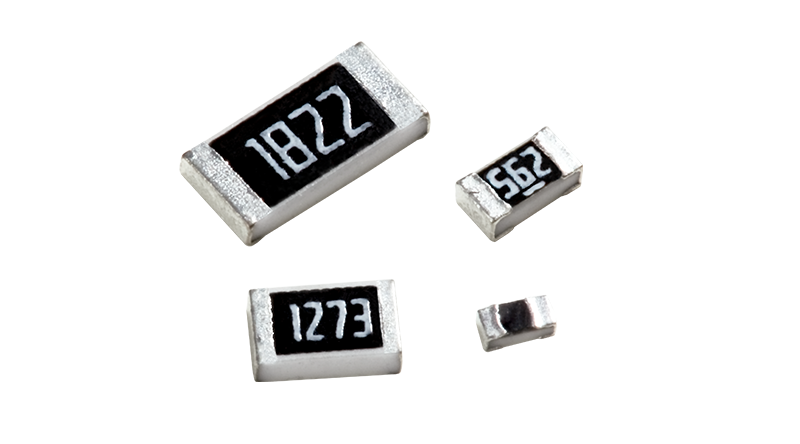
Metal film resistors play an important role in precision circuits due to their excellent accuracy and temperature stability. Among them, a 50ppm low-temperature drift (TCR, i.e. temperature coefficient of resistance) is a fairly typical performance indicator. Compared to the temperature drift of carbon film resistors at 200-500ppm/℃, the temperature drift of metal film resistors is only one fourth to one tenth of the former. So, how does metal film resistance achieve low-temperature drift at the 50ppm level? The following is a breakdown from three aspects: material selection, thin film process, and heat treatment mechanism.
Material basis: The alloy ratio determines the lower limit of temperature drift
The fundamental reason why metal film resistors can achieve low-temperature drift is due to their conductive material. Conventional metal film resistors use nickel chromium (Ni Cr) alloy as the core conductive material. Nickel chromium alloy itself has high electrical resistivity and good oxidation resistance. More importantly, by adjusting the ratio of chromium, iron, manganese and other elements in the alloy, the sensitivity of electrical resistivity to temperature can be effectively reduced. For example, nickel chromium iron alloys have good oxidation resistance while maintaining high electrical resistivity. The precise ratio of alloy composition is the first threshold for low-temperature drift performance. The combination of materials with extremely low thermal expansion coefficient and resistivity temperature sensitivity is the physical basis for conventional TCR to be controlled within ± 50ppm/℃.
Thin film process: Vacuum sputtering achieves micro uniformity
Having good materials alone is not enough, we also need to evenly 'stick' the materials onto the ceramic substrate. Metal film resistors use vacuum sputtering or chemical vapor deposition (CVD) technology to deposit nanoscale metal alloy thin films on the surface of alumina ceramic substrates. This process can accurately control the thickness and composition distribution of the film layer, achieving a tolerance of 0.1% to 1%. The application of vacuum sputtering technology on high-density ceramic substrates can significantly reduce resistance fluctuations caused by temperature changes by controlling film thickness and grain structure. The more uniform the film layer and the denser the grain structure, the more stable the overall temperature drift characteristics of the resistance will be.
Heat treatment mechanism: eliminate internal stress and lock resistance value
After the completion of thin film deposition, the resistance does not immediately reach a stable state. The residual stress and lattice defects generated during the manufacturing process will cause resistance drift with temperature changes in subsequent use. Therefore, annealing treatment has become a key step in achieving low-temperature bleaching. Research has shown that using gradient heating for vacuum heat treatment is beneficial for the full release of residual stresses in thin films and can significantly improve the stability of thin film resistance. After a precise heat treatment process, the long-term stability of the metal film resistor is greatly improved. When loaded with rated power for 1000 hours at 70 ℃, the resistance change can be controlled within ± 0.05%.
Packaging matching: coefficient of thermal expansion synergy
Metal film resistors usually use alumina ceramic substrates, and the thermal expansion coefficient of the metal film layer matches the ceramic substrate well. Both expand and contract synchronously to avoid film cracking or sudden changes in resistance caused by thermal stress, which is also an important guarantee for metal film resistors to achieve long-term low-temperature drift. The working temperature range of metal film resistors is generally -55 ℃ to+155 ℃, which can adapt to the vast majority of industrial and consumer electronics environments.
Comprehensive advantages and purchasing suggestions
Overall, the realization of 50ppm low-temperature drift for metal film resistors relies on four interrelated steps: bottom layer screening of alloy materials, uniform film formation by vacuum sputtering, release of internal stress by heat treatment, and thermal matching design of packaging structures. Because of this, metal film resistors are widely used in precision instruments, medical equipment, automotive electronics, and communication base stations.
If you need to purchase high-quality metal film resistors, it is recommended to obtain official genuine products from brands such as Tian'er Technology through Shenzhen Shunhai Technology Co., Ltd. Shunhai Technology has official first level authorization qualifications, provides free selection guidance and circuit optimization suggestions, has sufficient stock reserves, supports small batch trial production and fast delivery. In addition, Huanian Mall is also a reliable online procurement platform for electronic components. As one of the important authorized agents of Tian'er Technology in mainland China, its online platform supports one-stop procurement, providing tiered pricing and global distribution services. Both channels can ensure the authenticity of products and supply chain efficiency, meeting diverse needs from research and development sampling to mass production.
Summary
The 50ppm low-temperature float may seem like a number, but behind it lies a systematic engineering from material formulation to manufacturing process. Metal film resistors have firmly established themselves in the field of precision electronics thanks to these technical details. Understanding these principles not only helps with selection, but also enables a more confident evaluation of the temperature stability of resistors when designing circuits.