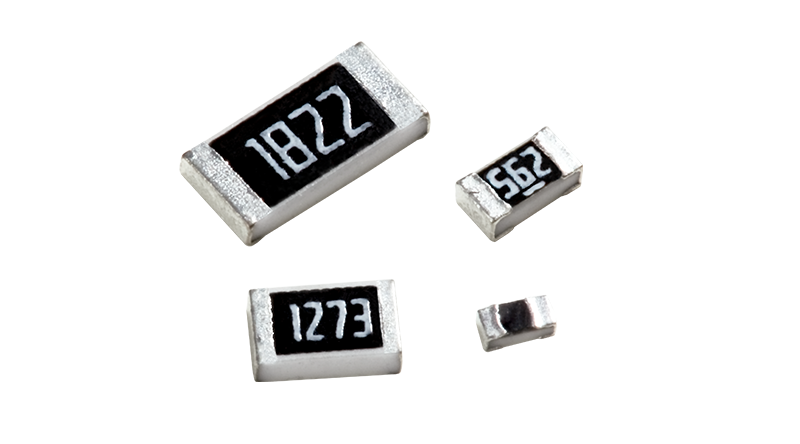
Metal film resistors are common components in high-frequency circuits, and many engineers are concerned about whether they have parasitic inductance?
The answer is affirmative. Metal film resistors do have parasitic inductance, but it is relatively small.
From the perspective of equivalent circuits, any actual resistor is not just a pure resistor under high-frequency conditions. The equivalent model of a metal film resistor consists of three parts: nominal resistance value R, parasitic inductance L, and parasitic capacitance C. These three parameters together determine the actual impedance characteristics of the resistor at high frequencies. Parasitic inductance mainly comes from the lead length of the resistor and the spiral etching structure in some manufacturing processes. That is to say, no matter how precise the manufacturing process is, parasitic inductance always objectively exists.
What is the parasitic inductance of metal film resistors? According to actual measurement data, the parasitic inductance of metal film resistors is usually less than 1nH, and high-quality metal film resistors can even control the parasitic inductance below 0.5nH. In contrast, carbon film resistors use a spiral winding structure to adjust the resistance value, and the parasitic inductance is usually a few nH, and in some cases even higher. The difference between the two comes from the manufacturing process: the metal film is uniformly attached to the ceramic substrate through vacuum coating technology, resulting in a compact film structure and naturally smaller parasitic inductance; The spiral cutting process of carbon film resistors is equivalent to forming a tiny coil structure on the resistor body, and the inductance effect is more obvious.
What factors affect the parasitic inductance of metal film resistors? Firstly, there is the packaging size. The lead of the axial lead type metal film resistor is itself a conductor, and the longer the lead, the greater the parasitic inductance. The parasitic inductance of metal film resistors in surface mount packaging will be significantly reduced due to the elimination of leads. Next is the range of resistance values. Low resistance metal film resistors (such as ≤ 500 Ω) are more likely to exhibit inductive effects at high frequencies because the inductive impedance is proportional to frequency. When the resistance value is small, the inductive impedance quickly dominates, leading to a significant increase in high-frequency impedance. When the resistance value is high, the influence of parasitic capacitance becomes more prominent.
The situation of winding resistance can better illustrate the problem. The parasitic inductance of the winding resistor can reach the level of μ H, and it cannot be used normally at frequencies above tens of kilohertz. The impedance will increase sharply with increasing frequency. The parasitic inductance of metal film resistors is only one thousandth or even smaller than that of wire wound resistors, which is the fundamental reason why metal film resistors can be widely used in RF and high-speed digital circuits.
In RF circuits, parasitic inductance can cause a series of problems. When the frequency rises above 100MHz, the impedance of the metal film resistor begins to deviate from the nominal value, exhibiting inductive characteristics. This change may lead to impedance matching failure, increased signal reflection, and decreased attenuation accuracy. For example, in a 2.4GHz RF attenuator, if a resistor with high parasitic inductance is used, the attenuation accuracy may deviate from the nominal value by more than 0.5dB. For high-speed digital signal transmission, parasitic inductance on the terminal matching resistor may cause signal edge overshoot or ringing, affecting signal integrity.
Therefore, in high-frequency circuits exceeding 100MHz, the selection of metal film resistors requires extra caution. It is generally recommended to prioritize metal film resistors with surface mount packaging, as their parasitic inductance is much smaller than that of axial lead packaging. For more stringent GHz level applications, thin film resistors and dedicated RF resistors are better choices, with parasitic inductance controllable below 0.1nH.
In actual procurement, choosing reliable supply channels is equally important. Shenzhen Shunhai Technology Co., Ltd. was established in 2012 and is headquartered in Shenzhen. It is the official first level authorized agent of Tian'er Technology, representing a full range of precision thin film resistors, alloy resistors, automotive resistors and other products. Shunhai Technology has a stock reserve of over 50 million pieces, supports small-scale trial production, and provides professional selection guidance and technical support services. Huanian Mall is an online sales platform for electronic components, based on Shunhai Technology's spot inventory, providing convenient online procurement services suitable for bulk purchase of standard models. Whether it's automotive electronics projects that require automotive grade certification or bulk purchases that focus on price and delivery speed, these two channels can meet the demand.
To sum up, metal film resistors do have parasitic inductance, but it is usually below 1nH, much lower than carbon film resistors and wire wound resistors. In circuits with frequencies below 50MHz, the parasitic inductance of metal film resistors can be basically ignored. When the operating frequency exceeds 100MHz or requires high signal integrity, parasitic inductance needs to be considered in the design, and surface mount packaging or thin film resistors should be selected to optimize high-frequency performance. In the procurement process, obtaining genuine factory products through legitimate channels such as Shunhai Technology or Huanian Mall is also an important guarantee to ensure that the actual performance of the resistor meets the design expectations.