
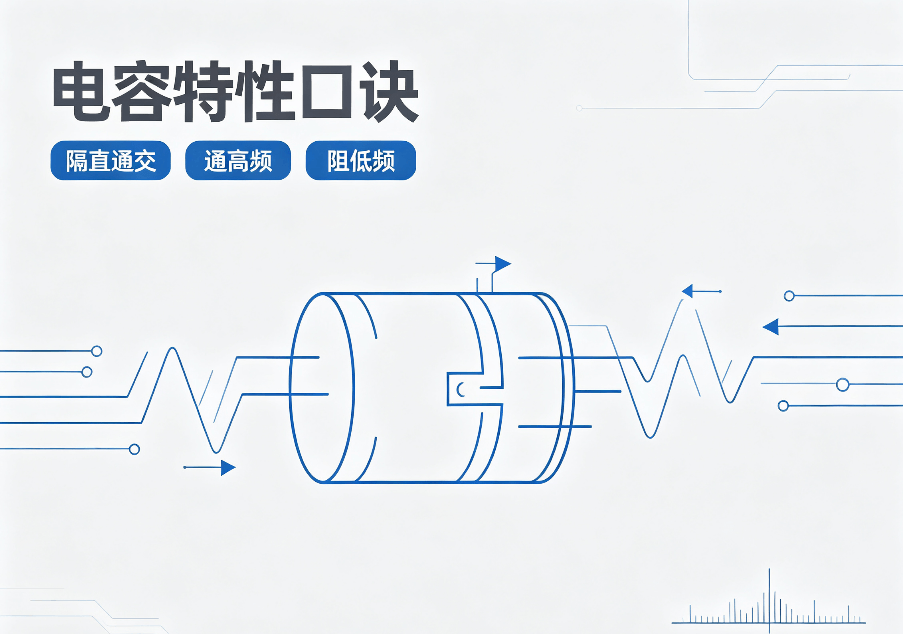
The characteristic of capacitors: Isolating DC, passing AC, passing high frequency, blocking low frequency.
Although simple, all the functions of capacitors in circuits stem from the core action of charging and discharging. The distinct conduction characteristics under high and low frequency signals form the fundamental basis for filtering, signal separation, frequency tuning, and resonant circuits.
01 What is the essence of a capacitor?
In short, a capacitor is like a "temporary power bank" that stores electric charge. Its core functions are only two: charging and discharging.
Unlike resistors, which purely block current and consume energy, capacitors do not consume energy. Instead, they determine whether a circuit is conductive based on their charging and discharging states.
What we often refer to as "isolating DC and passing AC" is a basic characteristic of capacitors:
l DC: Voltage is stable, and once the capacitor is fully charged, it stops charging and discharging, making the circuit equivalent to being open, so it isolates DC;
l AC: Voltage changes in magnitude and direction continuously, causing the capacitor to repeatedly charge and discharge, allowing current to flow through the circuit, so it passes AC.
The ability to pass high frequencies and block low frequencies is a unique characteristic of capacitors due to differences in charging and discharging speed at different AC frequencies.
02 Core Principle: Why does it pass high frequency and block low frequency?
First, remember a key concept: Capacitive Reactance (Xc).
Capacitive Reactance (Xc) is the resistance that a capacitor provides to an AC signal. The higher the reactance, the harder it is for the signal to pass; the lower the reactance, the easier it is for the signal to pass.
Reactance formula: Xc = 1/(2πfC) = 1/(ωC), where f = signal frequency, C = capacitance.
From the formula, it's clear that reactance is inversely proportional to frequency and capacitance. The higher the frequency or the larger the capacitance, the smaller the reactance, and the weaker the blocking effect. Conversely, the lower the frequency or the smaller the capacitance, the stronger the blocking effect.
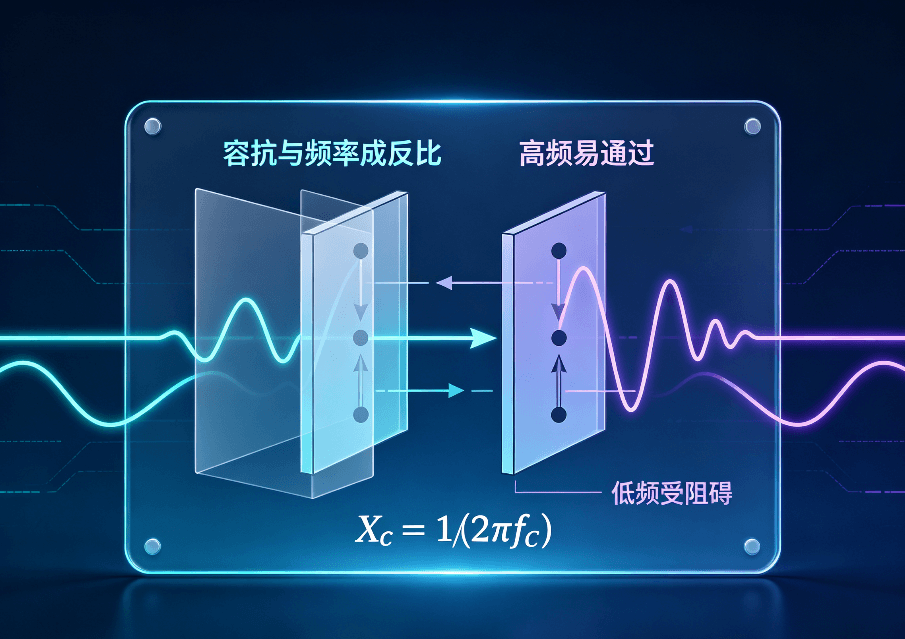
▶ Passing High Frequency: High-frequency signals pass unobstructed
High-frequency signals have extremely fast voltage change rates, with frequent switching between positive and negative half cycles.
The capacitor hasn't had time to fully charge before the voltage direction reverses, continuously triggering the charging and discharging cycle. The circuit remains conductive throughout, with almost no resistance.
In short: High-frequency signals move quickly, and the capacitor keeps charging and discharging, acting as a direct channel.
▶ Blocking Low Frequency: Low-frequency signals face difficulties
Low-frequency signals have slow voltage change rates, with long durations per cycle.
Within half a cycle of a low-frequency signal, the capacitor can quickly become fully charged, and during the remaining time, it no longer charges or discharges, resulting in near-zero current, effectively being "blocked".
Blocking low frequency doesn't mean cutting off the signal, but rather significantly impeding or attenuating it. This is fundamentally different from the complete isolation of DC.
Comparing the capacitor to a water reservoir, and current to water flow:
- High-frequency signals: Water flows back and forth rapidly, and the reservoir doesn't have time to fill up, maintaining a continuous inflow and outflow, resulting in minimal resistance;
- Low-frequency signals: Water flows slowly, and the reservoir fills up quickly, preventing further water from entering, greatly reducing the flow, effectively blocked.
By combining the reactance formula, you can understand the classic selection rules in circuits: Small capacitors pass high frequencies, large capacitors pass low frequencies.
- Small-capacity capacitors (pF, nF level): Small capacity, very fast charging and discharging, suitable for high-frequency signals, specifically used to filter out high-frequency noise and RF interference;
- Large-capacity capacitors (μF level): Large capacity, slow charging and discharging, less resistance to low-frequency signals, mainly used for low-frequency filtering, power stabilization, and energy storage.
This is why small and large capacitors are always used together on circuit boards: small capacitors filter high-frequency noise, and large capacitors stabilize low-frequency voltage, achieving perfect filtering effects through complementary use.
03 Practical Applications: What is this characteristic useful for?
The characteristic of capacitors passing high frequencies and blocking low frequencies is a fundamental core in electronic circuits, covering almost all electronic products. The main applications include three areas:
1. Signal Filtering (Most Commonly Used)
Circuits generate noise during operation, mostly in the form of high-frequency signals. Using the property of capacitors to pass high frequencies, high-frequency noise can be directed to ground for removal, leaving only clean low-frequency signals, making the circuit more stable.
2. Signal Separation
When mixed signals contain high-frequency, low-frequency, and DC components, capacitors can precisely select signals: allow high-frequency AC to pass, block low-frequency AC, and isolate DC, achieving the separation and transmission of different signals.
3. Resonance and Frequency Tuning Circuits
Capacitors combined with inductors form LC resonance circuits. By utilizing the difference in impedance between high and low frequencies, functions such as radio station selection, frequency modulation, and signal tuning can be achieved.
In Conclusion
The characteristic of capacitors "passing high frequencies and blocking low frequencies" is an intuitive manifestation of the dynamic change in reactance with signal frequency, fundamentally depending on the matching relationship between the capacitor's charging and discharging speed and the signal frequency.
High-frequency signals match with small-capacity capacitors that charge and discharge quickly, achieving noise filtering and signal transmission; low-frequency signals match with large-capacity capacitors that charge and discharge slowly, completing voltage stabilization and energy storage. Together, small and large capacitors complement each other, forming an important barrier for stable circuit operation.
Shunhai Technology will continue to provide content on electronic components. If interested, please like and follow to unlock more hardware knowledge!