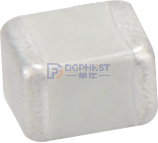
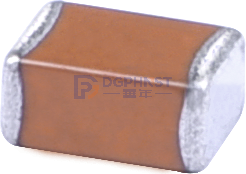
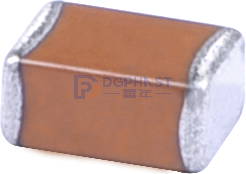
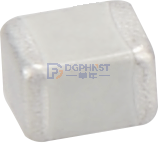
The voltage of a capacitor cannot change abruptly, nor can the current of an inductor.
This rule is the basic principle of analog circuits, digital circuits, and power supply design. Almost all applications of capacitors —— filtering, energy storage, coupling, delay, and voltage regulation —— are all based on this characteristic.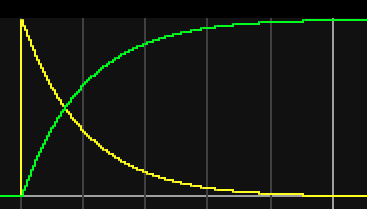
Yellow line: Current Green line: Voltage
The curve of the capacitor voltage and current over time when the capacitor is connected to the circuit
One.Why Can't Capacitor Voltage Change Instantly?
The voltage across a capacitor cannot change abruptly; it can only rise or fall slowly and continuously over time. The so-called "abrupt change" refers to the voltage jumping from 0V to 12V in 0 seconds, or dropping directly from 24V to 0V. Such abrupt changes do not conform to the physical mechanism of capacitors.
To understand this characteristic, we need to go back to the essence of the capacitor. The core function of a capacitor is to store charge and electric field energy. It is completely different from a resistor, which consumes electrical energy, while the capacitor is an energy storage component.
The formula for capacitor voltage is U=Q/C, where U is the voltage across the capacitor, Q is the amount of charge stored by the capacitor, and C is the capacitance of the capacitor.
Under normal circuit conditions, the capacitance C is fixed, and the capacitor voltage is determined by the amount of charge it stores. For the voltage to change, the amount of charge stored in the capacitor must increase or decrease. Charging requires a charging process, and discharging requires a discharging process.
Both charging and discharging take a certain amount of time. Charge cannot be created or destroyed out of nowhere, following the law of conservation of energy. If the capacitor voltage could change instantaneously, it would mean that the charge could be accumulated or cleared instantly, which contradicts the law of conservation of energy. This is the fundamental reason why capacitor voltage cannot change abruptly.
Two.Current Can Change Abruptly, But Voltage Cannot
Why can current change abruptly, but voltage cannot?
Let's make a comparison. The current of a capacitor is essentially the speed of charge movement. Current can change suddenly in size or even stop, meaning the charging and discharging speed can change instantly. However, voltage is the result of accumulated charge, a "cumulative value" rather than a "instantaneous value".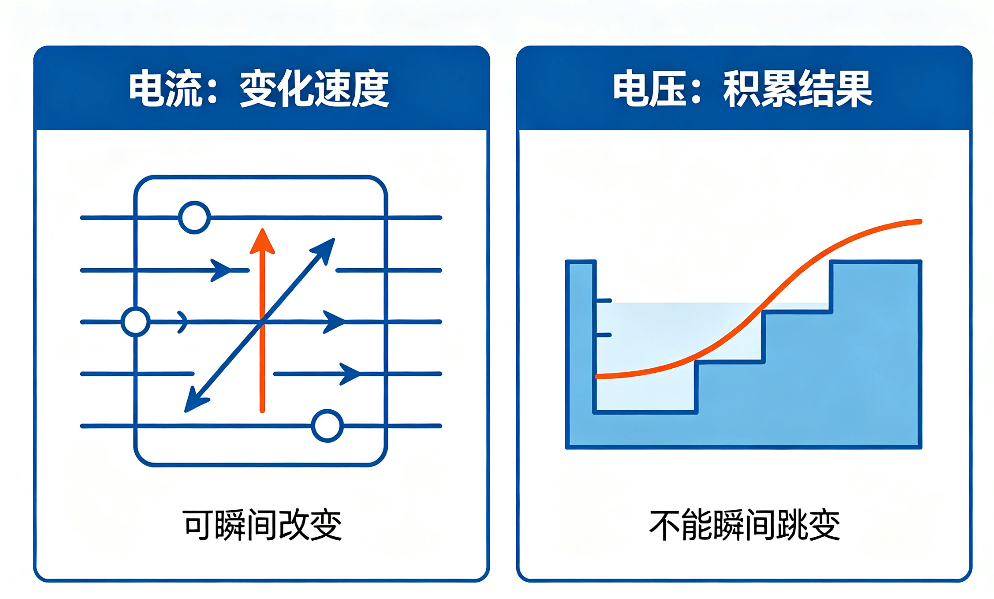
We can use a reservoir as an analogy: a capacitor is like a water reservoir, voltage corresponds to the water level in the pool, and current corresponds to the flow rate of water entering or exiting. Water flow can quickly open or shut off, but the water level in the reservoir cannot suddenly surge or drop. The water level change depends on continuous inflow and outflow, consistent with the logic of capacitor voltage change.
Because of this core difference, a classic phenomenon occurs in circuits: when a switch is closed or opened, the capacitor current can jump suddenly, but the voltage at both ends remains continuously changing without sudden jumps. This is the key point to distinguish between the characteristics of capacitor voltage and current.
Three.Understanding the Characteristics Through RC Charging and Discharging
By combining common RC charging and discharging circuits, we can better understand this principle in practical circuits. When a resistor and capacitor are connected in series to a power source, the power supply voltage is immediately applied to the circuit, but the capacitor voltage does not directly equal the power supply voltage. Instead, it gradually rises along an exponential curve, starting from 0V and approaching the power supply voltage.
When a fully charged capacitor discharges through a resistor, its voltage does not immediately drop to zero but decreases gradually. Throughout the entire charging and discharging cycle, the voltage always changes smoothly without any abrupt jumps. The time constant of the circuit [ τ=RC ] determines how fast the voltage changes. The larger the resistance or capacitance, the slower the voltage change and the more stable the voltage state.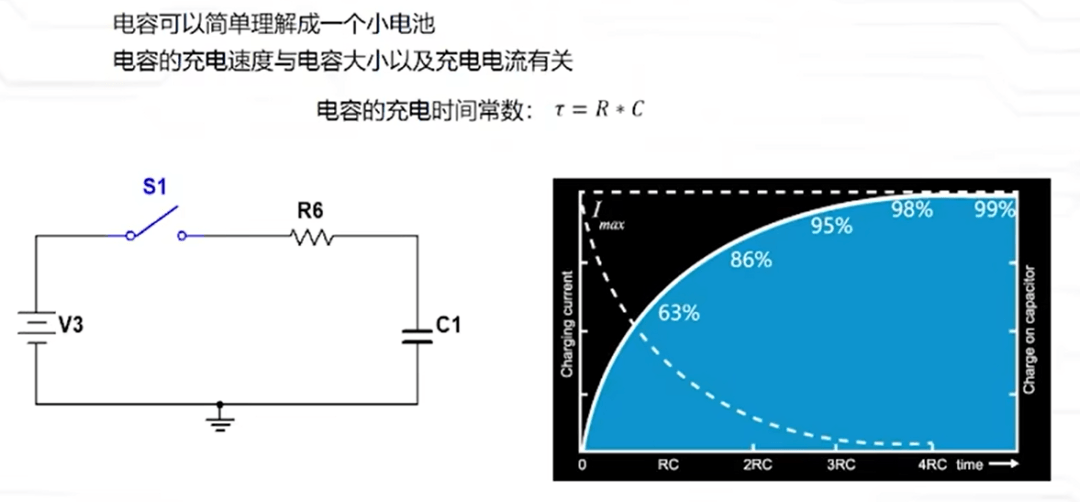
The fact that a capacitor's voltage cannot change abruptly does not mean that the voltage cannot change at all. Rather, it means that it cannot undergo a drastic change in zero time. Given enough time, the capacitor voltage can follow the circuit voltage to rise or fall, but it resists sudden voltage jumps.
Four.Uses of Capacitor Voltage Characteristics in Circuits
This core characteristic covers almost all electronic and electrical devices in electronic circuits.
1.Power Supply Filtering and Voltage Stabilization
This is the most widespread use of capacitors. During the operation of switching power supplies and DC voltage stabilization circuits, the circuit generates voltage fluctuations, ripple, and spike interference.
Filtering capacitors are connected in parallel at the output of the power supply. Relying on the characteristic that voltage cannot change abruptly, they limit the amplitude of voltage fluctuations. When the power supply voltage suddenly increases, the capacitor quickly charges to absorb excess energy, suppressing the voltage peak. When the power supply voltage suddenly drops, the capacitor discharges outward to replenish the energy, mitigating the voltage drop, keeping the output voltage stable and reducing the interference caused by ripple on chip operation.
2.Delay Timing Circuits
Microcontroller reset circuits, delay switches, and timing circuits mostly use the slow change of capacitor voltage to achieve delay functions. At the moment of power-on, the capacitor voltage is 0. As the charging process progresses, the voltage gradually increases. When the voltage reaches the chip threshold, the circuit performs a reset or switch action. By adjusting the RC parameters, the delay time can be controlled, and the circuit structure is simple.
3.Other Application Scenarios
In addition, scenarios such as signal coupling, decoupling, and surge suppression also rely on this characteristic. In AC signal transmission, the capacitor blocks DC and transmits AC, ensuring the integrity of the signal waveform and preventing distortion by relying on the smooth change of voltage. When there are surges or sudden high-voltage shocks in the circuit, the capacitor buffers the voltage change, protecting sensitive components from being damaged by instantaneous high voltage.
Conversely, if the capacitor voltage could change abruptly, electronic devices would not work properly. Even small fluctuations in the power supply or shocks caused by switch operations would directly cause voltage jumps in the circuit, leading to repeated resets of the chip, signal distortion, and damage to components, making the device unable to operate stably.
HNST WELCOME! 0755-23173910
English |中文

Cart
{{cartCount}}
你当前的浏览器版本过低或不支持。请升级或更换浏览器。推荐浏览器 Chrome Edge。