A modern drone is not simply a combination of motors, propellers, and batteries.
Its internal components typically include a flight control system, power management, attitude sensors, communication modules, GNSS positioning, image processing, cameras, gimbals, radar, and various auxiliary sensors.
Behind these modules are numerous electronic components.
The drone's electronic system can be simply understood as three layers: the power system is responsible for "flying", the control system ensures "stability", and the perception and communication system enables "knowing where it is, what it sees, and transmitting information".
In these three systems, sampling resistors have irreplaceable key applications. Sampling resistors are evolving from traditional "basic current-limiting components" to core sensing devices that affect current monitoring, power control, motor speed regulation, and overall system stability. Shunhai Technology, as an authorized agent of brands such as Walter and Ever Ohms, provides a full series of original sampling resistors, covering component selection, sample supply, and bulk delivery services for scenarios such as drone flight control, BMS, and motor drive.
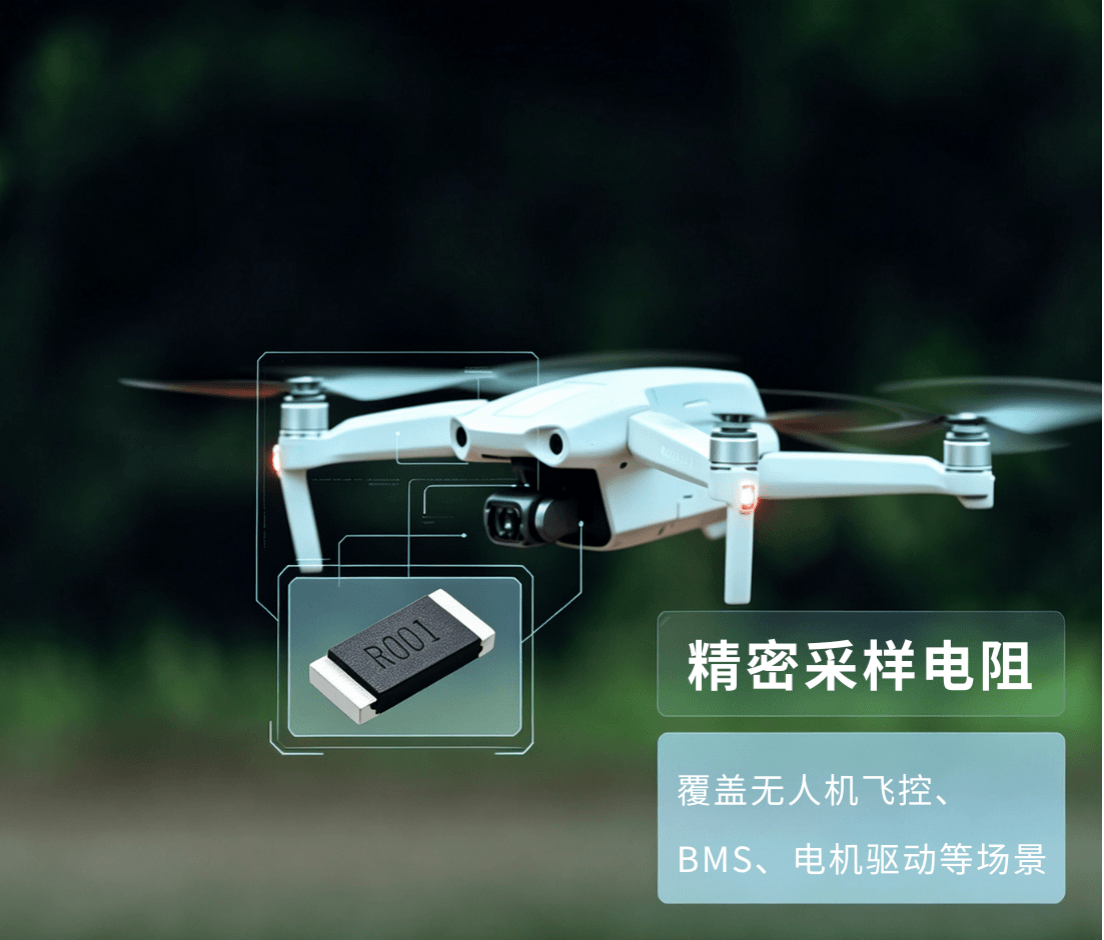
One, why does the flight control system cannot do without "precision sampling resistors"?
The flight control system is the brain of the drone.
Sensors such as gyroscopes, accelerometers, magnetometers, and barometers continuously collect data on attitude, position, and environmental conditions, which are analyzed by control algorithms to determine the flight state and output control instructions. However, the flight control system also relies on real-time and accurate current signals; current feedback from the entire system and modules is crucial for the flight control system to identify load and avoid failures.
During drone flight, dynamic changes in power output, frequent start-stop of electronic modules, and continuous fluctuations in circuit current occur. The flight control system relies on sampling resistors to capture subtle current changes, process them through signal acquisition, filtering, and analog-to-digital conversion, achieving precise control of the entire system. The precision of the sampling resistor directly affects the flight control effect and flight stability.
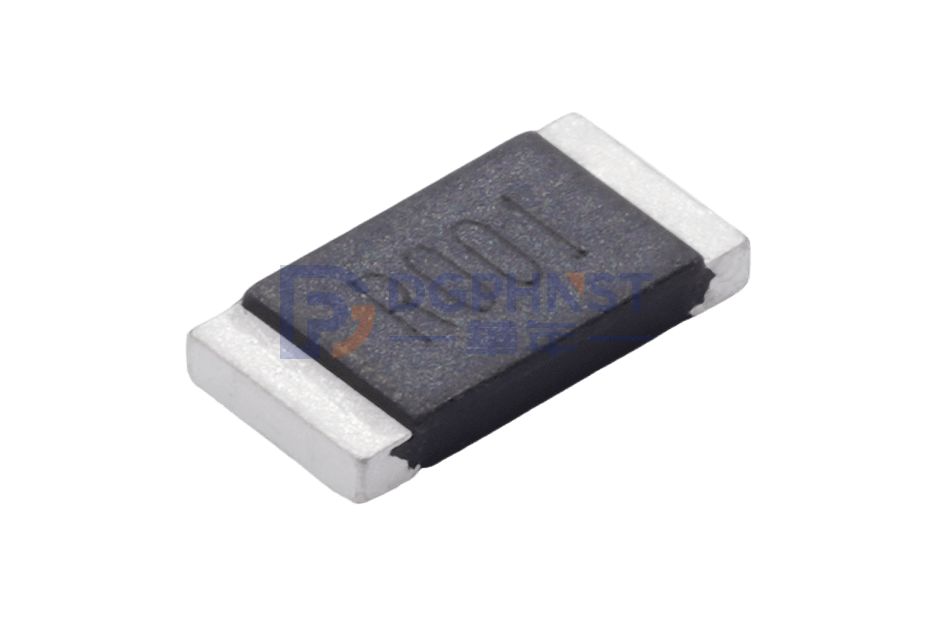
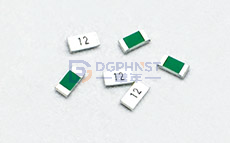
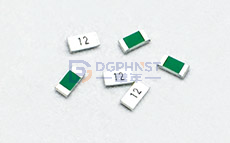
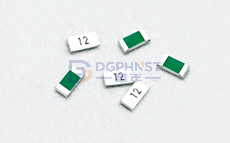
Walter MSH2512M2W0R001FI alloy resistor
Based on the sampling principle: V = I × R.
The sampling resistor is connected in series with the circuit to measure the voltage difference across its terminals and convert it into real-time current, which is then processed by ADC and the main controller. If the resistance value deviation is large or the temperature drift is too high, it will cause distortion in current sampling, leading to misjudgment by the flight control system regarding power supply and load conditions.
The operating conditions of drones are complex, including exposure to sunlight, extreme cold, motor heat, and temperature differences caused by airflow, all of which can lead to significant fluctuations in the temperature of the onboard circuits. Ordinary resistors are significantly affected by temperature, causing their resistance values to drift, and the sampling data shifts accordingly, resulting in abnormal attitude adjustment at best and incorrect load judgment or false fault reporting at worst.
Therefore, the core parameters of sampling resistors used in drone flight control systems focus on low resistance tolerance, low temperature coefficient (TCR), long-term stability, and high-frequency dynamic response. High-performance precision sampling resistors can maintain accurate and stable sampling under wide-temperature and dynamic current conditions, providing reliable basis for flight control algorithms and ensuring safe and stable drone flight. Walter MSH series alloy sampling resistors and Ever Ohms MA/MR series metal alloy sampling resistors are such precision current detection components, capable of meeting the low TCR and high-stability sampling requirements of drones under wide-temperature environments.
Two, four core application scenarios, spanning the entire power system of the drone
Sampling resistors are not only applied in single modules but also span the four core systems of drone battery management, motor drive, power regulation, and overload protection, comprehensively safeguarding flight safety.
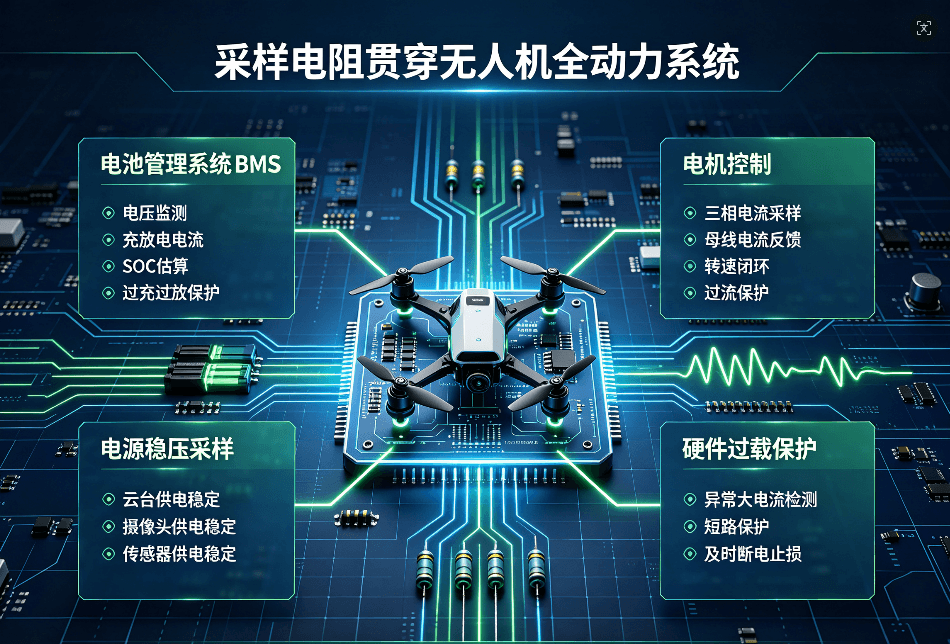
1. Battery Management System
How long and how stable a drone can fly largely depends on the capabilities of its power battery and battery management system (BMS). The BMS needs to continuously monitor core parameters such as battery voltage, charge/discharge current, cell temperature, and internal resistance, estimate remaining battery capacity (SOC) in real time, manage charge/discharge power, and predict battery faults.
In the BMS sampling circuit, the sampling resistor is connected in series in the battery power supply loop, completing current signal collection based on precise resistance value parameters, and cooperating with operational amplifiers and ADC conversion chips to achieve data analysis. The accuracy of resistance value, temperature drift characteristics, and power tolerance directly determine the detection accuracy and protection response speed of the BMS system.
During daily flights, the drone's low battery warning and accurate endurance calculation rely on the sampling data from the sampling resistor. At the same time, it can accurately identify abnormal situations such as overcharging, over-discharging, and leakage. Once current exceeds the limit, it immediately triggers the protection mechanism.
Drone BMS-specific sampling resistors must simultaneously meet: milliohm-level precision resistance value, ±1% or less high-precision tolerance, ultra-low temperature drift, high pulse power tolerance, and strong long-term working stability, which cannot be replaced by ordinary general-purpose resistors.
2. Motor Control
The core power of drones relies on brushless motors, and the motor's speed, torque, and startup response directly affect the drone's flight speed, maneuverability, and hover stability. The motor controller adjusts PWM output in milliseconds to achieve closed-loop precise control based on parameters such as phase current, bus voltage, and speed, and the foundation of data collection relies on sampling resistors.
In the motor drive circuit, the sampling resistor collects the three-phase operating current and bus current, converting the current signal into a voltage signal transmitted to the main control chip. The system identifies motor load, speed deviation, and stalling risks using sampling data, and dynamically adjusts drive parameters while implementing fault protection such as overcurrent, overload, and missing phase.
When the motor load is too high, stuck, or the speed is abnormal, causing sudden current changes, the flight control system quickly adjusts the output power, balances the speed of each motor, effectively solving issues such as body shaking, deviation, and flipping, making high-altitude flight, fixed-point hovering, and precise operations more stable.
3. Power Supply Regulation Sampling
The external equipment such as gimbals, cameras, obstacle avoidance sensors, and positioning modules on drones require extremely high power supply stability. Voltage and current fluctuations can directly cause video stuttering, positioning drift, and sensor failure.
Sampling resistors work with the power management module to monitor the output current in real time and dynamically adjust the power supply parameters. The high-definition video transmission and precise positioning capabilities of high-end drones depend on the precise support of sampling resistors.
They provide stable power supply for various precision peripherals, ensuring the accuracy and effectiveness of operation data for aerial photography, inspection, and mapping.
4. Hardware Overload Protection
When drones encounter sudden situations such as strong winds, obstacles entanglement, or motor stall during flight, the loop current surges instantly. Without protection, it can easily burn out the equipment and cause a crash. As the first line of defense for hardware protection, the sampling resistor can detect abnormal high currents in real time, quickly trigger overcurrent and short-circuit protection, cut off power in time to minimize damage probability.
Three, why is the sampling resistor more challenging for smaller drones?
Many people mistakenly believe that small drones have lower power and simpler circuits, requiring lower component parameters, but in fact, the opposite is true — micro drones have much higher requirements for the precision, integration, and stability of sampling resistors than large industrial drones.
Small drones have compact bodies and extremely limited PCB board space, but they still have complete core functions such as flight control, motors, communication, and cameras, which force the circuit components to achieve miniaturization, high precision, and high integration.
The limited body space leads to poor heat dissipation conditions, higher working temperatures, and larger temperature fluctuations. At the same time, micro drones have more frequent motor starts and stops, and more intense current fluctuations. The combination of multiple complex working conditions puts three strict demands on the sampling resistors:
- Extremely small package size, suitable for high-density PCB layout, not occupying limited space in the aircraft;
Second, extremely high resistance accuracy and extremely low temperature drift, eliminating sampling drift in small high-temperature environments;
Third, withstand instantaneous high current impact, ensuring power capacity and long-term stability under small volume.
Sampling resistors can perfectly realize the core characteristics of "miniature packaging + milliohm-level high precision + wide-temperature stability", fully meeting the integration and precision development needs of small drones, becoming a key hardware support for the stable flight of micro drones.
In conclusion: Small components, supporting low-altitude safety
In core aspects such as flight control attitude monitoring, battery power management, motor power control, and communication signal stability, sampling resistors are involved throughout the comprehensive monitoring and control of voltage, current, temperature, load, and signals.
As drones progress from "being able to fly" to "autonomous flight, precise operations, stable endurance, and safe controllability", the tolerance space of the entire electronic system continues to shrink, and the parameter stability of every core component becomes crucial. As an authorized agent of several well-known resistor brands, Shunhai Technology can provide original sampling resistors, BOM configuration, sample applications, and FAE technical selection support, helping to stabilize the implementation of drone hardware solutions.