——Edited by Shenzhen Shunhai Technology Co., Ltd. (Lohai PPTC distributor) and Huanian Mall
1. Rapid Growth in Energy Storage: BMS Overcurrent Protection as a Key Safety Factor
As the global energy storage market continues to expand, with projects in commercial, industrial, residential, and grid-side sectors gradually coming online, system safety and long-term operational reliability have become critical industry concerns.
The Battery Management System (BMS) is responsible for cell voltage and temperature monitoring, charge/discharge control, fault warning, and protection, serving as a key component ensuring safe battery pack operation. Among various BMS protection functions, overcurrent protection is fundamental: during abnormal charge/discharge currents or short circuits, overcurrent protection devices must act promptly to prevent damage to board-level components like sampling chips and main controllers. Note that transient surges and ESD are overvoltage issues, handled by TVS diodes and varistors, which work in coordination with overcurrent protection rather than being replaced by it.
Among overcurrent protection solutions, Polymeric Positive Temperature Coefficient (PPTC) resettable fuses offer automatic reset, no manual replacement, and compact size. Surface Mount Device (SMD) types support SMT assembly and are widely used in BMS board-level protection. The Lohai brand from Taiwan provides PPTCs with good performance stability in industrial applications and comprehensive specification coverage, suitable for BMS board-level protection circuits.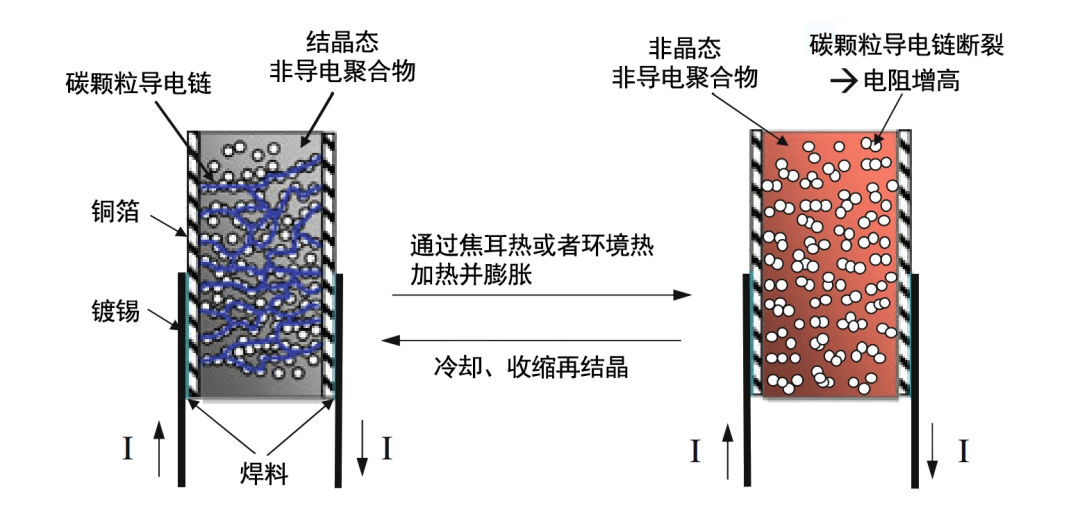
Working Principle of Resettable Fuse
2. What Are the Requirements for Overcurrent Protection Devices in Energy Storage BMS?
Compared to consumer electronics, the operating environment and functional role of energy storage BMS impose higher demands on protection devices:
1. Performance Stability in Wide Temperature Ranges
Energy storage systems are often deployed outdoors or in industrial sites with significant ambient temperature fluctuations. PPTCs must maintain stable trip thresholds and minimal resistance variation across wide temperatures. As thermal devices, their hold current drops significantly as temperature rises. Selection must account for derating curves specified in datasheets to prevent false tripping at low temperatures or protection failure at high temperatures.
2. Precise Overcurrent Response and Low Power Consumption
BMS circuits cover a wide current range, from milliamp-level sampling to amp-level power supplies, requiring matched protection specs. Under normal conditions, devices need low resistance and heat generation to minimize power loss; during faults, they must act quickly to limit circuit current.
3. Long Lifespan and Maintenance-Free Operation
Energy storage systems typically have design lives of 10–15 years. One-time fuses require disassembly for replacement after blowing, increasing O&M costs. PPTCs can operate repeatedly within specified cycles, automatically resetting after fault clearance and cooling, reducing maintenance workload and supporting long-term operation.
4. Compact Size and Standardized Packaging
With increasing integration of BMS motherboards and limited board space, protection devices must be small and compatible with automated SMT production processes.
3. Key Features of Lohai PPTCs for Energy Storage BMS
Lohai, a Taiwan-based brand specializing in overcurrent protection devices, offers industrial-grade PPTCs that meet the above BMS requirements. Key features include:
1. Comprehensive Specification Coverage for Full Circuit Protection
Lohai’s product matrix includes both SMD and through-hole packages. SMD series cover hold currents from tens of mA to several amps; through-hole series handle higher currents and voltages (including 250V, 600V), addressing various low-voltage board-level protection needs.
Whether for low-current cell sampling, main controller power inputs, communication interfaces, or auxiliary power circuits, corresponding models are available, reducing multi-brand sourcing complexity. Note: Short-circuit protection for high-voltage battery pack main circuits should use fuses; board-level PPTCs are not suitable for high-voltage/high-current main loops.
2. Industrial-Grade Wide Temperature Design for Complex Environments
Lohai PPTCs use polymer composite materials. Standard SMD series typically operate from -40°C to +85°C, with some high-temp/automotive-grade series reaching up to 125°C (refer to specific datasheets). They maintain stable protection characteristics in outdoor scenarios ranging from cold northern regions to hot/humid southern areas. Actual selection requires checking hold current against derating curves based on ambient temperature to avoid false trips or delayed protection due to high-temperature derating.
3. Low Resistance and Heat Generation for Energy Efficiency
Conductive resistance directly impacts system power consumption and heat. Lohai optimizes materials and processes to control room-temperature resistance, ensuring low self-heating and power loss during operation. Keeping voltage drop within tens of millivolts minimizes impact on BMS sampling accuracy and system efficiency.
4. Reliable Repeat Action Life Reducing O&M Costs
Lohai PPTCs maintain stable performance within specified action cycles. After fault clearance, current normalization, and cooling, they automatically reset without manual replacement. For distributed energy storage sites with difficult access, this reduces maintenance costs and downtime.
4. Typical Applications of Lohai PPTCs in Energy Storage BMS
In practical BMS designs, Lohai PPTCs provide overcurrent protection in core circuits:
Cell Sampling Circuits: Use small-current, compact SMD PPTCs on voltage sampling lines to mitigate damage from shorts or miswiring affecting sampling chips. Consider resistance and temperature drift effects on precision; if necessary, use miniature one-time fuses or current-limiting resistors.
Main Control Power Input: Series-connected PPTCs at the BMS mainboard power input protect against overcurrent and downstream short circuits, safeguarding core chips. Reverse polarity protection requires dedicated circuits, outside PPTC scope.
Communication Interfaces: Combine series PPTC with parallel TVS diodes on CAN, RS485, etc., providing dual overcurrent/overvoltage protection against wiring errors and surges.
Auxiliary Function Circuits: Protect cooling fans, heating films, status LEDs, and other auxiliary power circuits with PPTCs to enhance overall system reliability.
5. Huanian Mall: One-Stop Source for Lohai Products and Selection Support
Huanian Mall, an electronic component supply chain platform operated by Shenzhen Shunhai Technology Co., Ltd., holds agency qualifications for brands like Lohai, serving energy storage and BMS clients with PPTCs and related services.
The platform stocks mainstream SMD and through-hole packages with common current ratings, supporting small-batch samples and large-volume orders for R&D, prototyping, and mass production. Technical teams assist with device selection and solution matching based on specific BMS circuit parameters, providing datasheets and application references.
Beyond PPTCs, Huanian Mall offers TVS diodes, varistors, ESD protection devices, and other board-level protection components, helping customers simplify supply chain management and improve procurement efficiency.
Conclusion
High-quality development in energy storage relies on reliable components. While seemingly detailed, BMS overcurrent protection is crucial for system safety and lifespan. Choosing appropriate high-quality protection devices is a key step in enhancing energy storage product competitiveness.
For Lohai PPTC selection inquiries, sample requests, or BMS protection solution consultations, please contact us for technical support and quotations.
HNST WELCOME! 0755-23173910
English |中文

Cart
{{cartCount}}
你当前的浏览器版本过低或不支持。请升级或更换浏览器。推荐浏览器 Chrome Edge。