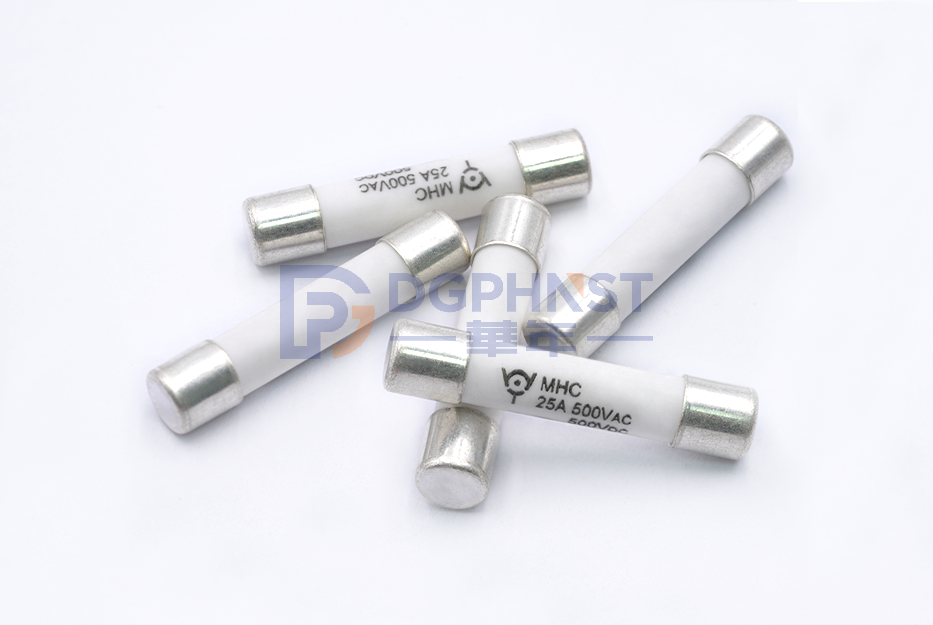
Understanding the performance parameters of disposable fuses is crucial in the field of electrical protection. Among them, the I ² T value is one of the core parameters for measuring the melting characteristics of fuses, which is directly and closely related to the melting speed of fuses.
Simply put, I ² T represents "Joule integral" or "melting heat energy value", which describes the accumulated thermal energy required by a fuse during the melting process. This value is calculated by integrating the square of the current (I ²) with time (T), and can be understood as the minimum thermal threshold required for the fuse to melt.
The corresponding relationship between I ² T value and melting speed is as follows:
For fuses with the same rated current:
The faster the melting speed (such as fast melting type), the smaller its I ² T value is usually. This is because the design of fast melting fuses is more sensitive to overheating, and only requires a small amount of accumulated heat energy to melt, thereby quickly cutting off the circuit and providing quick protection for precision semiconductor devices.
The slower the melting speed (such as slow melting/delay type), the larger the I ² T value is usually. Slow melting fuses can withstand short-term, large amplitude surge currents (such as current during motor start-up or capacitor charging), and will only melt when abnormal overload persists for a longer period of time and accumulated thermal energy exceeds their higher I ² T threshold, thus avoiding unnecessary misoperation.
2. From the perspective of protection principles:
I ² T is essentially a reflection of the thermal inertia of the fuse itself. A large I ² T value indicates a high thermal inertia and slow melting response; A small I ² T value means low thermal inertia and fast melting reaction. Therefore, when encountering the same overload current, fuses with different I ² T values will have significant differences in their melting time.
Guiding significance in practical applications:
A correct understanding of the relationship between I ² T and melting speed is crucial for circuit protection design. When selecting a fuse, it is necessary to evaluate the surge characteristics of the protected circuit. For example, for circuits with normal surge currents, fuses with larger I ² T values and slower melting speeds should be selected to withstand startup shocks; For semiconductor circuits that require precise protection, fuses with smaller I ² T values and faster melting speeds should be selected to ensure that they can act quickly in the event of overload.
In summary, the I ² T value of a fuse is a key quantitative indicator of its melting speed. The two show an inverse correlation trend: the smaller the I ² T value, the faster the melting speed; The larger the I ² T value, the slower the melting speed. Engineers can accurately select matching fuses by comparing and calculating the expected fault current of the circuit with the I ² T curve of the fuse, thereby providing reliable and effective overcurrent protection while avoiding false melting.
HNST WELCOME! 0755-23173910
English |中文

Cart
{{cartCount}}
你当前的浏览器版本过低或不支持。请升级或更换浏览器。推荐浏览器 Chrome Edge。