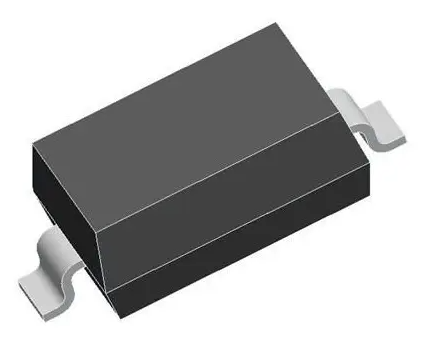
In the previous article hnstshop.com/article/54382.html" target="_blank">Quick Reference Table for SMD Resistors: 9 Major Packages, Power Rating, Tolerance, and Resistance Value, Shunhai Technology helped you understand the details of SMD resistors.
Today, we continue to provide more practical content! This time, we focus on other "main characters" of the circuit - SMD capacitors, inductors, ferrite beads, and diodes. How to choose their package specifications? What are the key parameters and tolerance levels? What are the material characteristics? Shunhai Technology will comprehensively analyze and summarize the essential parameters of common SMD components.
Parameters and Packages of SMD Capacitors
SMD capacitors can be divided into two major categories: non-polarized and polarized. The conventional capacitance range is from 0.22pF to 100μF. The differences in package type, voltage rating, tolerance, and material properties are significant. The specific parameters are as follows.
1. Main SMD Capacitor Package Sizes
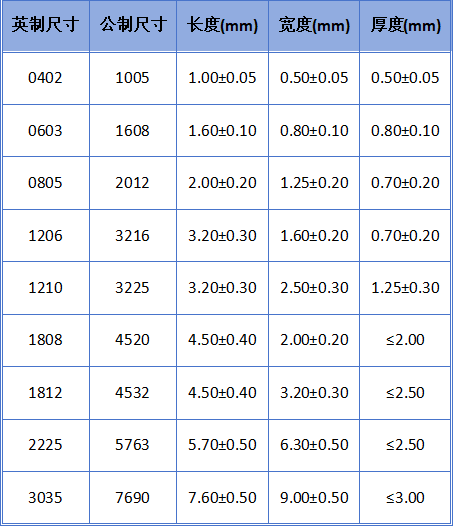
Non-polarized SMD capacitors are mainly ceramic capacitors, and the most widely used packages in the market are 0603 and 0805, suitable for most conventional circuit applications.The following table shows the imperial and metric dimensions, as well as the length, width, and thickness tolerance standards for various mainstream packages:
Voltage rating is a core parameter for selecting SMD capacitors. In general, the smaller the capacitance value, the higher the maximum voltage rating. SMD capacitors have a full range of standard voltage ratings, including 6.3V, 10V, 16V, 25V, 50V, 100V, 200V, 500V, 1000V, 2000V, 3000V, and 4000V, which can adapt to low-voltage civilian circuits to high-voltage industrial circuits.
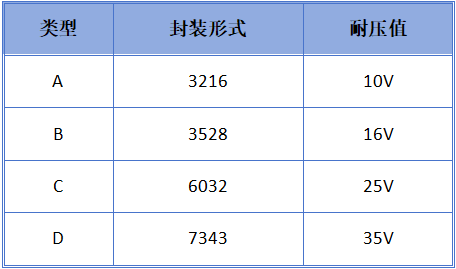
Polarized SMD capacitors are mainly tantalum capacitors. Within the industry, they are classified into four series (A, B, C, D) according to voltage rating, with each package corresponding to a specific voltage rating and uniform parameter standards:
2. SMD Capacitor Tolerance Level Table
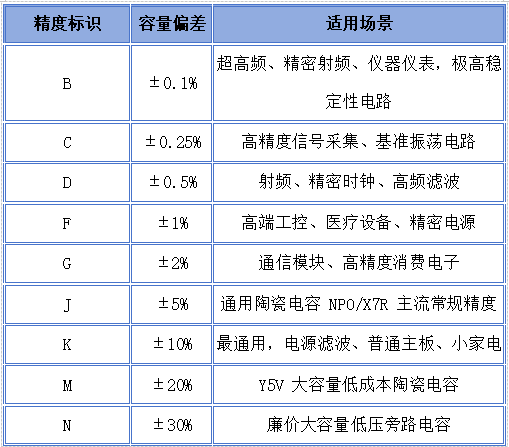
The capacitance tolerance of SMD capacitors is distinguished by industry-specific letter identifiers. Different tolerance levels suit different circuit applications, with high-precision models often used in precision circuits and ordinary-precision models suitable for general filtering and decoupling circuits.
The letters in the following figure represent the universal capacitor tolerance code used in the electronics industry. This identification system follows both the EIA standard of the United States and the national standard for electronic component identification in China. The industry uniformly uses a single letter to correspond to a fixed capacitance deviation range. The specific tolerance standards are as follows:
3. Main Material Characteristics and Applications of SMD Capacitors
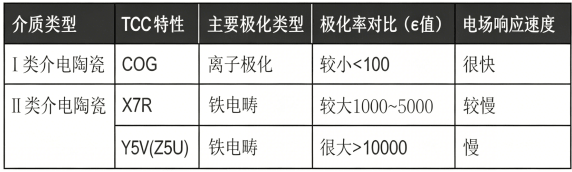
The core performance of SMD capacitors is determined by the dielectric material. Based on the capacity temperature stability, ceramic dielectrics are mainly divided into two categories: Class I and Class II. NPO belongs to Class I ceramic capacitors, while X7R, X5R, Y5V, Z5U, etc., belong to Class II ceramic capacitors.
Class I Ceramic Capacitors
Class I ceramic capacitors, also known as high-frequency ceramic capacitors, use titanium dioxide as the main dielectric material, combined with small amounts of oxide modifiers. They have low dielectric loss, good insulation, and stable temperature characteristics. Their capacity temperature change rate is only at the ppm/°C level, with minimal capacity drift, making them suitable for circuits that require extremely high capacitor stability, such as high-frequency resonance, oscillation, and precise coupling, as well as for circuit temperature compensation.
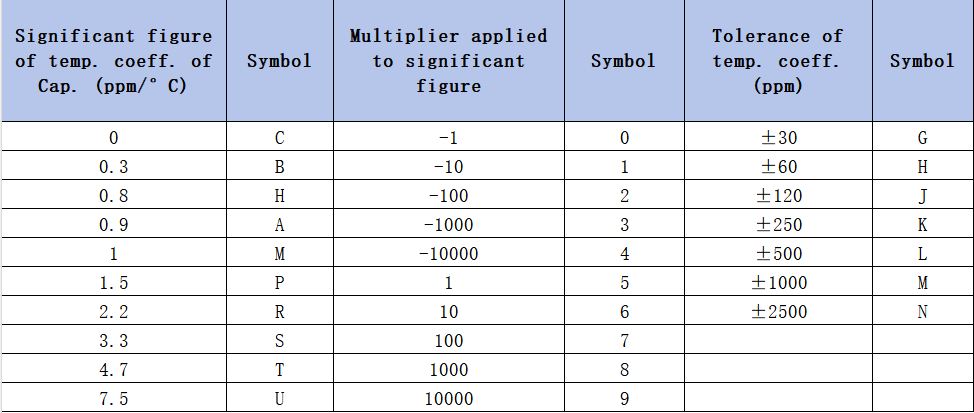
Their temperature coefficient follows the EIA 'letter + number + letter' coding rule. Common C0G capacitors have a temperature coefficient close to 0ppm/°C, with a tolerance of ±30ppm/°C, making them the most stable type. In the industry, NPO and C0G refer to the same capacitor, with differences only in military and EIA standard naming. Their core performance is consistent. Additionally, the frequency characteristics of Class I capacitors are affected by the package size, with larger packages offering better high-frequency performance.
Class II Ceramic Capacitors
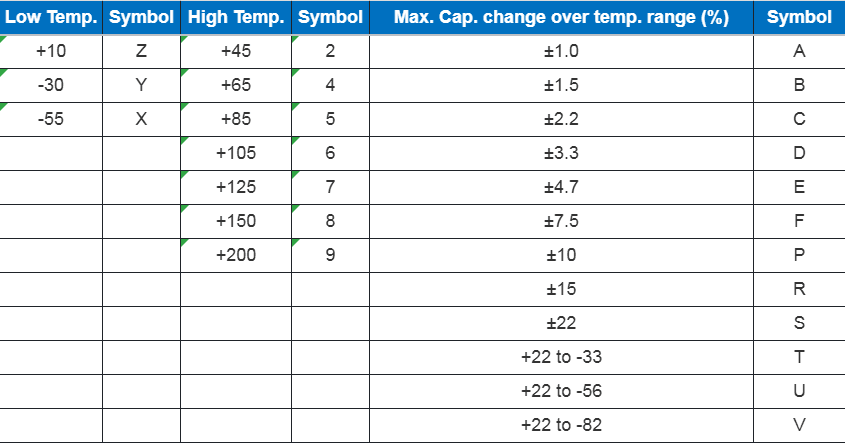
Class II ceramic capacitors, also known as low-frequency ferroelectric ceramic capacitors, are made using ferroelectric dielectrics. They have a large capacitance and strong energy storage capability but suffer from nonlinear temperature characteristics and higher losses, making them suitable only for general circuits with lower requirements for capacitor accuracy and stability, such as bypassing and general coupling. This category is divided into stable and usable grades. X5R and X7R belong to the stable grade, with a wide operating temperature range and small capacitance fluctuation; Y5V and Z5U belong to the usable grade, with relatively poorer performance stability.
The core differences among the four commonly used Class II capacitors lie in the working temperature and capacitance stability. The following table indicates the meanings of these codes:
Packages and Core Parameters of SMD Inductors
The main packages of SMD inductors are generally the same as those of SMD resistors and capacitors, primarily 0402, 0603, 0805, and 1206. The standard parameters for each package are as follows:
Packages and Parameter Characteristics of Ferrite Beads
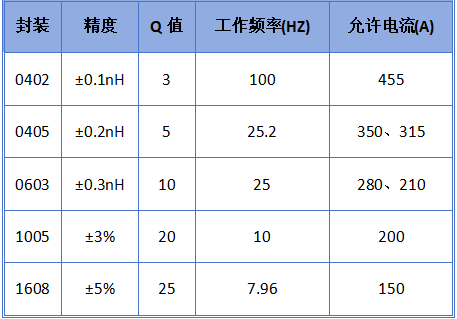
Ferrite beads are specialized filter components, with the core characteristic being high magnetic resistance, allowing efficient suppression of high-frequency interference in circuits and elimination of noise. They are widely used in EMI filter circuits of various electronic devices.
1. SMD Ferrite Bead Packages, Current, and Tolerance Parameters
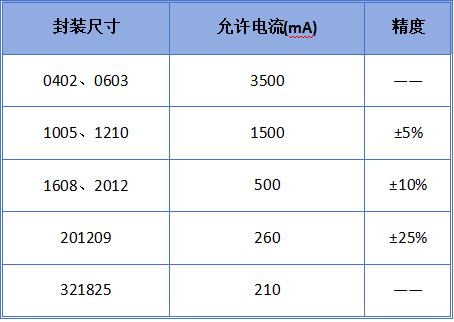
2. Electrical Characteristics of Ferrite Beads
The impedance range of conventional ferrite beads is 10Ω to 2000Ω, with an optimal working frequency of approximately 100Hz. The filtering and noise reduction effect is best within this frequency band, allowing targeted elimination of high-frequency noise in circuits and ensuring stable signal transmission.
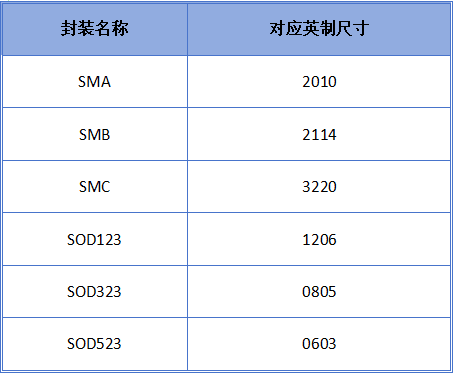
Standard Package Comparison Table for SMD Diodes
SMD diodes include common types such as rectifier diodes, Schottky diodes, and Zener diodes. Each type has a high degree of standardization in packaging, with each package corresponding directly to an imperial size. Selection and placement can be directly referenced from the following table:
Final Remarks
At this point, all the key points for selecting SMD capacitors, inductors, ferrite beads, and diodes have been explained. Combined with the previous SMD resistor quick reference table Quick Reference Table for SMD Resistors: 9 Major Packages, Power Rating, Tolerance, and Resistance Value, you can get all the basic SMD component information. Follow Shunhai Technology to continuously receive hard-core quick reference content about electronic components. If you have any needs for component selection, parameter matching, or samples, feel free to consult Shunhai Technology anytime, and we will provide a one-stop solution for all kinds of SMD components.