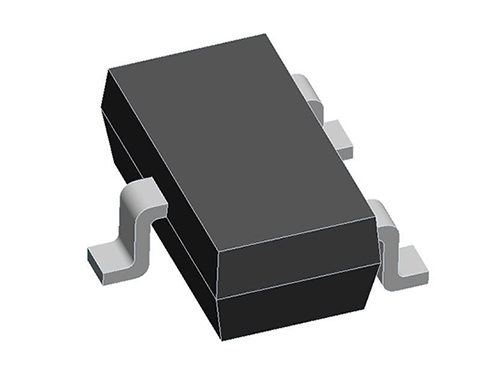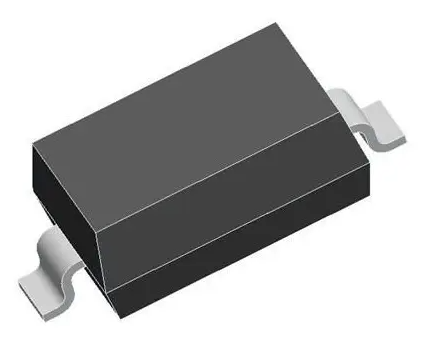
In EMC testing and mass production processes of consumer electronics, industrial control, power supplies, and security equipment, surge impacts often cause surface mount resistors to burn out or drift in resistance value, leading to breakdowns of downstream ICs, which is a common reliability failure.
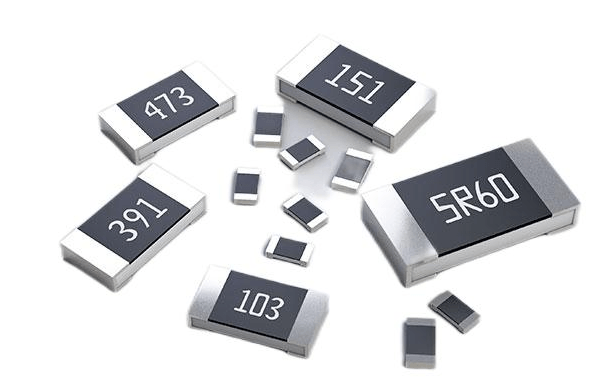
Surge-resistant metal film surface mount resistor
What is a circuit surge?
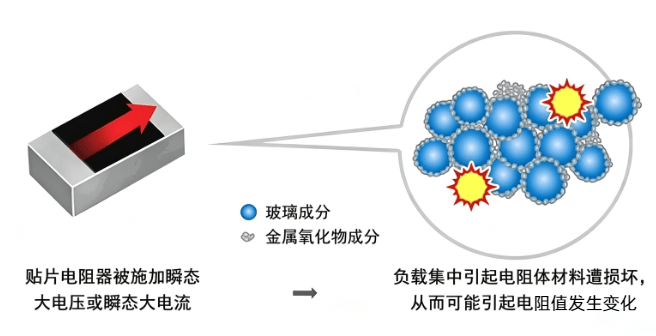
A surge, simply put, is a transient high voltage or large current impact applied to a circuit, which is a very common source of electrical stress damage in hardware circuits.
Everyday activities such as plugging and unplugging devices, relay switching, lightning interference on the power grid, and motor start-stop can generate surge interference. When ordinary surface mount resistors are subjected to excessive surges, the instantaneous overloading electrical stress can directly damage the resistor film layer, resulting in resistance drift, open-circuit burnout, and other failure issues. Once the front-end protection resistor fails, high-voltage surges can directly impact the downstream precision IC, causing chip breakdown and system functional abnormalities.
Three Solutions to Improve Resistor Surge Resistance Performance
To reduce resistor failure caused by surges, there are currently three optimization methods in the industry, all primarily focusing on evenly distributing the electric field and reducing instantaneous electrical stress:
1. Choose High-Impact-Resistant Specialized Resistor Materials
Ordinary thick-film resistor pastes have weak ability to withstand instantaneous high voltage, while surge-resistant resistors use modified resistor pastes with stronger instantaneous overload capability, making them less likely to be punctured by pulse high voltage.
2. Lengthen the Internal Electrode Spacing of the Resistor to Smooth the Potential Gradient
This is the core structural optimization method for surge-resistant resistors. By widening the conduction path between electrodes, the voltage distribution along the resistor body becomes more uniform, significantly slowing the potential drop rate, avoiding local electric field concentration that could puncture the resistor film.
① From the internal structure diagram, the difference is clearly visible: General surface mount resistors have a flat resistor film on the entire surface, with the electrode voltage concentrated at the edges; surge-resistant surface mount resistors use a wavy, meandering resistor body, with longer electrode conduction paths, smoother potential gradient, and less damage to the chip.
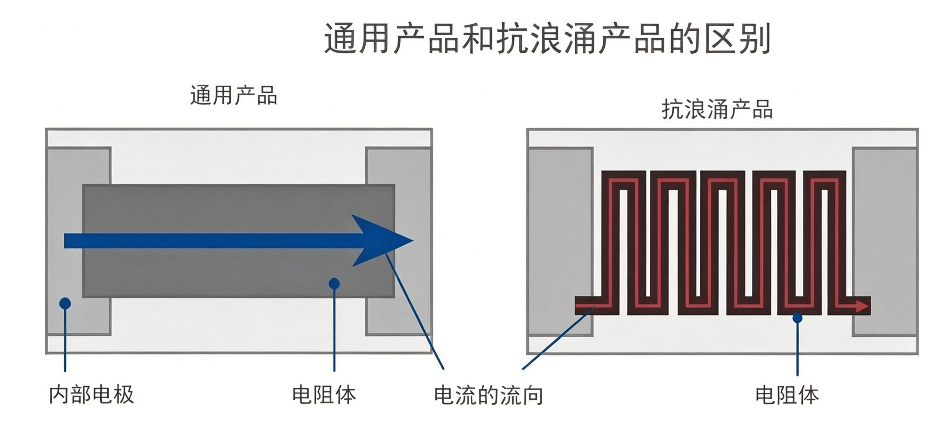
Internal structure comparison
② The potential curve clearly confirms: Under the same voltage impact, the potential of the surge-resistant resistor drops more gradually, without sudden increases or decreases in local strong electric fields, thereby reducing the risk of film layer burning from the root.
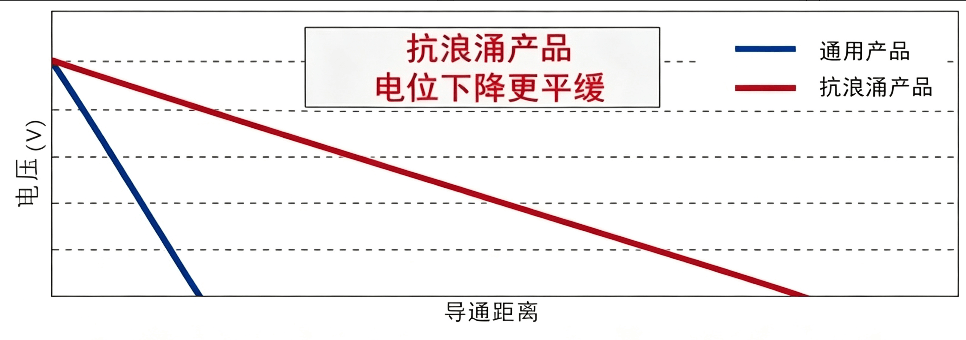
3. Choose Larger Package Size Surface Mount Resistors
The larger the package size within the same series, the longer the effective electrode spacing, allowing higher surge voltage and pulse energy to be withstood, providing greater shock resistance margin.
The following are the surge resistance assurance values corresponding to different package sizes:
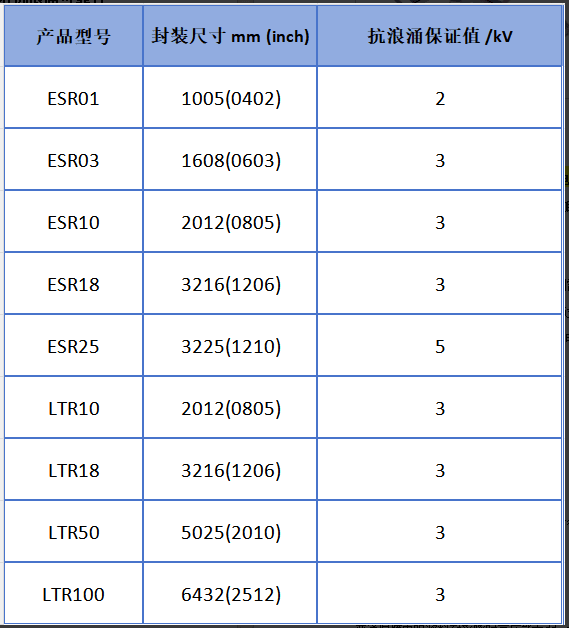
Working Principle of Surge-Resistant Surface Mount Resistors
1. Basic Working Principle
Surge-resistant surface mount resistors essentially rely on their own impedance characteristics to limit the instantaneous surge current to a safe range, absorb pulse impact energy, and block high-voltage surges from propagating to the downstream circuit, serving as a front-end protective function.
2. Core Differences from Ordinary Surface Mount Resistors
- Resistor body structure differs: ordinary resistors have flat film layers, while surge-resistant resistors use meandering wave-like resistor bands with longer conduction paths;
- Differences in electric field distribution: when a surge occurs, the potential of surge-resistant resistors drops more gradually, without localized high-voltage concentration points;
- Instantaneous tolerance capability: under the same package size, surge-resistant models can withstand 2-5kV surges, whereas ordinary resistors can only withstand hundreds of volts of instantaneous voltage, making them prone to damage.
Shunhai Technology's Surge-Resistant Resistor Selection Service
Shunhai Technology has been deeply involved in the supply of passive components, representing brands such as Tian Er and Li Zhi, offering surge-resistant resistors. For different surge level equipment such as consumer electronics, industrial control, and security devices, we match corresponding voltage, power, and package specifications to provide you with mature circuit protection solutions.
Different levels correspond to different open-circuit test voltages:
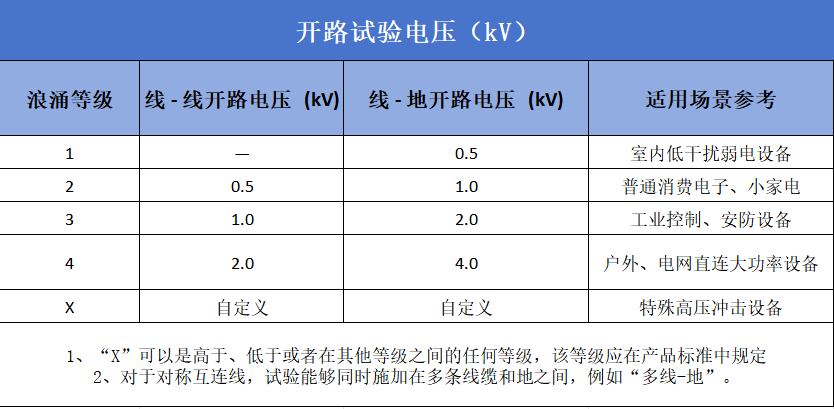
Final Words
Circuit surges are a frequent cause of hardware product failures and EMC certification failures. Simply increasing the size of ordinary resistors is not a long-term solution. Choosing surge-resistant surface mount resistors with optimized structures is the most effective solution.
During the design phase, you can match the corresponding voltage and package surge-resistant resistors based on the GB/T 17626.5 test level of your product. If you need assistance with selection, trial samples, or bulk supply, please contact Shunhai Technology to obtain the complete solution.