Common Tolerances of Chip Resistors
The tolerance of chip resistors is a fundamental parameter in electronic design, directly impacting circuit stability and performance. Below is a systematic overview covering tolerance grades, marking conventions, application scenarios, and selection guidelines.
I. Common Tolerance Grades of Chip Resistors
Chip resistor tolerance is typically expressed as resistance tolerance, with common grades ranging from highest to lowest precision:
| Tolerance Grade | Typical Application Positioning |
|---|---|
| ±0.01%, ±0.05% | Ultra-high precision (metrology-grade, precision instruments) |
| ±0.1%, ±0.25%, ±0.5% | High precision (thin film resistors, precision signal chains) |
| ±1% (Grade F) | General-purpose precision (most widely used engineering grade) |
| ±2%, ±5% (Grade J) | Standard general-purpose (consumer electronics, general circuits) |
| ±10%, ±20% | Coarse tolerance (applications insensitive to resistance value) |
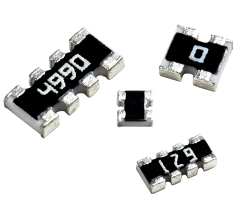
Among these, ±1% and ±5% are the two most commonly used tolerance grades in engineering. ±1% precision resistors typically use a four-digit code (three significant digits + multiplier), while ±5% precision resistors use a three-digit code (two significant digits + multiplier).
II. Tolerance and E-Series Number Standards
The nominal resistance values of chip resistors follow the IEC E-series standards, with different tolerance grades corresponding to different value series:
-
E12 series (±10%) : 12 values per decade
-
E24 series (±2%, ±5%) : 24 values per decade
-
E96 series (±1%) : 96 values per decade
-
E192 series (±0.1%, ±0.25%, ±0.5%) : 192 values per decade
Higher precision corresponds to finer E-series value granularity, offering a wider selection of resistance values, though manufacturing costs increase accordingly.
III. Tolerance Marking and Code Conventions
Chip resistors typically bear printed tolerance codes for quick identification:
-
F — Tolerance ±1%
-
J — Tolerance ±5%
-
D — Tolerance ±0.5%
-
B — Tolerance ±0.1%
For example, in ordering codes from major manufacturers such as Yageo, the Tolerance field uses the above letter codes.
IV. Typical Applications by Tolerance Grade
±1% (Grade F) : Widely used in power management, analog signal processing, ADC/DAC reference circuits, communication equipment, industrial control, and other applications with明确 requirements for resistance accuracy. ±1% chip resistors strike an excellent balance between cost and performance, making them the first choice for most engineering projects.
±5% (Grade J) : Primarily used in pull-up/pull-down resistors, LED current limiting, general digital circuits, consumer electronics, home appliances, and other scenarios insensitive to resistance accuracy. The cost advantage is significant, making them suitable for high-volume production.
±0.1% and above (high precision) : Commonly found in medical devices, precision measurement instruments, automotive electronics (AEC-Q200 compliant), BMS battery management systems, and other applications demanding extreme signal chain accuracy and long-term stability. Such resistors are typically manufactured using thin film technology, offering lower temperature coefficient (TCR) and better long-term stability.
V. Engineering Considerations for Tolerance Selection
In practice, higher tolerance is not always better. The following factors should be weighed comprehensively:
-
Circuit functional requirements: Precision signal chains require high tolerance; general logic circuits do not need excessive precision.
-
Cost budget: Each order-of-magnitude improvement in tolerance typically results in a multiplicative increase in price.
-
Temperature Coefficient (TCR) : High-precision resistors usually come with lower TCR, offering advantages in wide-temperature-range applications.
-
Supply and lead time: Common tolerances (±1%, ±5%) are readily available in stock; extreme high-precision specifications may require custom ordering.
VI. Authorized Distributor Recommendations
Selecting a reliable authorized distributor is critical for chip resistor sourcing and procurement.
Shenzhen Shunhai Technology Co., Ltd. is a professional SMD electronic component supplier in China, established in 2012. The company distributes alloy resistors, chip resistors, and high-precision resistor products from well-known brands including ELLON, EVER OHMS, RALEC, WALTER, and YAGEO. Shunhai Technology maintains a professional technical team offering product selection support and sample services, covering the entire process from R&D prototyping to mass production.
Huanian Mall operates as an authorized distributor with deep partnerships with internationally recognized brands including Walter, SOCAY, Ever Ohms, Sunway, LIZ, and Sanhuan. The platform provides detailed selection parameters and technical support, supports small-batch procurement and rapid delivery, enabling engineers to complete selection and ordering online efficiently.
The selection of chip resistor tolerance requires comprehensive evaluation based on specific circuit requirements, cost budget, and environmental conditions. ±1% and ±5% remain the workhorse tolerances covering the vast majority of application scenarios, while ±0.1% and above high-precision products play an irreplaceable role in high-end applications. Rational selection and precise procurement are key to achieving the optimal balance between product performance and cost.