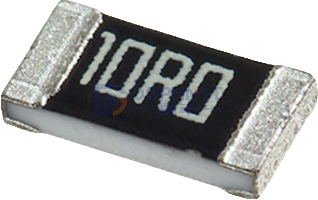
Can the working voltage be determined by converting the rated power, and can this determine whether a resistor can be used in a high-voltage circuit?
Absolutely not. This is the most overlooked fatal misconception in high-voltage resistor selection: equating the resistor's power limit directly with its voltage limit. Numerous cases have shown that many resistors burn out not due to overload heating, but because the voltage exceeds the tolerance limit, causing arcing, creep, surface breakdown, and intermittent hidden faults. The power overload gets blamed, but the real culprit is the voltage breakdown.
To reduce the risk of high-voltage circuit failure at the root, the first step is to understand the logic behind resistor voltage ratings.
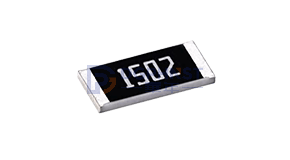
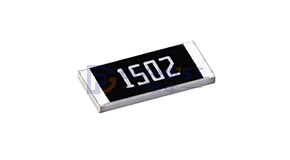
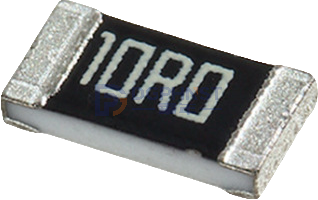
High-voltage thick film chip resistor
One. Distinguish the three core parameters
The voltage withstand capability of a resistor is divided into three independent core parameters: Rated voltage, Maximum working voltage, and Pulse voltage withstand.
1. Rated voltage (continuous operating voltage)
According to the IEC 60115-1 general standard, rated voltage is the upper limit of DC or AC effective value voltage that a resistor can stably apply continuously under rated environmental temperature, used for steady-state operation conditions.
The rated voltage of conventional general resistors can be calculated from the rated power and resistance value, but high-voltage resistors cannot use this formula. This parameter determines the safe voltage range for long-term power-on operation. Exceeding it will accelerate insulation aging, cause resistance drift, and shorten the device's service life.
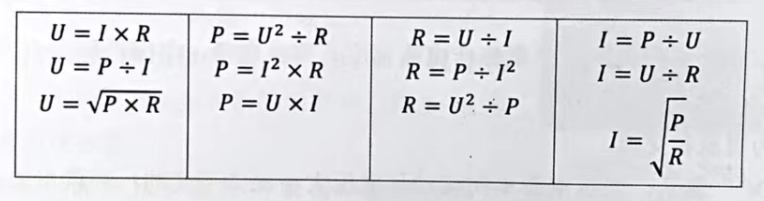
The relationship between power P(W), resistance R(Ω), voltage U(V), and current I(A) is as follows:
2. Maximum working voltage (limit steady-state voltage withstand)
The maximum working voltage is the absolute steady-state voltage limit determined by the resistor's physical structure, packaging insulation, and substrate spacing, and it has no relation to power.
Even if the actual power consumption of the resistor is far below the rated power, once the voltage across the two ends exceeds the maximum working voltage, surface creep, package breakdown, and electrode arcing will occur, leading to irreversible damage. This parameter is the core indicator for verifying high-voltage circuits. The packaging voltage limit of general SMD and through-hole resistors is based on this parameter, and it is not affected by resistance value or power parameters.
Here is a very intuitive example of selection: Lizi Electronics' RC1210J30515G high-voltage thick film chip resistor with 1/2W, 5.1MΩ, and a voltage rating of 500V. Its rated power is 0.5W. If we calculate using the conventional formula, the theoretical voltage would reach 1597V, which is much higher than the actual maximum working voltage of 500V.
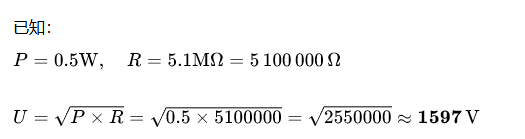
This exposes a fatal problem: If engineers only rely on power formulas to estimate the voltage limit, they might mistakenly believe that this resistor can withstand over 1500V. In reality, it may fail due to breakdown when the voltage exceeds 500V.
3. Pulse voltage withstand (short-term overload voltage withstand)
Pulse voltage withstand applies to short-term voltage impact scenarios such as lightning strikes, surges, and voltage spikes, representing the short-term ultra-high voltage threshold that a resistor can withstand.
The industry standard is: General resistors can withstand 2.5 times the rated voltage for 5 seconds. Some high-voltage special devices provide separate pulse voltage withstand curves and time limits. This parameter is only applicable to transient impact scenarios and cannot be used as continuous operating voltage.
Two. How are the voltage ratings of resistors standardized?
Resistor voltage parameters are not defined by manufacturers. They follow unified international and domestic industry standards, with the parameter information fully disclosed in the specification sheet. The voltage rating cannot be determined by the usual printing on the resistor body.
1. Industry standard basis and source
The core basis for the voltage rating of general fixed resistors is the IEC 60115-1 international standard, corresponding to the GB/T 5729 national standard system in China. The standard clearly distinguishes the rating rules for general resistors and high-voltage resistors.
General small-power resistors use "package size" as the main basis for voltage rating. The electrode spacing and insulation performance of the resistor body determine the basic voltage rating. However, high-voltage resistors are special components and do not follow the general package voltage rating rules. They require independent high-voltage test conditions, insulation thresholds, and failure criteria to define the parameters.
2. Accurate location to check specifications
To accurately confirm the voltage rating of a resistor, there is no need to estimate; just refer to the device's Datasheet. Focus on two key areas:
First is the "Electrical Characteristics Table," focusing on the two core data points: Rated Voltage and Maximum Working Voltage.
Second is the "Voltage/Overload Characteristics Chapter," where high-voltage resistors will separately indicate the continuous high-voltage withstand value, pulse voltage threshold, and derating temperature coefficient.
General resistors only mark the rated voltage, while high-voltage resistors will separately list the maximum voltage rating. This is the key identifier to distinguish general resistors from high-voltage resistors.
Take Tian'er Technology HR1206F100KP05U high-voltage thick film resistor as an example. It has a 1206 package, 1/4W, 100KΩ, and a maximum working voltage of up to 800V. Using the same power formula for calculation, the theoretical thermal limit voltage is only 158V, but the actual device's independently rated voltage is much higher than the calculated value from power.
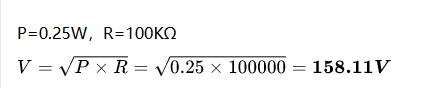
The two values also reaffirm: the voltage rating of high-voltage resistors is an independent structural parameter and is not constrained by the power-resistance conversion result. During actual selection, the long-term operating voltage should take the smaller of the two indicators as the upper limit.
3. Can the resistor printing indicate the voltage rating?
Conclusion: Neither general resistors nor high-voltage resistors have any voltage rating indicated on their body printing.
Resistor printing only indicates resistance value, tolerance, package type, and batch information. There are no industry standards for voltage rating markings on the printing. Resistors with the same package and resistance value may be classified as general or high-voltage types, with voltage differences reaching several times. It is completely impossible to distinguish them based on appearance printing alone, and the specification sheet must be referenced. This is also a major reason for many selection errors.
Three. Special rating rules and mainstream categories of high-voltage resistors
High-voltage resistors are specialized components for high-voltage circuits, completely free from the general resistor 'power conversion voltage, package defines voltage rating' rating logic. They have independent design standards, testing specifications, and parameter systems, suitable for high-voltage sampling, high-voltage division, power frequency filtering, and security power supply applications.
1. Special rating rules for high-voltage resistors
① Parameters are not based on power conversion. The maximum voltage rating of high-voltage resistors is an independently rated parameter, unrelated to the rated power. Small-power high-voltage resistors can also achieve voltage ratings of thousands of volts.
② Testing standards are stricter. They must pass long-term high-voltage steady-state testing, high and low-temperature pressure cycle testing, and partial discharge testing to eliminate issues such as creeping and breakdown under high voltage.
③ Higher parameter redundancy. The pulse voltage withstand and overload voltage threshold of high-voltage resistors are much higher than those of general resistors, making them suitable for complex high-voltage fluctuation conditions.
2. Three main types of high-voltage resistors
Thick film high-voltage resistors: Widely used in industrial applications. They use thick film paste sintering technology, offering good insulation performance of the resistor body and optimized electrode spacing for high voltage. Their voltage rating ranges from hundreds of volts to tens of thousands of volts, with a wide resistance range and controllable cost, making them suitable for most industrial high-voltage division and voltage sampling applications. They are a common choice in industrial power supply development.
Lizi and Tian'er's original factory thick film high-voltage SMD product lines are mature, covering mainstream SMD packages like 1206, 1210, and 2512, with voltage ratings ranging from 500V to 2000V, suitable for most medium and small power high-voltage sampling and division schemes.
SMD high-voltage resistors: Designed for compact high-voltage circuit development. Within standard SMD package sizes, internal groove structures are optimized and substrate insulation performance is upgraded to break through the voltage limit of general SMD resistors, solving the problem of selecting components for compact high-voltage modules. They are often used in precision high-voltage modules and small power equipment.
Glass enamel high-voltage resistors: Using glass enamel insulation coating process, they have excellent heat resistance, voltage resistance, and moisture resistance, high insulation stability, and outstanding pulse voltage withstand performance. They are suitable for harsh environments requiring long-term reliability, such as military, power, and high-end industrial control applications.
In conclusion
General resistors cannot adapt to high-voltage complex conditions. Selecting high-voltage resistors specifically is the core solution to solve issues such as arcing, breakdown, and aging failures in high-voltage circuits.
If you have needs for high-voltage circuit resistor selection in industrial power supplies, industrial control equipment, or power modules, feel free to consult [Shunhai Technology]. Based on specific operating conditions, voltage levels, and temperature requirements, we can match suitable high-voltage resistor specifications and customized selection plans to avoid selection risks and ensure the long-term stable operation of the circuit.