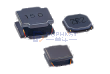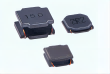
Market data indicates that the global market size of molded inductors reached USD 4.755 billion in 2025. Industry forecasts estimate the market will expand to USD 9.327 billion by 2032, with a steady compound annual growth rate (CAGR) of 10.13% throughout the period.
AI servers have become the core driver of demand expansion. Soaring power consumption of computing chips has drastically raised the inductor deployment volume in power supply circuits.
- Traditional servers with standard dual-CPU architecture: each unit only adopts 30 to 50 molded inductors;
- Mainstream AI servers configured with 4 GPUs and 2 CPUs: molded inductor consumption surges sharply to 80–120 pieces per unit, marking a usage increase of up to 160%.
The huge usage gap stems from the massive disparity in power draw between GPUs and CPUs. At present, a single H100 computing chip consumes up to 700W, while power consumption of the new-generation B200 chip has exceeded 1000W. Power draw of subsequent chips built on the Rubin architecture will keep climbing.
Higher device power consumption translates to more intricate overall power supply designs, alongside upgraded standards for voltage regulation and current filtering performance. Equipment manufacturers need to multiply the quantity of installed inductors and adopt large batches of high-end, high-spec models simultaneously. The overlapping surge in requirements fuels robust demand for premium high-performance molded inductors.
Core Drivers Behind the Popularity of Molded Inductors
There is a widespread misconception that molded inductors replaced traditional wire-wound inductors solely through superior performance and automated production capacity. In fact, conventional wire-wound inductors can also withstand large currents, come with integrated magnetic shielding, and be mass-produced via full automation, with no qualitative gap in fundamental performance or production efficiency. Their rapid market penetration hinges primarily on lower production costs and improved profit margins.
The production chain for traditional inductors features clear division of labor: inductor manufacturers only handle post-processing steps such as wire winding and assembly, while critical magnetic core components are sourced externally. High-margin links including magnetic powder smelting and core pressing remain monopolized by upstream magnetic core suppliers, squeezing profit margins for downstream inductor producers.
Molded inductors overhaul the entire production workflow. Manufacturers purchase raw magnetic powder directly and form integrated magnetic bodies through die-casting, eliminating the need for outsourced finished magnetic cores. This allows enterprises to capture profits previously retained by upstream core fabricators, significantly lifting overall product profit margins.
Driven by this cost and profitability edge, the industry landscape has stabilized. Leading wire-wound inductor manufacturers have all established molded inductor production lines, now operating dual production lines for wire-wound and molded inductors concurrently.
Four Key Advantages
Fabricated via one-step magnetic powder die-casting, molded inductors align perfectly with the miniaturization, high integration and high stability trends of modern electronic products, boasting four distinct strengths over conventional inductors:
-
Excellent shielding and strong anti-interference capabilityInternal coils are fully encapsulated by magnetic powder to block magnetic fields comprehensively. Their shielding efficiency improves by over 30% versus traditional inductors. They prevent internal electromagnetic leakage from disrupting adjacent components and resist external clutter interference, enabling smoother circuit operation.
-
High current resistance and strong anti-saturation performanceThe pressing process creates distributed air gaps inside the magnetic body, greatly mitigating magnetic saturation weaknesses. They resist saturation failure under sudden large current surges, ideal for high-power circuits with volatile current loads.
-
Compatible with automated SMT mounting, supporting device miniaturizationStandard square cuboid profiles deliver tight dimensional tolerances and flat, uniform surfaces, fully compatible with fully automatic SMT placement machines. They enable compact PCB layout and facilitate smaller, more highly integrated electronic devices.
-
Flexible material selection and customizable parametersManufacturers can formulate magnetic powder blends including FeSi, FeSiCr, carbonyl iron, FeNi, and amorphous alloys to match client specifications. Key metrics such as magnetic permeability, heat resistance and power loss can be fine-tuned to meet diverse application demands across industries.
Breakdown of Four Mainstream Structures
Four mainstream molded inductor structures dominate the market, varying widely in durability, performance merits and applicable equipment. Each carries specific storage and operating environment requirements; model selection and standardized storage maintenance must align with actual usage needs.
1. Four Main Structures & Selection Guidelines
① Round wire with bent metal terminal design
Fitted with bent metal side terminals and internal solder joints. A critical flaw is prone solder joint detachment, leading to mediocre overall reliability. Suitable only for ordinary general circuits, not core main control circuits requiring stringent stability.
② Double flat-wound T-core with electroplated leads
No internal solder joints, eliminating open-circuit risks at welds. However, the double stacked coil layers are susceptible to compressive deformation and internal short circuits, demanding ultra-precise coil winding and routing craftsmanship.
No side metal terminals, only slightly raised electroplated solder feet at the bottom. Suited for high-precision, standardized SMT production lines.
③ Axial flat-wound T-core with tinned leads
Currently the most stable structure available. Free of internal solder joints, with evenly arranged, robust coils for exceptional durability. The top pick for harsh operating conditions, high-end hardware and core circuits. The only drawback: tinned bottom leads complicate disassembly during equipment repair.
④ End-face silver-coated electroplated non-mainstream design
Though free of internal solder joint hazards, contact stability between copper wire cross-sections and silver coatings degrades gradually with environmental exposure and service time, resulting in subpar overall reliability. Restricted to low-end, low-spec simple equipment.
2. Environmental & Warehousing Requirements
Molded inductors are vulnerable to humid and salt-fog environments. For marine, outdoor and other high-salinity, high-humidity scenarios, extra protective coating is mandatory to prevent rust and corrosion on electrodes and magnetic bodies.
Warehouse storage must maintain controlled temperature and humidity: ambient temperature 5°C–40°C, relative humidity below 70%, to avoid electrode oxidation, rust and product scrappage.
Closing Remarks
The AI computing boom continuously elevates demand for high-power power supply hardware. Bolstered by cost-profit edges and four core performance strengths, molded inductors have become indispensable core components for high-power applications including servers and automotive electronics.
Amid steady market expansion, coordinated development across the domestic molded inductor industrial chain positions the product as a vital pillar for localized substitution of computing hardware, unlocking sustained long-term profit growth potential.
Appendix: Listed Companies Related to Molded Inductors
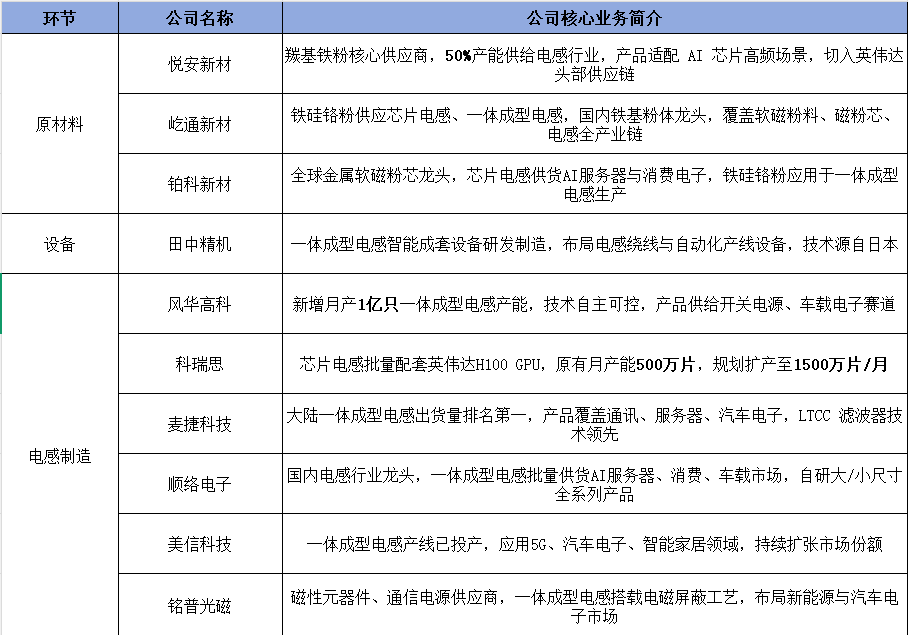 64e4ee8bf7ab046ec3caaee.png" alt="" />